Scout for Fall Armyworms this Fall

By Anthony Zukoff
Insect Diagnostic Program, Integrated Pest Management, Western KS Crop Pests
Thursday, Sept. 3, 2026
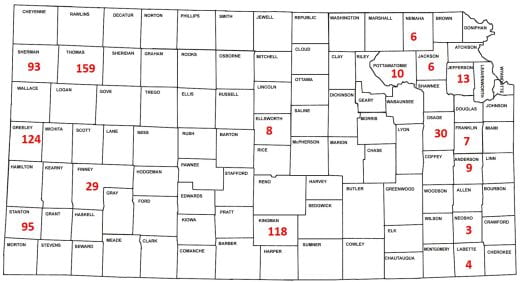
Fall armyworms began arriving in Kansas in mid-June. After a brief lull in activity, pheromone trap counts have been increasing, particularly in the western half of the state during the end of August (Figure 1). Fall Armyworm, Spodoptera frugiperda, can damage several important crops as well as pasture, turf and home landscaping. This insect does not overwinter in Kansas, it is native to the tropical regions of the western hemisphere and is active year-round along the gulf coast and southern Florida, migrating to northern states from these locations each year. At least two full generations are possible in Kansas with defoliation and grain damage being the biggest concerns. Each generation’s abundance and distribution across the landscape are usually different; the first generation does not necessarily impact the abundance of the second generation.
Late planted sorghum is currently at risk during grain fill as fall armyworm will completely consume berries as they develop. Early planted wheat and triticale will be vulnerable to caterpillar activity and fields should be scouted weekly until the first frost. Stressed pasture is also at risk in the eastern half of the state.
Caterpillars increase in size at an exponential rate and most of the feeding occurs during the later stage of development. It is critical to scout early and treat, if needed, when the caterpillars are less than a half-inch long. Larger caterpillars are harder to control and do the most damage. Often, infestations are discovered after it is too late to treat. Recommended thresholds can be found below.
Fall Armyworm Thresholds
Alfalfa
1-2 caterpillars per square foot can destroy seedling alfalfa. 10-15 per square foot can destroy 12” tall plants.
Sorghum
1-2 caterpillars/head during flowering to soft dough reduces yield 5-10%.
Pasture/Brome
Treatment is warranted with 3 to 5 caterpillars per square foot. If weather conditions are delaying growth, plants may be at higher risk from caterpillars
Wheat
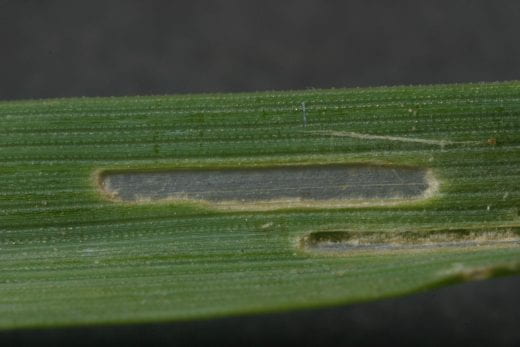
“Window-paning” damage (Figure 2) in early planted wheat indicates young caterpillar activity. If 25-30% of plants show damage, examine field frequently. Treat at 2-3 active larvae/ft.
Anthony Zukoff—Southwest Research and Extension Center – Garden City, KS