National Mosquito Control Awareness Week

By Frannie Miller
Pesticide Safety and Integrated Pest Management (PS-IPM) Coordinator
Wednesday, June 24, 2026
As summer settles in and warmer weather brings mosquitoes into our daily routines, communities are coming together to celebrate National Mosquito Control Awareness Week (June 21-27, 2026). This annual celebration shines a spotlight on prevention and innovation, and this year explores how communities are turning yesterday’s threat into today’s solution.
It is important to be able to identify mosquitoes to avoid confusion with other insects such as crane flies, gnats, moth flies, and biting midges. Mosquitoes have a long proboscis, scaled wings and a slender body. Mosquitoes can be identified to genera by their body markings, resting posture, activity patterns and breeding habitats. Common genera found in Kansas includes Aedes and Culex.
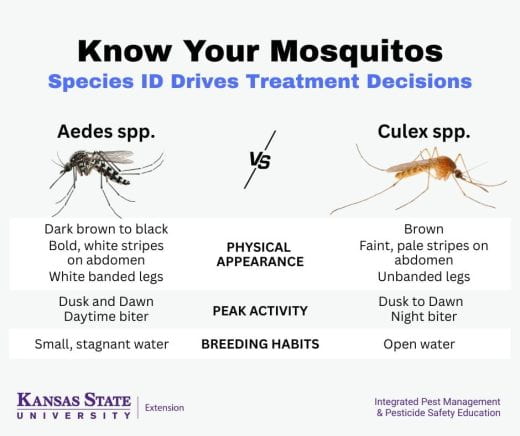
Mosquitoes are more than just a summertime nuisance that affects our activities as they are also a serious public health threat. These tiny insects can spread diseases such as West Nile virus, Zika virus, dengue fever, and malaria, putting people of all ages at risk. Even one neglected bucket of standing water can become a breeding ground for hundreds of mosquitoes in just a short period of time. This is why everyone needs to take responsibility.
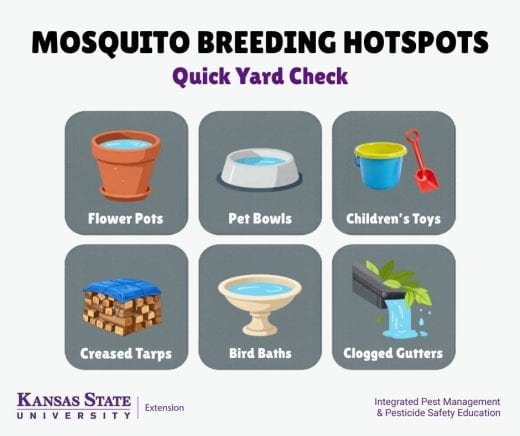
Protecting the community starts with a few simple actions:
- Eliminate standing water by dumping bird baths, flower pots, buckets, tarps, tires, and other containers.
- Clean gutters and downspouts as these can be overlooked breeding sites.
- Irrigate gardens and lawns carefully to prevent standing water for more than a few days.
- Fill or drain tree holes, stumps, and puddles.
- Use EPA registered repellents containing ingredients such as DEET, Picaridin or IR3535 if you are going out at dusk or dawn or avoid activities at dusk or dawn when mosquitoes are most active.
If you want to learn additional information, check out the Mosquitoes in Kansas publication at: MF3668 Mosquitoes in Kansas
Frannie Miller – Pesticide Safety and IPM Coordinator