Brown wheat mite active in western Kansas
Reports of brown wheat mite activity in both continuous and rotated wheat fields have come in from western Kansas recently. Areas that continue to stay dry going into the next couple of months should keep an eye out for this pest in wheat and triticale as dry, cool weather supports brown wheat mite population growth.
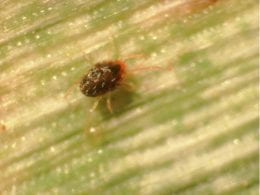
Brown wheat mite (Figure 1) is a sporadic pest of wheat and triticale in western Kansas but can also become problematic in eastern Kansas during dry years with the last major outbreak of 2022 extending into central Kansas areas. Typically, continuous wheat and triticale face a higher risk of damage from this pest, and injury can be confused with drought stress. Mites damage individual cells in the leaf, causing stippling, while concentrated feeding at leaf tips causes plant tissue to dry out and die. Plants take on a scorched appearance and eventually wither (Figures 2 and 3).
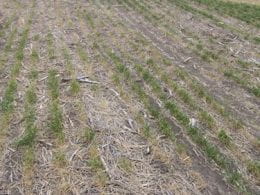
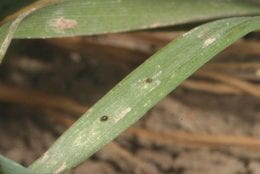
Brown wheat mites present in fields right now are from eggs that hatched last fall. They can easily survive cold temperatures and can produce multiple generations during the winter and an additional two to three generations in the spring. These mites are active during the day, with peak activity during the afternoon on warm days. They do not produce webbing like spider mites and can easily be observed moving rapidly on leaf surfaces when scouting a field. Their rapid movement and tendency to drop to the ground when disturbed can make assessing the level of infestation difficult.
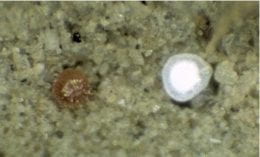
The economic threshold is estimated to be several hundred mites per foot of row in early spring. Stressed plants are most likely to succumb to damage. A solid rainfall is typically all that is needed to knock brown wheat mite populations below damaging levels, but that does not look to be in the forecast any time soon. Fields with noticeable populations of mites should be scouted for their eggs. Brown wheat mites lay two different types of eggs on soil clods and debris; red “winter” eggs and white “summer” eggs (Figure 4). The white eggs will remain dormant through the rest of the growing season and hatch in the fall. Red eggs will continue to hatch this spring and add to the current population. By late April, adults begin to lay the white, diapausing eggs. Once there are more white eggs in the field than red eggs, the population is naturally declining and treatment is not likely warranted.
For fields that require treatment, options for control of brown wheat mite are limited. Chlorpyrifos and dimethoate offer control, but there are also some products for suppression of brown wheat mite populations (Table 1). As always, be sure to follow all directions on the labels for proper use of any chemical.
Table 1. Products registered in Kansas for control or suppression of brown wheat mite. For more specific information relative to any insecticide, always refer to the actual label on the product.
| Trade Name | Chemical Name | Mode of Action Class | Purpose | Rate |
| Numerous prodcuts | Chlorpyrifos | 1B | Control | 0.5-1 pint/A |
| Dimethoate | Dimethoate | 1B | Control | .3-.5 pint/A |
| Besiege | Lambda-cyhalothrin and chlorantraniliprole | 3A+28 | Suppression | 10 fl.oz/A |
| Proaxis | Gamma-cyhalothrin | 3A | Suppression | 3.84 fl.oz/A (.015 lb a.i./A) |
| Silencer | Lambda-cyhalothrin | 3A | Suppression | 3.84 fl.oz/A (.03 lb a.i./A) |
| Warrior II with Zeon Technology | Lambda-cyhalothrin | 3A | Suppression | 1.92 fl.oz/A (.03 lb a.i./A) |
Anthony Zukoff, Extension Entomology – Garden City
azukoff@ksu.edu