Did We Get Enough Rain? Using Spring Precipitation to Predict Pasture Production in Western Kansas
Keith Harmoney, range scientist, Hays
Most of Kansas received some precipitation since the last Beef Tips update. From the Hays area and eastward, significant rainfall occurred. The phrase ‘May showers bring June flowers” doesn’t roll off the tongue nearly as well as the age-old alternative, but that’s exactly what happened in a sea of quickly growing grass. West of Hays, most areas also saw some rainfall. But was it enough rainfall for the grass to reach long-term average production?
One of the very best early indicators of how much forage growth we’ll achieve in our western Kansas rangelands is predicted by the amount of precipitation that’s received in April, May, and June combined (Apr+May+Jun). Figure 1 below shows almost fifty individual years of pasture yield data at the KSU Ag. Res. Ctr. – Hays correlated to the amount of Apr+May+Jun rainfall received in those years. When Apr+May+Jun rainfall is below average (about 9 inches) at Hays, then end of year pasture yield has a very predictable relationship with that rainfall (r2=0.70, the closer the number is to 1.00 the better the relationship). The grass needs the water and the grass converts that water into yield fairly directly, so it’s a great predictor of end of season pasture yield during dry springs.
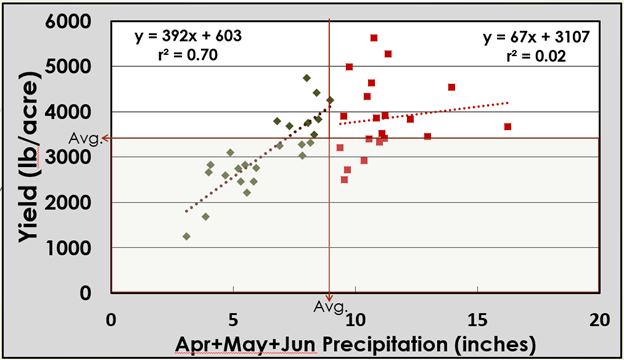
This April through June time period coincides with the physiological stages of our dominant rangeland grasses in which the most rapid growth occurs. In fact, nearly 65% of the forage produced within a growing season usually occurs by the end of June. This early predictor of low pasture yields from low Apr+May+Jun rainfall makes it possible to do some stocking, or rather de-stocking, planning. The relationship shows that the percentage of average rainfall received in Apr+May+Jun is approximately the percentage of average end of season yield that will be produced. For example, if the Apr+May+Jun rainfall is 60% of the average, then end of season yield will be about 60% of average. The mid-season stocking reductions in the western Kansas grass turnout publication (Grass-turnout-decisions-in-western-kansas_MF3716) flow chart are based on this observed relationship. So, when Apr+May+Jun rainfall is low, season yield will be low, and stocking should likely be adjusted.
When Apr+May+Jun precipitation was greater than average, then yield had very little relationship with the rainfall amount and made yield hard to predict (r2=0.02). During these years, we likely had some excess that didn’t get captured in the soil and converted to grass growth, so the relationship to predict end of year pasture yield ends up being poor with above average rainfall. But, even though predicting the exact amount of forage is tough during those abundant rainfall years, the graph shows that yield was almost always close to average or higher with the above average spring rainfall. So, being able to predict end of year yield isn’t as critical when rainfall is high.
Another source that helps to predict the end of season pasture yield is the GrassCast website (https://grasscast.unl.edu/). This website uses the known relationships of historical weather data with pasture production data from locations all across the Great Plains, along with other weather variables to predict what percentage of the average pasture forage amount will be produced for an area if they receive lower than average, average, or greater than average rainfall for the rest of the year.
So, did western Kansas get enough rainfall recently to reach long-term average pasture production by the end of year? In some locations possibly, but by using these two tools, folks in western Kansas should be able to assess if the amount of forage pastures are likely to have at the end of the growing season is enough to balance their initial stocking rates.