Grass Turnout and the Return of Drought
by Keith Harmoney, range scientist, Hays
The phrase “April showers bring May flowers” comes to mind this time of year, and all of the native forbs that will be blooming and showing off their colors in the midst of the sea of green grass in our Kansas pastures. At the time of this writing, though, that phrase may only come true for portions of southeast and northeast Kansas. The rest of Kansas, especially the southwest and northwest, has been experiencing increasingly dry conditions since receiving some moisture last fall. The current U.S. Drought Monitor shows that 75% of Kansas is at least abnormally dry, at least 50% is in moderate drought, and over 10% is in severe drought. Breezy, unseasonably hot spring days haven’t helped the landscape to hold on to soil moisture, either. It’s dry, it’s early in the growing season, and many livestock producers have summer grass turnout and stocking rate decisions for the year on their mind.
We recently developed a western Kansas grass turnout publication (Grass-turnout-decisions-in-western-kansas_MF3716) with a decision tree flowchart as another resource to help producers make tough decisions of when and how to adjust stocking during spring scenarios, just like we’re experiencing now.
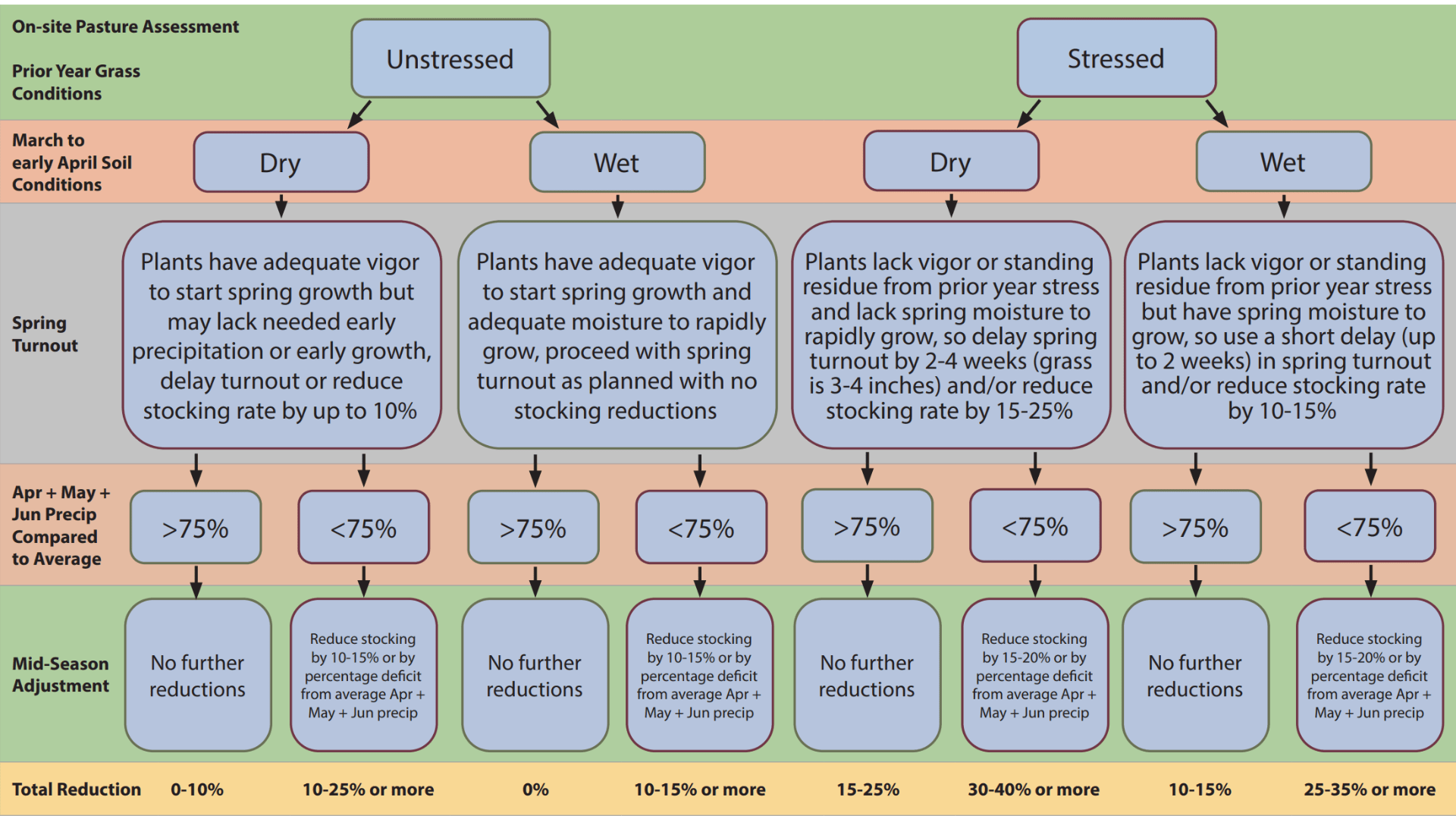
The majority of the information is based on years of data collected at the KSU Ag Research Center – Hays in west-central Kansas, and has direct application to many of the short to mixed-grass dominated pastures in the western part of the state.
To help assess pasture stocking for the upcoming growing season, how pastures ended the prior season needs to be evaluated first. Did the pastures suffer from drought and go dormant early last year, did the pastures have more utilization than the 50% take half/leave half concept that sustains above ground leaf growth and below ground root growth, or did pastures finish the year with more residual grass than usual and plenty of leaf area to keep converting sunlight into energy through the end of the season? Pastures going into dormancy vigorous and full of carbohydrate reserves should be free of stress and have potential to quickly grow and be vigorous the next spring, but If pastures finished last season stressed for growth, then they will likely come out of dormancy with less energy in their system and have slower spring growth potential.
Next, the availability of late winter and early spring moisture determines if our grasses can capitalize on vigorous growth potential and start the season with good initial production. The Kansas Mesonet is a great resource to check on a region’s soil moisture status to start the year (https://mesonet.k-state.edu/agriculture/soilmoist/). While adequate soil moisture during the dormant season is associated with higher average end-of-season yields, accurately predicting forage production depends mainly on precipitation received during the growing season. The rainfall total of Apr-May-Jun combined is one of the best predictors of pasture forage yield that we have available. When Apr-May-Jun rainfall is below average then end of year pasture yield has a direct and predictable relationship with that rainfall. With low Apr-May-Jun rainfall, the grass is lacking soil water for growth, and any precipitation is converted into yield fairly directly. At the end of June, the rainfall percentage below the Apr-May-Jun total precipitation average is also approximately the percentage of yield reduction to expect by the end of the season.
If early growing season rainfall is low and we can predict below average yields, then we know that our initial stocking rate goals when turning out on grass in the spring will most likely remove more forage than what was planned to sustain the take half/leave half balance. Pasture grasses need to retain 50% of their leaf area to keep photosynthesizing and converting sunlight into energy, but the landscape also needs to retain this vegetative cover to capture rainfall and help it to infiltrate into the soil. Removing too much vegetation early or leaving too little vegetation during the growing season could make drought conditions worse if rainfall does happen to occur and lack of cover allows that rainfall to flow off the landscape.
Our research data shows pasture yield is highly likely to be close to average or greater when Apr-May-Jun precipitation is above average. That means we have enough forage yield to meet the forage demand required from our initial balanced stocking rates when first turning out on grass. Predicting pasture yield is most critical when Apr-May-Jun rainfall is low, because season yield will be low and stocking likely needs adjusted.
Drought is a common occurrence in Kansas rangeland and pastures, and we should have a plan ready and in place each year because drought is going to return sometime. At the moment, it appears as if this is the year drought will make its comeback. Like you, I’m hoping its short lived, but if not, we have information in the grass turnout decision tree that might help you to make some tough stocking decisions this spring. Until then, I’m longing for the return of those April showers and blooming May flowers in a sea of green grass.
Webinar recording (April 29, 2026)- Rethinking Summer Grazing Webinar with Chip Redmond (KSU Mesonet) and Keith Harmoney (range scientist)