Consumer Juiciness Acceptability Supports the Beef Marbling Insurance Theory
Objective: The objective of this study was to determine whether increased marbling reduces the negative impact that increased degree of doneness has on consumer palatability scores.
Study Description: Beef strip loins were collected to represent five quality treatments [Prime, Top Choice, Low Choice, Select, and Select enhanced; n = 12 pairs/quality grade] and fabricated to 1-in steaks. Steaks were cooked to one of six degrees of doneness: very-rare (130°F), rare (140°F), medium-rare (145°F), medium (160°F), well-done (170°F), or very well-done (180°F). Consumers (n = 360) rated each steak for juiciness, tenderness, flavor, and overall liking on 100-point continuous line scales, and whether each trait was acceptable or unacceptable.
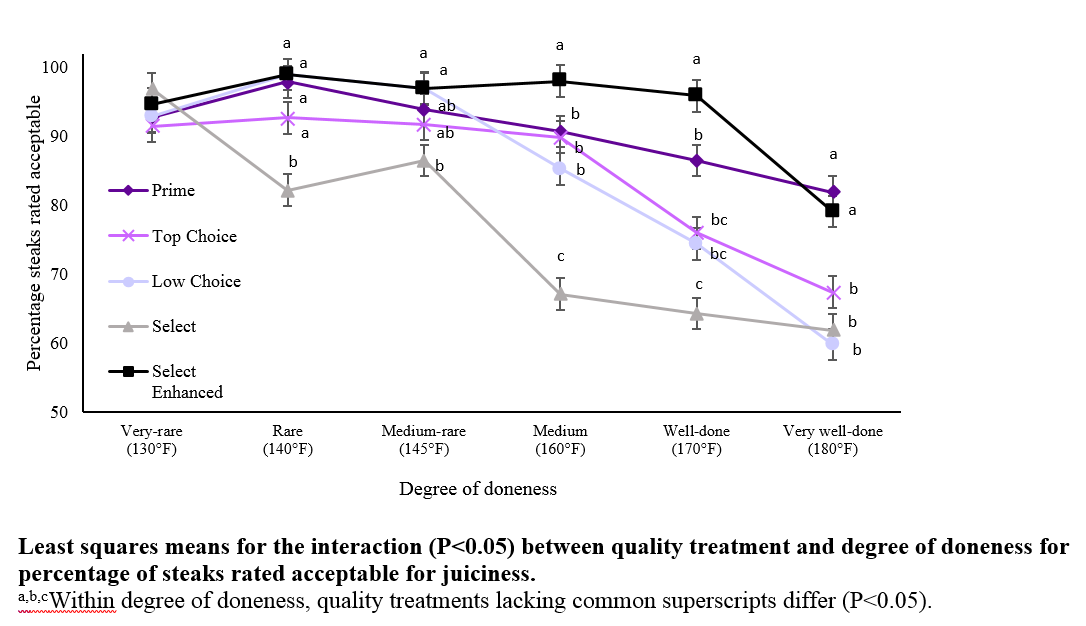
Bottom Line: Marbling could play a role in compensating for the negative effects of advanced degrees of doneness on juiciness acceptability, providing insight into the quality grade needed for consumers to be satisfied with juiciness based on their preferred degree of doneness.
View full research report by authors L.N. Drey, K.R. Vierck, L.L. Prill, J.M. Gonzalez, T.A. Houser, E.A.E. Boyle, J.L. Vipham, and T.G. O’Quinn at http://newprairiepress.org/kaesrr/vol4/iss1/