Lessons from the Blue Zone
K-State students go abroad to study aging in Greece
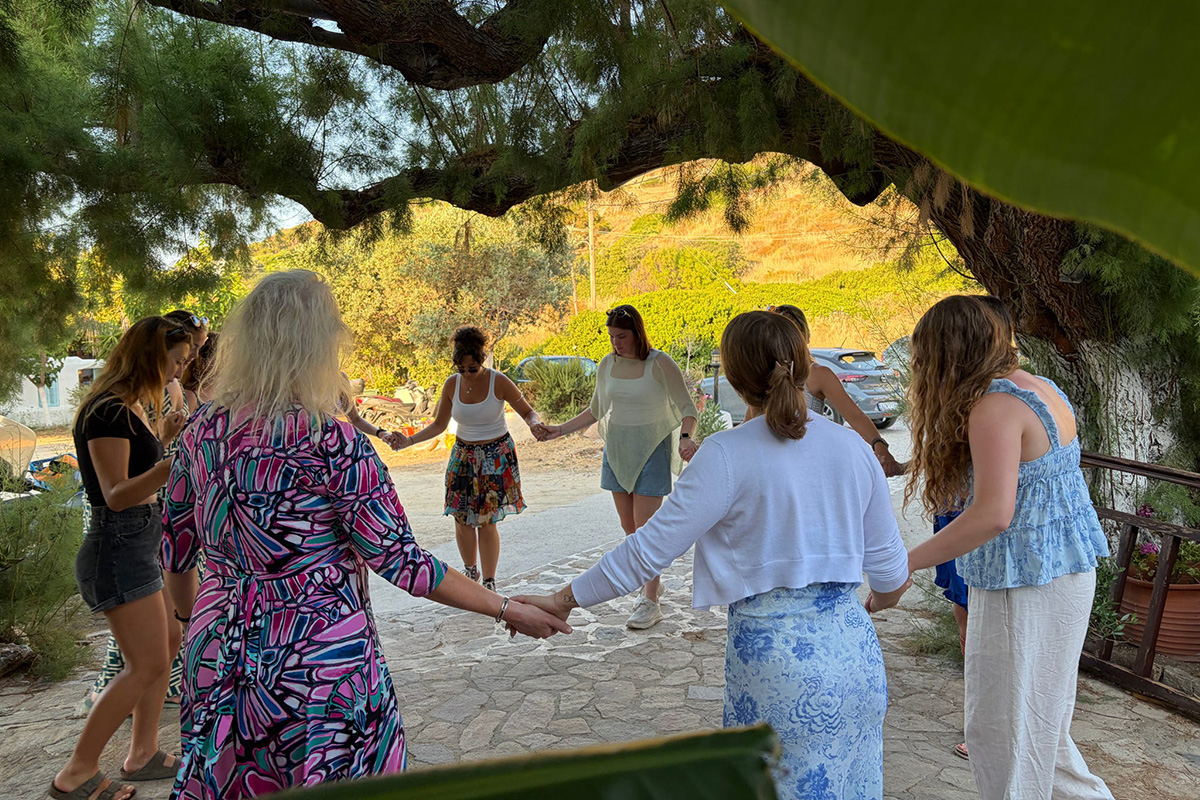
Students were given the opportunity to learn the Greek style of dance from the town locals.

By Cadence Brier
Staley School of Leadership
Wednesday, Sept. 30, 2026
What’s the secret to a long and healthy life?
To explore that question, 20 Kansas State University gerontology and psychology students traveled across the globe to immerse themselves in one of the world’s best-known longevity hotspots: the Blue Zone of Ikaria, Greece, where residents live past 100 at unusually high rates.
Building an authentic experience
Heather Bailey, professor of psychological sciences, collaborated with colleagues in the School of Human Sciences to design a 12-day course exploring Blue Zones, the Power 9 and the psychology of aging. The goal was to give students a multicultural learning experience that brought concepts they had studied at K-State to life.
Bailey spent more than two years designing and preparing for the Education Abroad course with Justine Irving, associate teaching professor, and Laci Cornelison, gerontology program chair and interim director of K-State’s Center on Aging.
Bailey said studying Blue Zones abroad was something she had wanted to do for years. A grant from K-State’s Applied Learning Experiences team helped make it possible.
“We teach about it in the classroom, but when we finally got the opportunity to develop a study abroad class, I was like, this is it,” she said. “Let’s get immersed in it. Let’s learn about how they live.”
To support K-State’s goal of providing an applied learning experience to every degree-seeking student before graduation, the university’s Applied Learning Experiences office has awarded more than $379,000 in grants since spring 2025 to help faculty members integrate applied learning into their courses.
“The grant was amazing to have. It helped buy out some of our time from other responsibilities we have,” Bailey said. “Part of it paid for our travel, so students didn’t have to cover that portion of it. It allowed us to be better prepared and cut our costs.”
Living the Power 9
A central part of the course was exploring the Blue Zones Power 9, nine lifestyle habits associated with some of the world’s longest-lived populations.
The habits emphasize incorporating natural movement into daily life, finding a sense of purpose, making time to slow down and relax, stopping eating before feeling completely full and choosing a largely plant-based diet. They also emphasize social connections, including spending time with family and friends, belonging to a supportive community and participating in a faith community. Another principle centers on sharing wine with friends during a meal.
Students saw many of those habits woven into everyday life in Ikaria, but they were particularly interested in the idea of “downshifting,” or intentionally making time to slow down.
Their local guide and host, Thea, said Ikarian culture approaches stress differently than U.S. culture.
“We don’t feel stress as strongly as they do in the United States. We take time to meditate and relax throughout the day. We kind of sit with the feeling if we have it, then move on.”
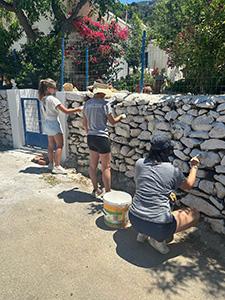
Throughout the trip, students participated in educational activities, conversations with residents and visits throughout the island. Local doctors spoke with the group about the Greek health care system, and students visited the island’s nursing home, which houses 15 residents and has a waiting list of 30 people. They also spent time cooking in residents’ homes.
One excursion offered a particularly memorable lesson in what natural movement can look like.
Argies, an 85-year-old Ikarian woman who grows her own food and makes her own dairy products, wanted to show the students the goats on her land. What students expected to be a short walk down the road turned into a hike through a steep, forested mountainside.
Argies made the trip in flip-flops.
Students were struck by how active she was in her 80s — and even more surprised to learn that she makes the hike multiple times a day. The experience gave them a firsthand look at how natural movement can simply be part of everyday life.
Connecting knowledge to practice
When they arrived in Greece, students received journals to record memories, observations and daily reflections. Reflection is a key component of applied learning because it encourages students to connect what they have learned with what they are experiencing.
Molly Lafferty, a sophomore majoring in social work and psychology with a minor in gerontology, said she enjoyed the daily journals and their emphasis on reflection rather than grades.
Each day, Lafferty responded to provided prompts while adding her own observations.
“I really appreciated it because I could just put whatever I wanted in the journal. I didn’t have to worry about following a rubric,” she said. “That’s the best part about learning outside the classroom or studying abroad. It’s not about what I need to do to get the grade.”
Senior Abby Smith, who studies human development and family science, joined the trip with little previous exposure to gerontology.
“I’d never done a gerontology course before, so it was really cool to be able to go to the Blue Zone and to see the Power 9s we talked about in real life.”
Seeing those habits in practice also inspired Smith to be more present in her own life.
Junior Kaitlyn Bennett, who studies communication sciences and disorders, has worked in retirement homes for years. During the group’s visit to a local nursing home, she saw firsthand how what she was learning about aging and the Ikarian lifestyle could inform her future career.
A once-in-a-lifetime experience
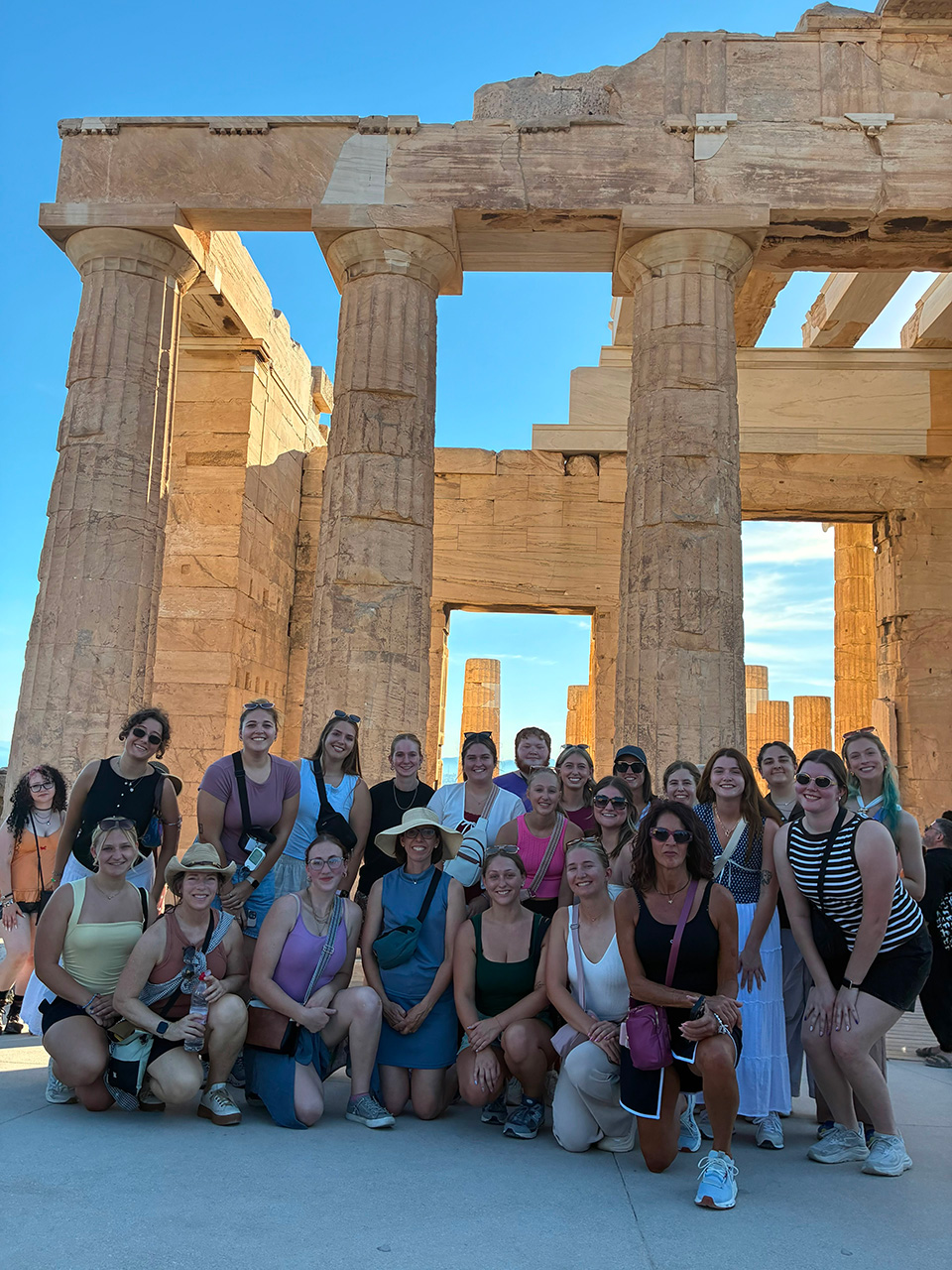 For Bailey, the goal was to give students an opportunity not just to read about healthy aging but to see the concepts they were studying unfold around them.
“There’s only so much you can learn, I think, from seeing pictures or videos or reading an article,” Bailey said. “I’m hoping that students get the experience to see that, ‘Oh, what they’re telling us in the classroom is legit.’”
“This opportunity lets them have real, meaningful experiences that they can connect to. We were literally cooking in an older woman’s house in Greece who didn’t speak a lick of English. It’s just a once-in-a-lifetime experience; you get so much more out of it.”
The experience gave students a chance to connect what they had learned at K-State with the people, places and daily routines they encountered in Ikaria. They returned to campus with a new perspective on aging — and on how the choices and connections that shape everyday life can matter across a lifetime.
Building on this summer’s course and pending approval, the psychological sciences and gerontology programs plan to return to Ikaria in summer 2027. Future courses could take students to other Blue Zones, including Sardinia, Italy, in 2028, as well as Costa Rica and Okinawa, Japan.