History comes to life for Wildcats in Berlin
Faculty-led study abroad program explores Germany's memory culture and lasting impact of history


By Necia Chronister
Department of Modern Languages
Monday, Aug. 10, 2026
Eight Kansas State University students spent 10 days in Berlin, Germany, from May 22-31, exploring the country's memory culture through historic sites, memorials and conversations about how Germany remembers its past.
Led by Necia Chronister, professor in the Department of Modern Languages, the faculty-led study abroad program examined Berlin's history from its founding in the 13th century through Prussian imperialism, the Weimar Republic, the Nazi era, Germany's division during the Cold War and the reunification of East and West Germany in 1990.
 Beyond learning about major historical events, students examined Germany's priorities and strategies for commemoration by discussing current debates surrounding city planning, commercial development, green space and the preservation of historic sites. The program also included excursions to royal palaces in Potsdam and the Sachsenhausen concentration camp in Oranienburg. Throughout the trip, students explored the continuing effects of war, dictatorship and division on German society today.
For many students, seeing history firsthand left a lasting impression.
"It's hard to narrow down how I was changed by the trip," one student said. "There were days I went back to the hostel with my eyes so full I didn't know how I could cram another day of seeing the past into them."
Visiting the Berlin Wall, seeing World War II munition damage still visible on older buildings and standing at Checkpoint Charlie made history feel immediate and personal.
"I suppose I was hardest hit by Checkpoint Charlie," the student said. "I hope I have never taken any of my freedoms for granted."
Inspired by Berlin's tradition of free speech and dialogue with the past, the students added their own messages to a section of the Berlin Wall and, as a group, included a Powercat.
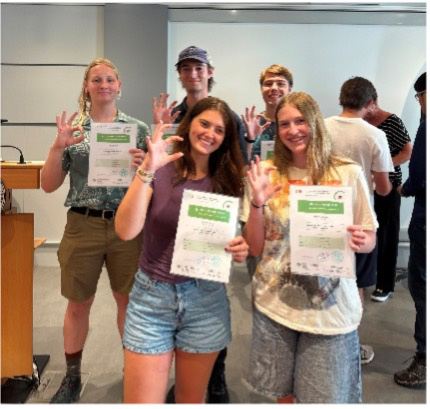
Following the Berlin program, five of the eight students continued their studies in Germany through a four-week German language program at the Institute for German Language and Culture in Wittenberg. There, they attended German-language classes, participated in extracurricular activities, took excursions to other cities, and learned about the city where Martin Luther posted his 95 Theses, which sparked the Reformation.
One student said the experience strengthened both language skills and historical understanding.
"The improvements on my skills as a translator and the history I learned really enlightened me on things I previously could not understand. I look forward to learning more about Germany and continuing my language skills past what they are now."
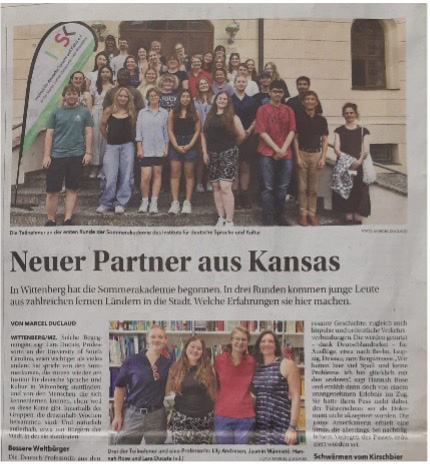
K-State's presence also made an impression in Wittenberg, where the students' participation was featured in the local newspaper.
In their reflections at the end of the course, all eight students described the value of studying abroad. One student said the experience reinforced the importance of approaching unfamiliar ideas with curiosity rather than judgment.
"If more people approached unfamiliar ideas with curiosity instead of judgment, I believe it would lead to greater understanding among individuals with different identities and backgrounds."
Together, the students' reflections highlighted how studying abroad can deepen historical understanding, strengthen language skills and encourage new ways of seeing the world.