K-State brings together global experts to strengthen animal health preparedness
Planning committee members for the Symposium on Biomanufacturing: Mitigating Transboundary Animal Disease Threats. Pictured from left are Steve Witte, Young Loo, Juergen A. Richt, Alfonso Clavijo, Catherine Hickman, and Christine Huncovsky. Event and program support was provided by Christine Huncovsky and Karinne Cortes (not pictured).
More than 110 leaders from industry, government and academia gathered in Manhattan, June 8-10, for the Symposium on Biomanufacturing: Mitigating Transboundary Animal Disease Threats, hosted by the College of Veterinary Medicine in partnership with the National Bio and Agro-Defense Facility, or NBAF.
The invitation-only event brought together experts from across the United States and multiple continents to strengthen partnerships and explore collaborative solutions to emerging animal disease threats. The symposium was planned in partnership with Juergen A. Richt, university distinguished professor and Kansas Regents distinguished professor, director of the DHS Emeritus Center of Excellence for Emerging and Zoonotic Animal Diseases, or CEEZAD, and director of the NIH Center on Emerging and Zoonotic Infectious Diseases, or CEZID, at K-State.
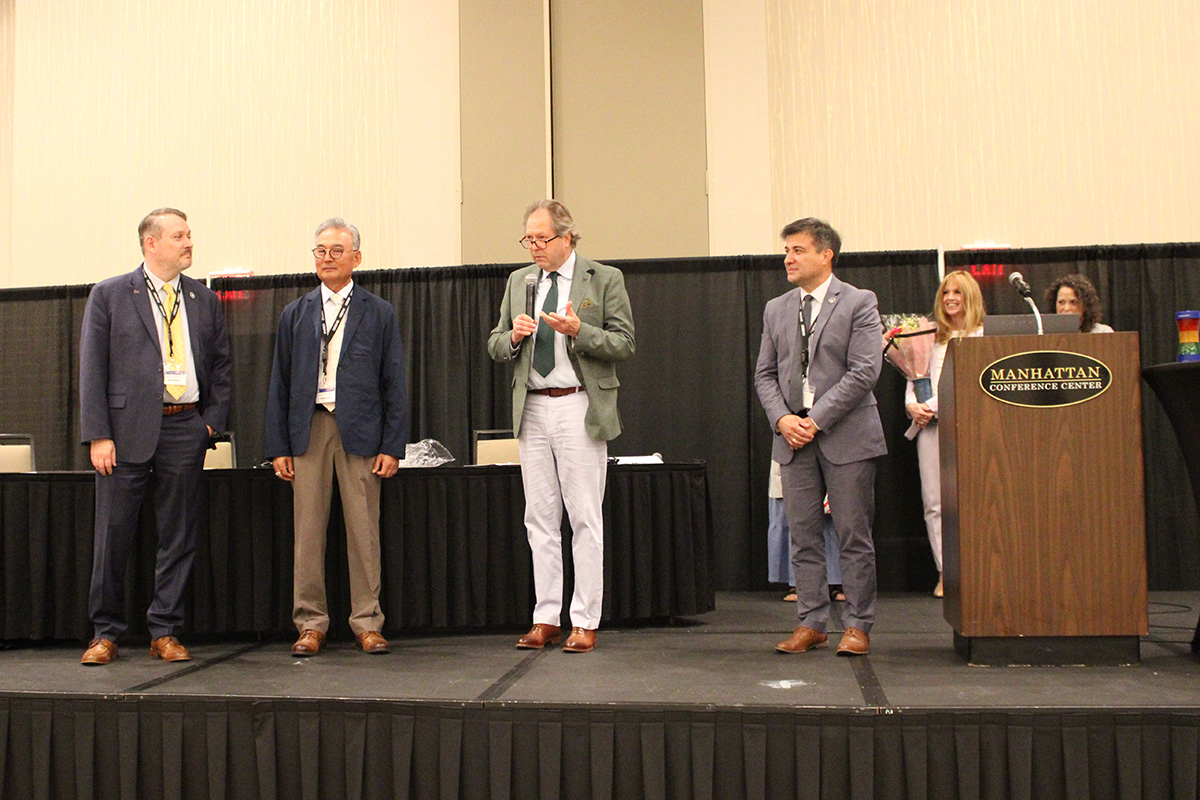
K-State faculty and researchers joined international leaders from government, academia and industry to share expertise on vaccine development, diagnostics, manufacturing and disease preparedness. Opening remarks from Hans Coetzee, vice president for research; Alfonso Clavijo, director of NBAF, and Richt highlighted the importance of collaboration in protecting animal agriculture, global food security and public health.
Speakers represented organizations from the United States and abroad, including The Pirbright Institute, PANAFTOSA, Iowa State University, USDA’s Center for Veterinary Biologics, USDA-NBAF, Colorado State University, VIDO, K-State and leading animal health and biotechnology companies from North America, South America, Europe and Asia.
A recurring theme was the need for proactive mitigation strategies, including diagnostics and veterinary vaccines, to address transboundary animal diseases that threaten livestock production, food security and economic stability.
“Transboundary animal diseases do not respect borders, and our preparedness cannot be limited by institutional boundaries,” Richt said. “This symposium demonstrated the power of bringing industry, government and academia together to identify practical solutions for vaccine development, diagnostics, manufacturing capacity and rapid response.”
The symposium reinforced K-State’s and Manhattan's growing role as a global hub for animal health, biodefense and biomanufacturing innovation.
— Submitted by Catherine Hickman