K-State joins national effort to prepare next generation of veterinary entomologists
Kansas State University is addressing a critical nationwide shortage of veterinary entomologists through the Research and Extension Experience in Veterinary Entomology for Students program, an innovative new program designed to provide undergraduates with hands-on research experience.
Veterinary entomologists play a crucial role in safeguarding livestock health and agricultural economies by studying insects and ticks that affect animals.
"Despite the significant impact arthropods like ticks and insects have on livestock production, there's a serious lack of trained veterinary entomologists," explains Cassandra Olds, assistant professor of entomology at K-State. "Many students simply aren't aware of this viable career path or what it entails."
Kansas, a global leader in beef production, marketing systems and research, is uniquely poised to combat this shortage. In 2021, cattle and calves accounted for 46% of Kansas' agricultural cash receipts, and the state ranked second nationally in cattle processed. The economic well-being of the state's agricultural sector is closely tied to the health of its livestock.
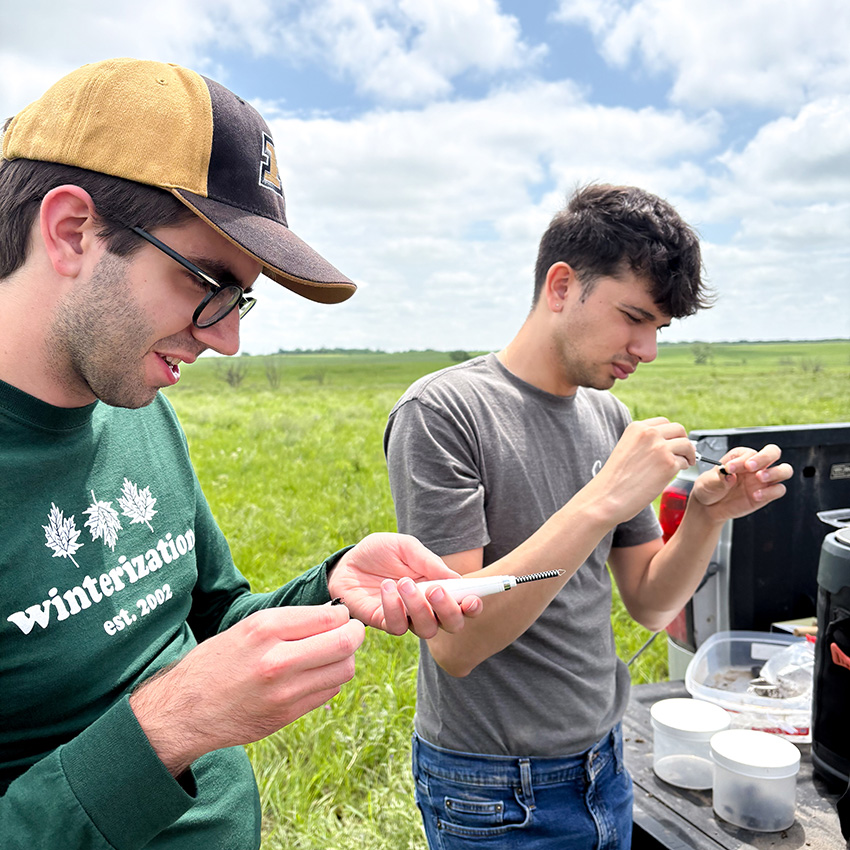
"With increasing insecticide resistance and the emergence of new tick and tick-borne pathogen species, our capacity to meet future research, extension, and teaching needs in this area is more critical than ever," Dr. Olds emphasizes.
To address these pressing issues, Olds collaborated with other university veterinary entomologists to develop the Research and Extension Experience in Veterinary Entomology for Students program, or REEVES.
Funded by the USDA-NIFA and led by the University of Tennessee, the 8-week summer residential program offers an immersive, hands-on experience in veterinary entomology research and extension. The overarching goal of REEVES is to introduce and train talented individuals for graduate and professional programs, as well as livestock-associated careers that emphasize team science. The program educates them on the fundamentals of veterinary entomology and provides them with real-world project experience relevant to the needs of stakeholders.
Two scholars are placed at each participating institution each year, K-State, University of Tennessee, Texas A&M and University of Georgia, and will run from 2025 till 2028.
REEVES scholars engage in impactful research and learn to collaborate effectively within scientific teams. They are given the opportunity to present their research at the annual Livestock Insect Workers Conference and an online REEVES Expo. This year at K-State, scholars evaluated the impact of stable flies on cattle performance in feedlots and investigated recent outbreaks of Theileria orientalis in the region.
"For me, the most exciting aspect of this field is the chance to do good at every level," says Olds. "You have the opportunity to positively impact both animal health and well-being, while simultaneously improving the livelihoods of the people who own them."
More information and how to apply can be found on the REEVES program website.