People with Purpose: Amanda Gaulke
Amanda Gaulke is taking the initiative to improve health outcomes through research and mentorship

By Mary Adeyemo
K-State News and Communications Services
Monday, Dec. 15, 2025
Amanda Gaulke, associate professor of economics, centers her work on creating real-world impact. Her research examines how chronic childhood health conditions disproportionately affect children from lower-income families, with the goal of informing policies that better support vulnerable populations.
In the classroom, Gaulke designs student-centered learning experiences that connect economics to current issues and emphasize clear communication. She also invests in graduate student development, helping future economists build confidence and refine their research skills.
In this edition of People with Purpose, Gaulke shares how she finds purpose in helping people — whether through policy-focused research or supporting students as they grow.
Q: How did you decide to go into higher education?
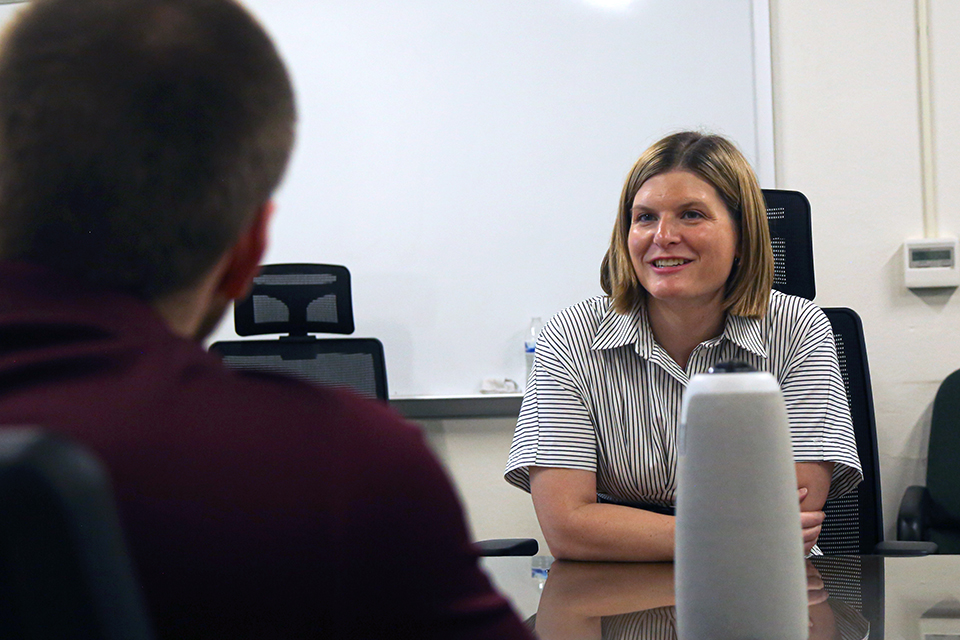
Gaulke: I picked my college based on meeting with the faculty member who would become my advisor. Professor Lemke had an enormously positive impact on my career, so I understand the value of a good professor. I was a tutor for the economics department, and that experience inspired my interest in teaching economics, as I found immense satisfaction in helping people understand economics.
Q: What's your favorite spot at K-State?
Gaulke: The rock wall at the Rec Center. Rock climbing is one of my favorite activities outside of work. I get to spend time with a friend, exercise and enjoy the challenge of trying to learn new routes.
Q: What is your teaching style and what's at the heart of it?
Gaulke: A significant motivation for my teaching style is to give economics real-world value. In my Econ 120 class, we complete weekly real-world applications that enable students to apply economic concepts to situations encountered through podcasts, articles, and other media.
In my Econ 633 class, we do group research projects where students apply the policy evaluation tools to a specific public policy of their choice in a non-partisan manner. My goal is that for each topic we cover, students can tell me why it would matter to someone who is not an economist.
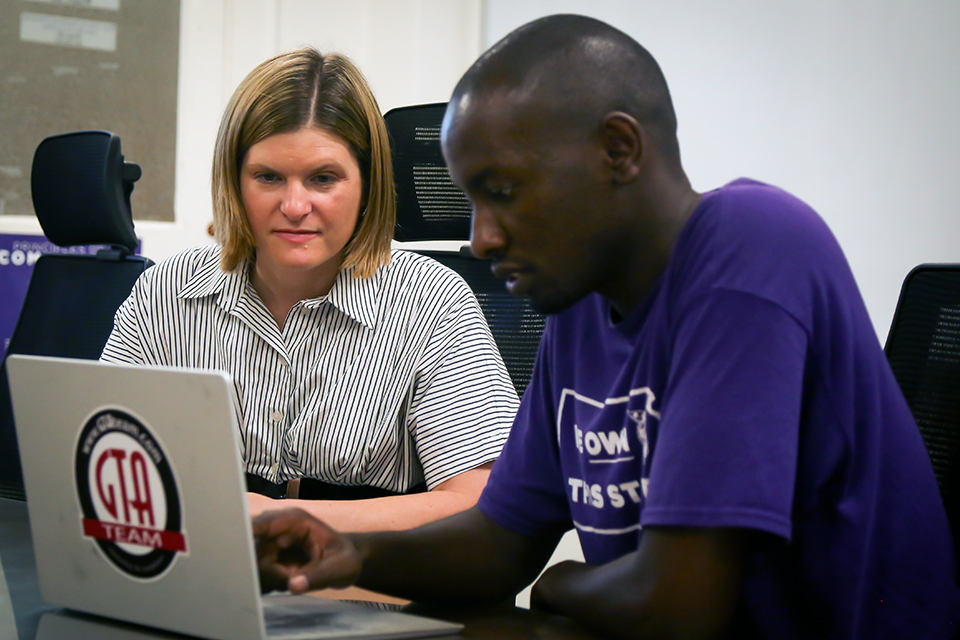
A second motivation for me is to make the class student-centered. I think about what type of class I would enjoy most as a student. This goes beyond things like being clear about what students need to demonstrate mastery of on midterms.
I adjusted some of the course content in Econ 633 based on a survey of student interests, so the specific policies we focus on are ones the students are most motivated to learn about. They pick their group's research topic. In Econ 832, we spend a lot of time learning to communicate research, as this is something graduate students are expected to do but is generally not formally taught to students.
Q: What's your favorite part about working with students?
Gaulke: I have had many great professors, advisers and mentors who have helped me along the way.
My favorite part about working with students is when I feel like what I did has helped them along their academic or career path in a positive way.
Q: What do you feel is your most significant contribution to research at K-State?
Gaulke: I think the most significant contribution of my research is to help society understand why children of lower-income parents have worse health outcomes.
I have spent a lot of time lately working with co-authors to document that this is, in part, due to children of lower-income parents being more negatively impacted by the same specific childhood health condition. This line of research was inspired by my own life experiences.
Q: What is your long-term goal for your research, and where are you in that process now?
Gaulke: I want the research I am doing on the impacts of being diagnosed with a chronic health condition in childhood to be used to create better policies to help these children and their families. A lot of my work has been done in the context of Type 1 Diabetes in Denmark, as Denmark has universal access to healthcare, and thus, you can rule out differences in outcomes due to differences in health insurance or access to healthcare.
During my sabbatical, I attended events hosted by the Danish Diabetes and Endocrine Academy to engage with medical providers and researchers. One of my co-authors was recently on a podcast discussing our work more broadly. Hopefully, those making healthcare policies will consider our results in making their decisions.
Q: What is your favorite way to serve your field and why?
 Gaulke: In terms of serving the broader profession, my favorite activity is to serve on scientific committees for conferences. The last couple of years, I have served on these committees for the Kansas Health Conference and the Essen Health Conference in Essen, Germany. This has been a great way to learn about new and interesting innovations in my field, both at a local and international level. Both conferences also focus on including junior faculty, postdocs, and graduate students.
At the K-State specific level, I really enjoy leading activities focused on professional development for graduate students. As an example, I am leading a job market exchange program where our PhD students visit KU to give a practice job talk, and their students come to K-State to give a practice job talk. I think it is important to support the next generation of economists.
Q: What's your favorite thing about being part of the K-State community?
Gaulke: I really enjoy being part of a land-grant institution and believe in the mission of serving society more broadly.
My research is very motivated by helping people, and my teaching and service are very motivated by helping the next generation.
###