People with purpose: Paul Lowe
Meet the university leader driving K-State's success in research partnerships nationwide

By Mary Adeyemo
K-State News and Communications Services
Monday, Nov. 17, 2025
At Kansas State University, the people who move the university's mission forward often do so quietly — investing in others, strengthening systems and creating opportunities that ripple far beyond their own roles. Paul Lowe is one of those people.
As associate vice president for research, overseeing sponsored programs, he has spent his career shaping an environment where faculty, staff and graduate and undergraduate researchers can do their best work.
Rooted in a childhood shaped by a lifelong educator and refined through years of hands-on experience across complex operational landscapes, Lowe leads with intention. He focuses on empowering others, reducing barriers and building the relationships that help K-Staters push ideas forward.
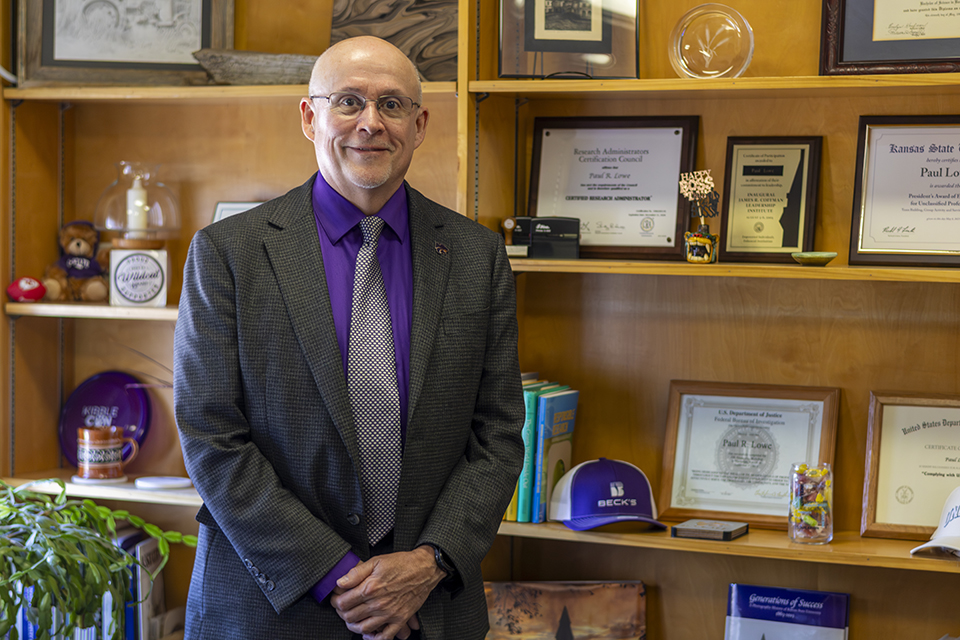
For more than three decades, Paul Lowe has been a behind-the-scenes leader whose intentional mentorship and barrier-breaking approach have helped drive K-State’s surge in research growth and innovation.
His work has helped fuel the university's remarkable growth in extramural funding — but he is quick to credit the "village" behind that success.
Lowe reflects on the lessons that shaped his leadership, the joy he finds in mentoring emerging professionals and the purpose that continues to guide his contributions to K-State's research community.
Q: What drives you to do the things you do to support students?
Lowe: My father was a life-long educator. He taught up to five generations of rural families in some cases before retiring. Growing up in that environment, my dad incorporated educational lessons into every task that appeared on our assigned chore list.
Living on a farm meant that we usually had a long list of assignments. Early on, I quickly learned about certain physics concepts, such as Newton’s First Law of Motion, which was introduced to us when it became apparent that my brothers and I were not completing our tasks in a timely fashion or were procrastinating altogether. When we complained about having to service the farm equipment before heading out for the day's work, we learned about the concept of friction and its effect on the wear and tear of the equipment. That lesson was also followed by lessons in economics and finance, as he lamented having to replace equipment with a teacher's salary.
Today, I find myself doing the same thing as I serve to mentor the next generations of professionals. I have had an awesome opportunity to work with both undergraduate and graduate students through employment and internships within the Office of Sponsored Programs, a unit of the Office of the Vice President for Research.
Having the opportunity to contribute, even in a small way, to their professional development is very satisfying and helps me carry on my dad's legacy of preparing the next generation of leaders, problem solvers and innovators.
Q: What is your leadership style, and how does that contribute to your success in your role?
Lowe: First, I must quote the famous philosopher Dolly Parton, who once said, "Find out who you are and do it on purpose."
I have always believed that one cannot effectively lead until they have walked the walk of those they lead and become an expert in all foundational concepts within their area of influence. My first management job in the private sector required that I rotate through and immerse myself in all operational and business aspects of each department of the company.
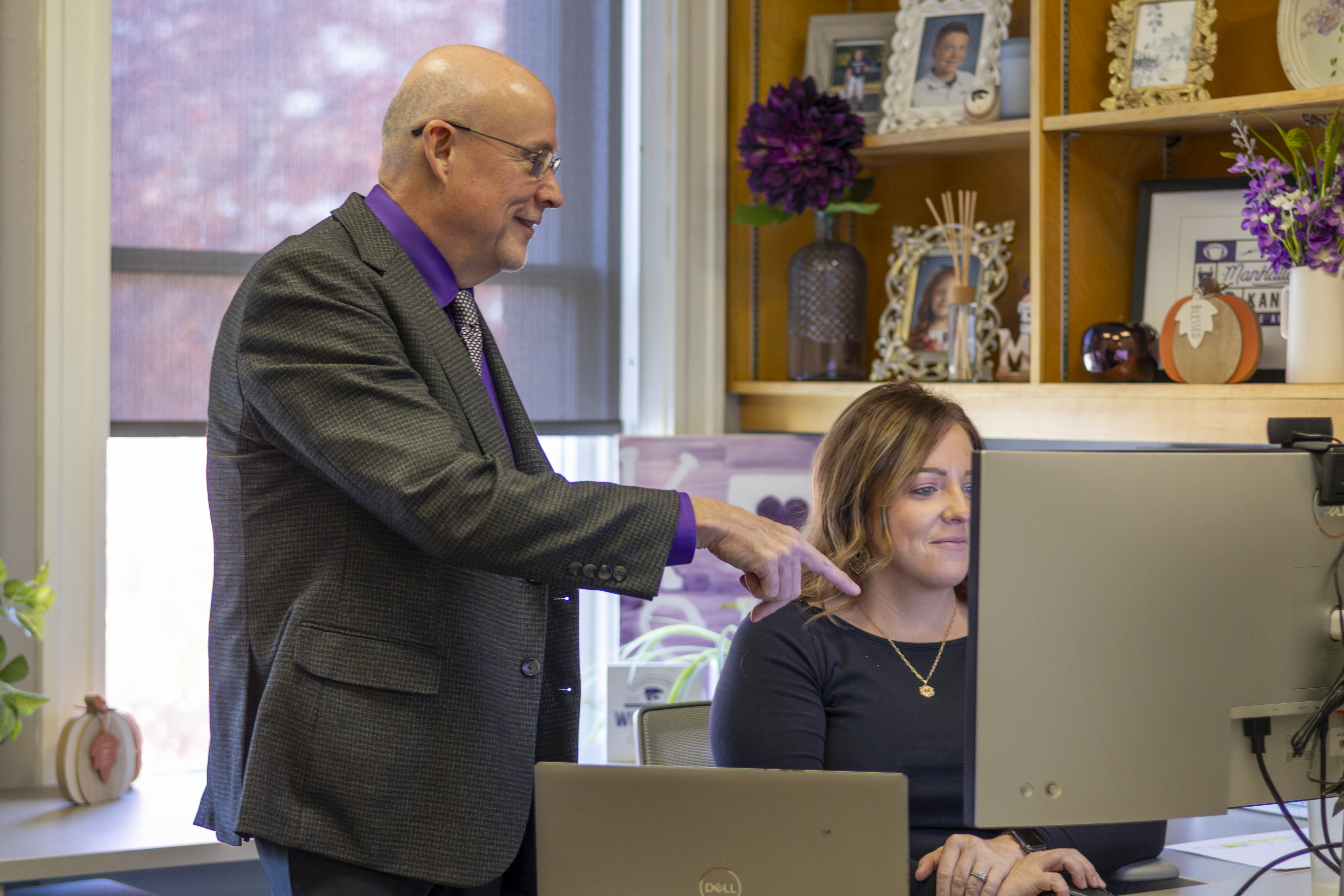
Early in my career at K-State, I found myself demonstrating personal initiative to pursue knowledge and expertise — not only to learn my job, but also to re-engineer and modernize processes on the fly. At the same time, I worked to increase productivity and success metrics while assuming full responsibility for day-to-day operations.
In other words, to become exemplars in their field, focused on efficiency, effectiveness, integrity and professionalism.
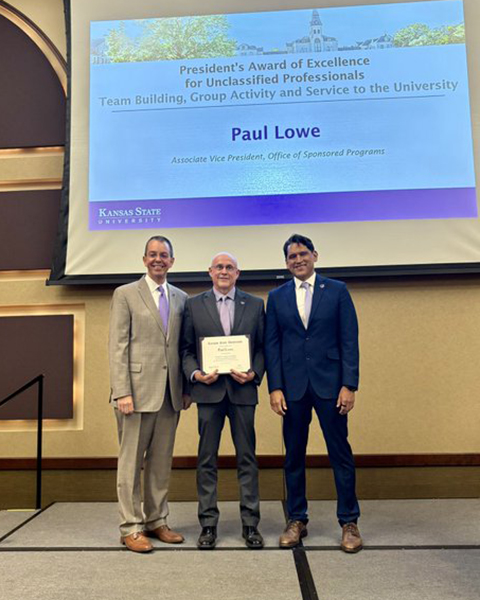
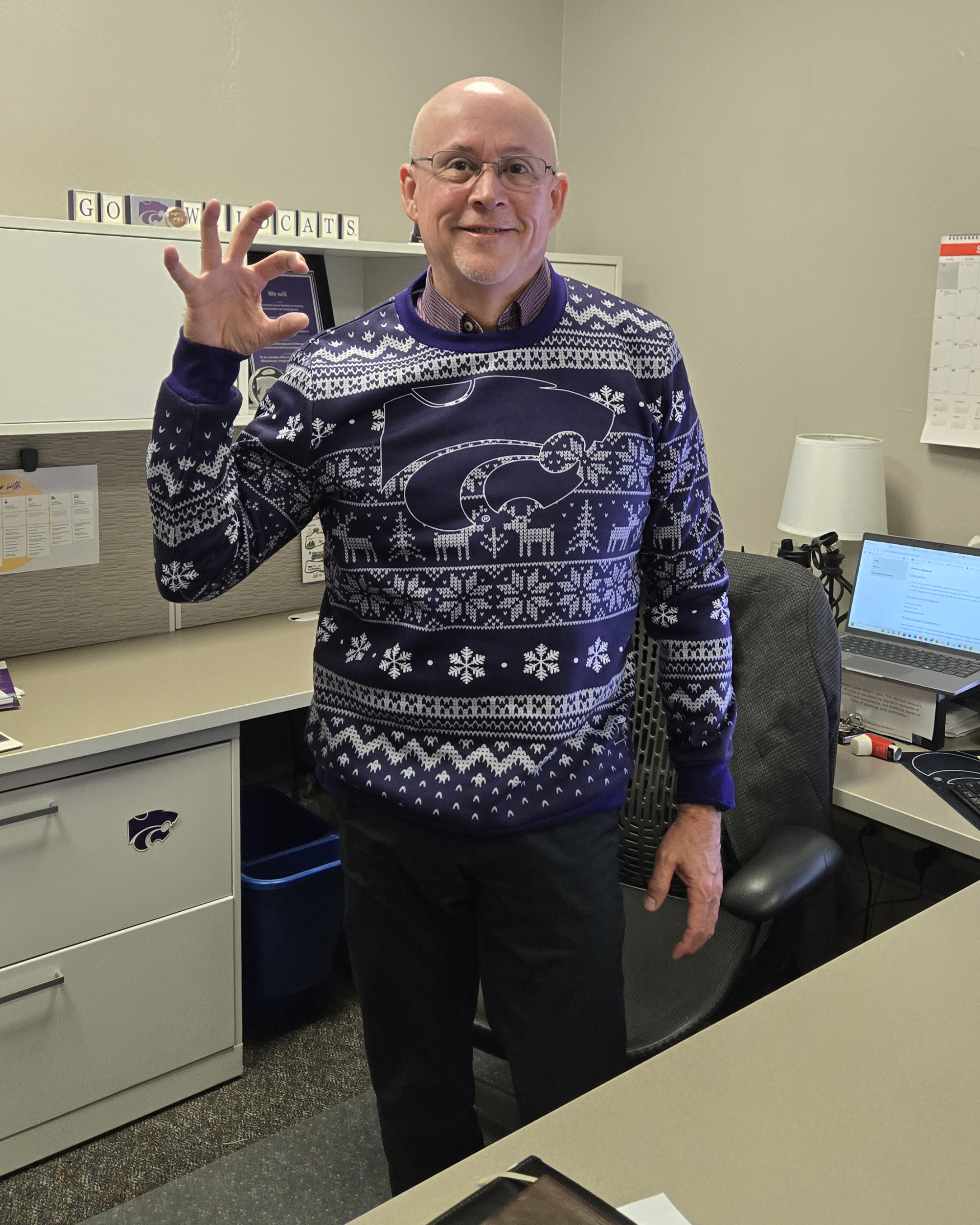
Paul Lowe was a 2025 recipient of the President's Award of Excellence for Unclassified Professionals.
I have had the distinct pleasure of searching for and hiring like-minded talent who possess the core work ethic required to succeed in a high-stress, high-throughput, deadline-driven environment. I have worked to empower each of them through mentoring, providing the requisite body of knowledge, and fostering a thirst for lifelong professional development — helping them become the very best at what they do.
Most of us are employed in positions that cannot be completed in a silo or bubble. I believe that empowering those I lead — by giving them a stake in developing operational efficiencies, providing the necessary resources for success, and supporting them in "learning moments" when things do not go as planned — has resulted in a long, satisfying career at K-State.
This experience illustrates the concept that it takes a village — a community of empowered, well-trained individuals — not just one person, to support the ambitious goals of this university.
I have never looked at my work solely through the lens of personal achievement. Instead, I return to my father's daily lessons on the farm as a guiding approach to ensuring the overall success of the department and, by extension, the university — the bigger picture.
When we established the office I now lead, the university was bringing in about $40 million per year in extramural funding. That total has since grown to more than $285 million.
These results are not the reflection of a single person but of an engaged village. My role over the years has simply been to reduce hurdles hindering success and to help establish a culture of confidence, purpose and expectation within the K-State research enterprise.
Q: If you had to highlight one time when you felt most successful in your role, what would that be and why?
Lowe: Though I tend to lift up others and divert attention away from myself, I was proud to be selected in 2025 for a President's Award of Excellence for Unclassified Professionals.
While I'm largely self-driven, receiving this recognition was both deeply appreciated and genuinely humbling.
Q: Who is your biggest inspiration on campus, and what do they do to make you feel that way?
Lowe: I have had the distinct pleasure of contributing to the growth of the K-State research enterprise under the leadership of four different university presidents and six vice presidents for research. Each one of these leaders brought forth their own vision and aspirations for the growth of the research enterprise at K-State, as well as the university as a whole.
It is their demonstrated passion for K-State, their confidence in the K-State community, and their empowerment of me to deploy a sense of "freedom to operate" that has inspired me to lean into and contribute to each one of these leaders' visions to take K-State to the next level.
Q: What is your favorite way to serve your profession/community and why?
Lowe: I was given the mandate several years ago to develop a contract negotiation track within the Office of Sponsored Programs, focused on the nuanced regulatory and contractual environment of extramurally funded programs.
This required building expertise across a wide range of sponsor types, contracting vehicles and negotiation strategies. I was also tasked with increasing industry-funded sponsored programs and establishing the processes, expertise and business acumen needed to build stronger, mutually beneficial relationships — all while ensuring that deals were negotiated and onboarded at the speed of business.
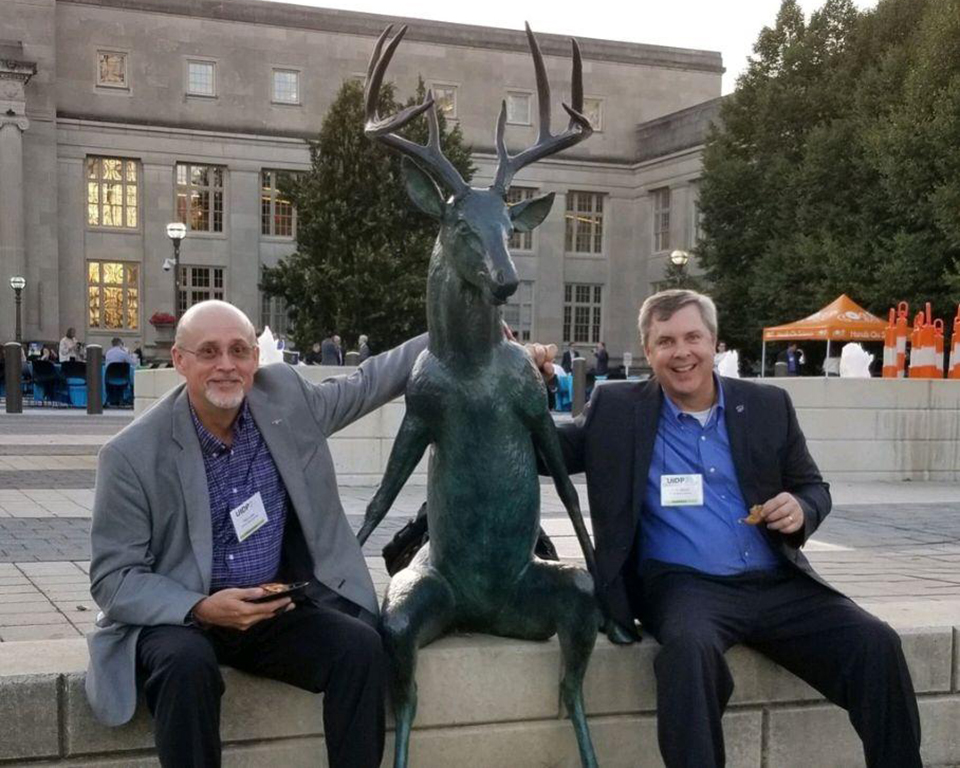
K-State's accomplishments and success in this area garnered nationwide attention. The University-Industry Demonstration Partnership — an organization formed within the National Academies to support collaboration between universities and industry — invited me to develop Negotiation Agreement Workshops to be delivered nationwide, addressing multiple industry sectors.
This experience allowed me to assemble a team of K-Staters to create a "Working With Industry Bootcamp" series for the university's faculty and staff. Through these experiences, I found my passion: developing tools, processes and strategies to bridge the university-industry interface — a daunting task at the time, given the seemingly disparate missions of these organizations.
I developed a passion for relationship-building negotiation strategies and for empowering the next generation of contract negotiators. Negotiation is a unique skill set that requires a holistic view of a potential relationship and the ability to design contract requirements that ease the other party's concerns — not unlike a prenuptial agreement.
When developing our "Working With Industry" curriculum, we built it around a dating analogy, which, in many ways, mirrors the stages of establishing enduring relationships with our industry partners.
One of my most gratifying experiences has been sharing this knowledge with others. And, I must admit, I also have a passion for closing deals and helping bring funding into the university.
I have truly enjoyed sharing this aspect of research administration with the greater research community.
Q: What do you hope your K-State legacy will be?
Lowe: Seriously, I don't spend any time or brainpower thinking about myself or my legacy. My job has been totally about lifting up K-State and contributing in any way that I can to support K-State's aspirational growth trajectory.
However, I do enjoy looking at the historical growth charts related to sponsored program funding over the years. It is like those proud moments when measuring and marking the growth of a child on the doorframe, beaming with pride at each milestone.
I hope that my intentional efforts to empower others position them for lifelong success and that they will, in turn, pay it forward.
Q: What challenges are you trying to solve through your work?
Lowe: 2025 has been a challenging year for research universities due to the federal transitions that have occurred with the new administration.
Maintaining continuity of programs, encouraging the research enterprise to keep pushing forward, and staying on top of the ever-changing funding and regulatory environment have required a significant amount of time and resources, at a level not previously required.
###