People with purpose: Laura Miller
Meet Laura Miller, a univeristy outstanding scholar who is finding a more agile approach to biosecurity
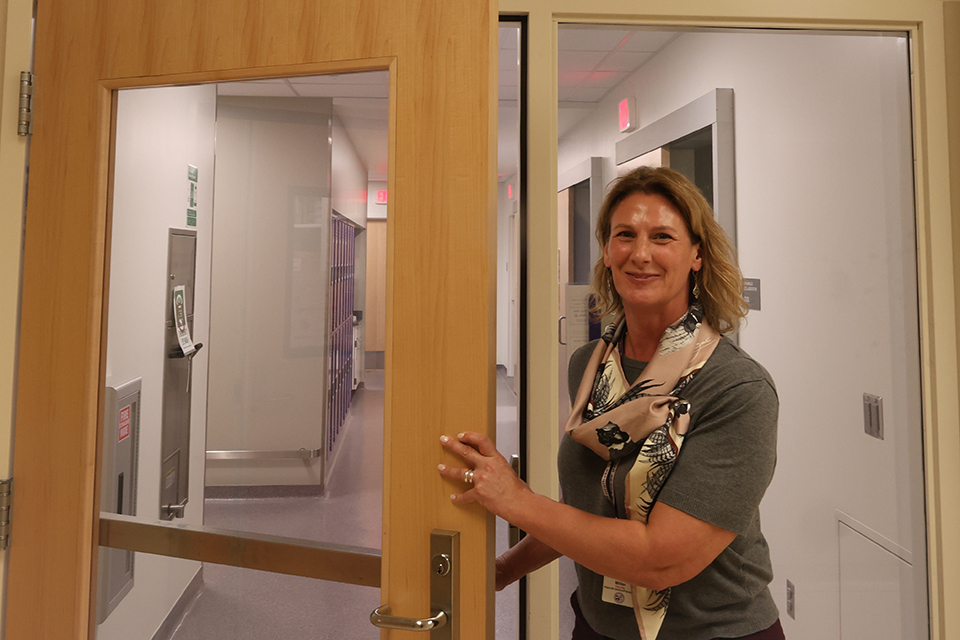
With a strong commitment to advancing agile approaches for preventing infectious diseases in dogs and horses, Laura Miller focuses on transforming research into real-world solutions that safeguard both animal and human health.

By Mary Adeyemo
K-State News and Communications Services
Monday, Nov. 10, 2025
With an urgent sense of the need to create a more agile approach to preventing infectious diseases, the heart of Laura Miller's passion lies in making research practical and providing high-impact solutions to protect animal and human health.
Having previously worked for the U.S. Department of Agriculture, she brings a unique perspective to mentoring students in preparation for high-stakes careers in government and industry.
Read on to learn, in her own words, how Miller, a University Outstanding Scholar and associate professor of veterinary virology, immunology and genetics in the College of Veterinary Medicine, is using the latest high-tech tools to study viruses, keep farms safe and protect our food supply.
Q: What has been the most impactful day at K-State for you and why?
Miller: The most impactful day for me was the day I was named a University Outstanding Scholar. It was a deeply meaningful day because it validated the rapid progress and hard work I've put into building my research program here at K-State.
It made me feel a profound sense of pride and belonging to the K-State community and confirmed that the vision I have for my lab and my students is being recognized.
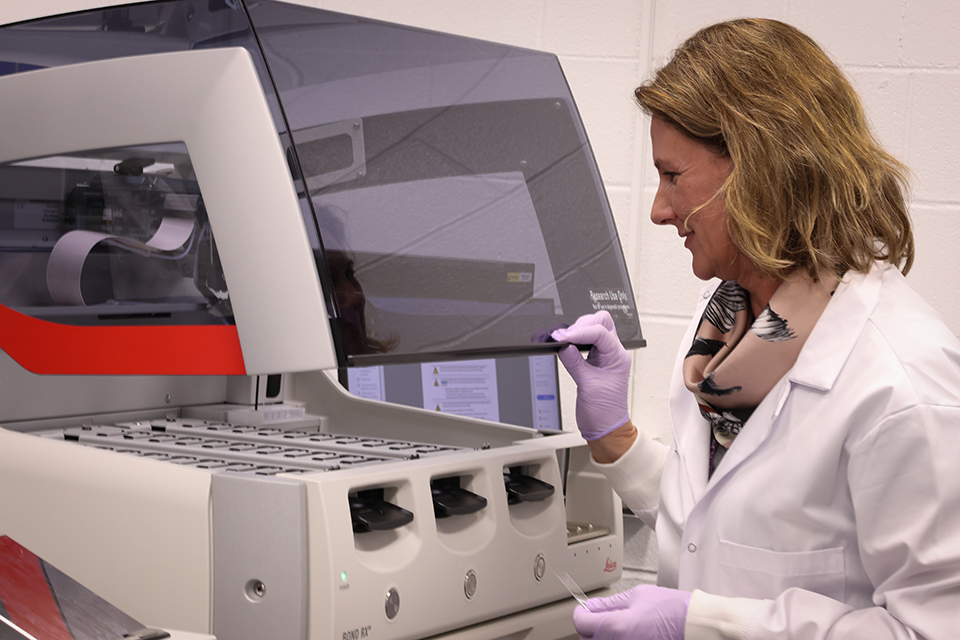
Miller, a University Outstanding Scholar, takes a hands-on approach to teaching. The graduate course she developed encourages students to think outside of the classroom and connect the dots between different scientific fields.
Q: What is one thing you want people to know about you?
Miller: I want people to know that my passion for animals extends far beyond my work in the lab. My life with my dogs and horses, as well as my involvement in the Kansas field trial community, is a core part of who I am. I believe it gives me a unique perspective on animal health and behavior that informs my work every day.
It's also where I find my work-life balance, and it's a wonderful community that helps me stay connected to the real-world applications of what I study.
Q: What is your teaching style and what's at the heart of it?
Miller: At the heart of my teaching style is an integrated, hands-on approach. I don't believe in teaching disciplines in isolation. I want to equip students with the skills they need to solve complex, real-world problems.
That's why the graduate course I developed innovatively integrates disease genomics, computation, and systems biology. My goal is to teach students not just what to think, but how to think like an innovative researcher who can connect the dots between different scientific fields.
Q: What's your favorite part about working with students?
Miller: My favorite part is watching a student's confidence grow as they start to own their research. It's incredibly rewarding to see them go from being a mentee to a contributing collaborator. I believe my background at the USDA gives me a unique perspective to prepare students for high-stakes careers in government and industry. My role is to foster their independence and curiosity, and seeing their success is the most rewarding part of my job.
Q: What do you feel is your most significant contribution to research at K-State? How did you become interested in that topic/research?
Miller: My most significant contribution to research at K-State has been building a unique, multi-platform system for infectious disease research. This vision came from my years working in government labs, where I saw firsthand the urgent need for a more agile approach to biosecurity.
I created a closed-loop system designed to rapidly develop and deploy solutions for emerging pathogens. We use advanced tools to identify novel targets, then apply that knowledge to develop next-generation vaccines and therapeutics.
The results are validated using cutting-edge systems like organoids and then refined with computational and AI tools. This is not just a theoretical model; it's a system supported by major funding from agencies like the National Institutes of Health, USDA and National Science Foundation, with a clear path to commercialization through patents and industry partnerships.
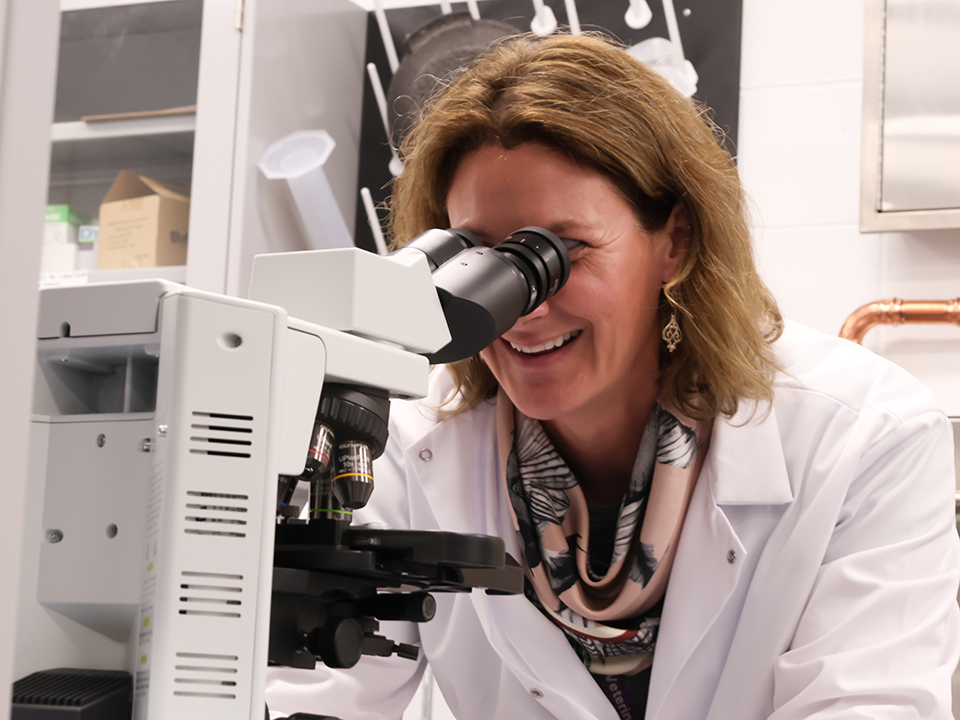
Miller plays the role of a "scientific detective" to find tiny clues that help figure out how a virus is making an animal sick.
Q: How does your work transform lives in Kansas and/or around the world?
Miller: My work transforms lives by directly addressing critical threats to our food supply and public health in Kansas and around the world. For Kansas, a key agricultural state, my research on livestock diseases protects the economic viability of our farms and the safety of our food supply.
On a global scale, my work has direct and vital applications to public health and national biosecurity. My expertise in high-consequence pathogens and high-containment research has been crucial in advancing preparedness for emerging threats. This is demonstrated by my collaborations at the National Bio and Agro-Defense Facility, or NBAF, and with the University of Kansas Medical Center on improving disease modeling for chronic diseases.
My expertise is also sought after at top international events, demonstrated by my keynote address at the International Porcine Reproductive and Respiratory Disease Syndrome Symposium in China, my being a featured speaker at IMMUNOLOGY2024 and the Conference of Research Workers in Animal Disease 2025, and representing K-State at the Food and Agriculture Organization of the United Nations Global Conference on Animal Health Innovation, Reference Centers and Vaccines in Rome.
Q: How would you talk about your work at the kitchen table?
Miller: I would say my work is about playing "scientific detective." I use the latest high-tech tools to find tiny clues that a virus leaves behind inside an animal's body. Once we find those clues, we can figure out exactly how the virus is making the animal sick. Then, my team and I can design and build new vaccines to stop the virus in its tracks, which ultimately helps keep our farms safe and protects our food supply.
Q: What would you be doing if you weren't in academia?
Miller: If I wasn't in academia, I would likely be working as a research director in a government laboratory, perhaps with the U.S. Department of Agriculture or a similar federal entity.
My career at the USDA was formative, and I found the mission-driven research deeply rewarding. I would be focused on a similar goal: translating foundational science into practical, high-impact solutions to protect animal and human health, but from a different vantage point.
Q: What is your favorite way to serve your profession/community and why?
Miller: My favorite way to serve is through a combination of leading my professional community and engaging directly with the communities I am a part of. I find it incredibly rewarding to guide the direction of my professional field.
My leadership roles, such as serving as president of the American Association of Veterinary Immunologists, allow me to help set the scientific agenda and ensure that our field is advancing in a meaningful way.
This same passion for service extends to my personal communities, where I focus on mentorship and advocacy. I believe it's my responsibility to help clear the path for the next generation of female scientists, and I do this through my work with the American Association of University Women, or AAUW.
Additionally, I find immense satisfaction in bridging academic knowledge with practical application through my involvement in the American Kennel Club and the Amateur Field Trial Clubs of America, bringing my professional expertise to a community that's so important to me.
Q: What's your favorite thing about being part of the Manhattan community?
Miller: I love the unique combination of a world-class university with a deep connection to the agricultural community. As a scientist, it's inspiring to work on research that directly impacts the food supply and is immediately relevant to the Kansas farming community.
Beyond the campus, the beauty of the Flint Hills prairie is a constant source of calm. It's this unique blend of cutting-edge research and the rich, agricultural landscape that truly makes this place feel like home.
###