People with purpose: Abby Knoblauch
Meet the scholar getting comfortable with the uncomfortable.
By Mary Adeyemo
K-State News and Communications Services
Monday, Nov. 24, 2025
Research in the humanities is often rigorous and very challenging. However, that's what education is about: getting uncomfortable with the familiar and integrating complex concepts to develop new perspectives and interpretations.
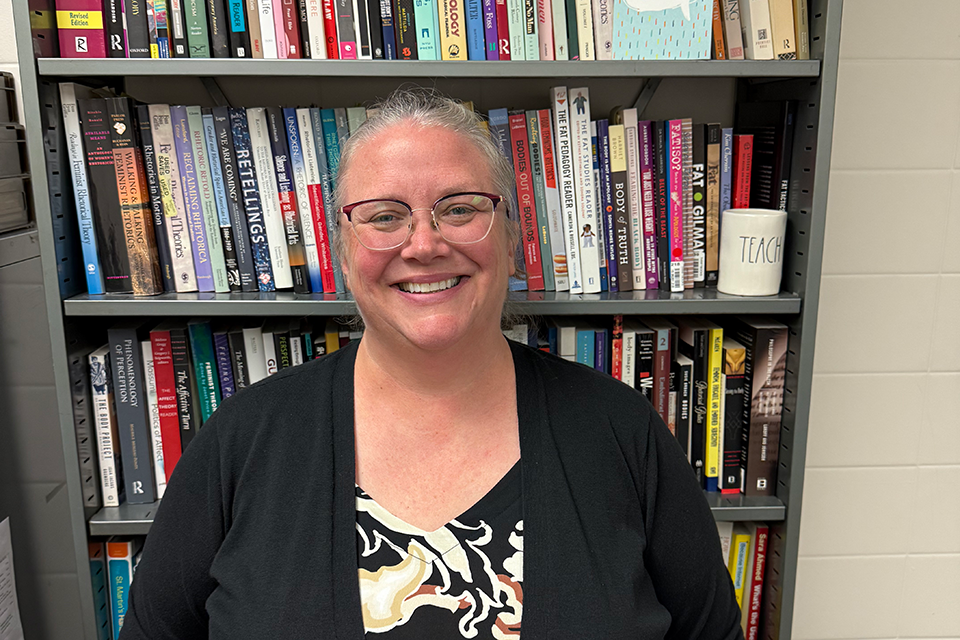
Abby Knoblauch, an associate professor of English and the director of the Expository Writing Program, shares how she helps prepare teachers to make an intentional impact on students' lives.
Q: How did you decide to go into higher education?
Knoblauch: I sometimes joke that I didn't decide — Lee Merrill decided for me. Lee was one of my college professors and when he found out that I was an English Education major rather than an English major, he kept me after class and told me that I should teach college instead of high school. That wasn't a career path I understood: I had no idea how someone became a college professor, so it wasn't something I had imagined as a possibility. He took the time to explain what graduate school was and what degrees I'd need to earn. In short, he described the process. Without Lee, I wouldn't be here.
Q: What's the coolest thing in your office, and what's the story behind it?
Knoblauch: I'm going to cheat and mention two. The first is a framed railroad spike with a small plaque that says "William the Bloody." Iykyk. The other is a photo negative of the now-demolished Ashland ore dock, transferred onto glass. The ore dock was 1,800 feet long and 88 feet high, serving as a loading point for massive ore boats that transported over 100,000 tons of iron ore. It was such an iconic feature of my hometown that the high school teams were (and still are) named the Oredockers. The image itself is a bit faded and haunting, and it makes me feel like someone has captured its ghost.
Q: What does a typical research day look like for you?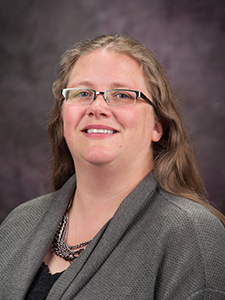
Knoblauch: Really, it's a lot of reading and writing. I want to give a shoutout to research and creative activity in the humanities, which is often not as visible as research that happens in a lab. Our research doesn't always "look" like work, in part because so much of our downtime as a society also involves looking at a screen. And yet, it's just as rigorous and challenging as any other kind of research. It takes time to understand and synthesize complex theoretical texts to develop a new theory or interpretation. It's a deep and intellectually challenging work.
Q: What is your teaching style and what's at the heart of it?
Knoblauch: This isn't exactly my teaching style, but my teaching philosophy is rooted, at least in part, in the idea that education is the process of learning something new, and that process can be uncomfortable. I want students to get comfortable being uncomfortable. I want them to understand that learning can be challenging, but that they can accomplish complex tasks. Regardless of the class I'm teaching, from first-year writing to a graduate seminar, my goal is to help students work through challenging ideas, texts, and activities. My pedagogy is centered on providing the scaffolding and support to help students accomplish things they weren't sure they were capable of.
Q: What do you hope your K-State legacy will be?
Knoblauch: I see my legacy as a pedagogical one. As the director of the Expository Writing Program, I help shape the educational experience of approximately 3000 undergraduate students each year. I'm proud of our curriculum and the impact it has; I'm also proud of the ways we prepare our teachers to engage with student writing and think critically about the intersections of language and power in writing classrooms. I also regularly teach a class for pre-service teachers where we discuss not only different writing processes, but also the impact that language arts teachers have on students' ideas about language itself. When you teach teachers, you send ripples out into the world, and engaged, intentional teachers can make a lasting impact on students' lives.
Q: What's your favorite thing about being part of the Manhattan/Salina/Olathe community?
Knoblauch: There's something a little bit magical about working on a college campus. I love the busy sidewalks between classes, the way Hale Library looks lit up at night against the big, dark sky, and the marching band practicing on fall afternoons. There's a sense of community that brings me joy. That's true of Manhattan, too. I'm always delighted when I run into friends and colleagues at the farmers market, or the Dusty Bookshelf, or Arrow. This isn't exactly a small town, but, as cliché as it sounds, it often still has that feel.