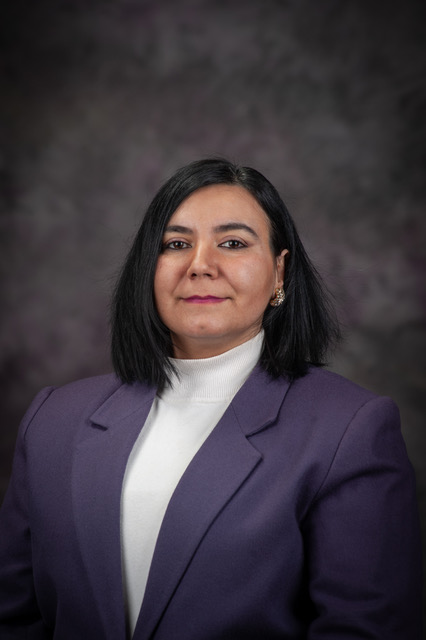
Hande McGinty
Assistant Professor, Computer Science
Hande McGinty has worked with the USDA and in the drug discovery industry. Her research focuses on knowledge graphs and their applications to artificial intelligence approaches with projects integrating food informatics and ag informatics.
What made you decide to be a part of the ID3A affiliate network?
My research has always been interdisciplinary, with much of my work sitting at the intersection of artificial intelligence, knowledge graphs, data science, agriculture, food systems, and health. Because of that, ID3A was a very natural fit for me. I was especially interested in being part of a community where computer scientists, agricultural researchers, engineers, and other domain experts could come together around real-world problems. Many of the challenges I am interested in, sustainable agriculture, food systems, environmental health, and trustworthy AI, cannot be addressed effectively within a single discipline. ID3A offered an environment where those different perspectives could come together and where I could both contribute my computational expertise and learn from researchers and stakeholders working directly in agriculture.
What skills, ideas, or opportunities do you bring to the program or network?
I bring expertise in knowledge graphs, ontologies, trustworthy and explainable AI, semantic technologies, data integration, and neurosymbolic AI.
A major focus of my research is understanding how we can bring together very different types of data and expert knowledge in ways that are not only useful for AI systems, but also transparent and understandable to the people using them.
I also bring a perspective that connects agricultural informatics with my background in USDA and bioinformatics and health informatics. Many of the challenges in these fields are surprisingly similar: heterogeneous data, complex relationships, uncertainty, and the need to translate large amounts of information into meaningful decisions. I enjoy identifying those connections and bringing computational approaches from one domain into another. I also hope to contribute opportunities for students and collaborators to engage with knowledge graphs, AI, and data science in ways that address practical agricultural and food-system challenges.
What opportunities within the affiliate network have you found to be most beneficial?
One of the most beneficial aspects of the affiliate network has been the opportunity to connect not only with researchers across disciplines, but also with agricultural stakeholders, producers, and industry partners.
Through ID3A, I have had opportunities to engage with organizations such as the Farm Bureau and to have conversations with people who are directly involved in agriculture and understand the practical challenges facing producers. Those conversations are extremely valuable because they provide a perspective that we do not always get within academia.
I have also really enjoyed opportunities such as the Women Who Grow the Farm AI panel, which allowed me to connect with women working across different areas of agriculture and hear directly about their experiences and priorities. These interactions often help move an idea from simply being an interesting AI or data science problem toward something that could address an actual agricultural need.
What is a collaboration you became a part of because of your involvement in the affiliate network?
One collaboration that grew directly from my involvement with ID3A is the development of a new Agricultural Informatics course, which I am currently working on collaboratively with Dr. Gaurav Jha, assistant professor in agronomy.
The course is intended to bring together agriculture, computer science, data science, and artificial intelligence and expose students to the growing opportunities at the intersection of these fields. We want students to work with real agricultural problems and datasets while learning how computational and AI approaches can support areas such as sustainability, production, management, and decision making.
I am particularly excited about this collaboration because it extends the interdisciplinary model beyond research and into education. Building this course together allows us to combine agricultural domain expertise with computing and AI expertise and better prepare students to work across those disciplinary boundaries.
Why do you value working in an interdisciplinary model across focus areas and colleges?
The problems we are trying to solve do not organize themselves according to academic departments. Sustainable agriculture, food security, water quality, environmental health, and responsible AI are all complex systems that involve many different types of data, expertise, and stakeholders. Computer science can provide powerful AI, knowledge representation, and data-integration methods, but those methods become much more meaningful when they are developed together with people who understand the domain and the practical context. At the same time, working with agricultural scientists and other domain experts exposes computational researchers to new problems that can drive advances in our own methods.
That exchange is what I value most about interdisciplinary research. It should not simply be computer scientists applying a technology to another discipline. The research questions, methods, and solutions should evolve through collaboration on both sides. ID3A provides an environment where those kinds of conversations and collaborations can happen naturally.