Research and the State reaches new heights
Annual forum helps strengthen emerging scholars and reinforce K-State’s mission to serve and innovate Kansas communities.
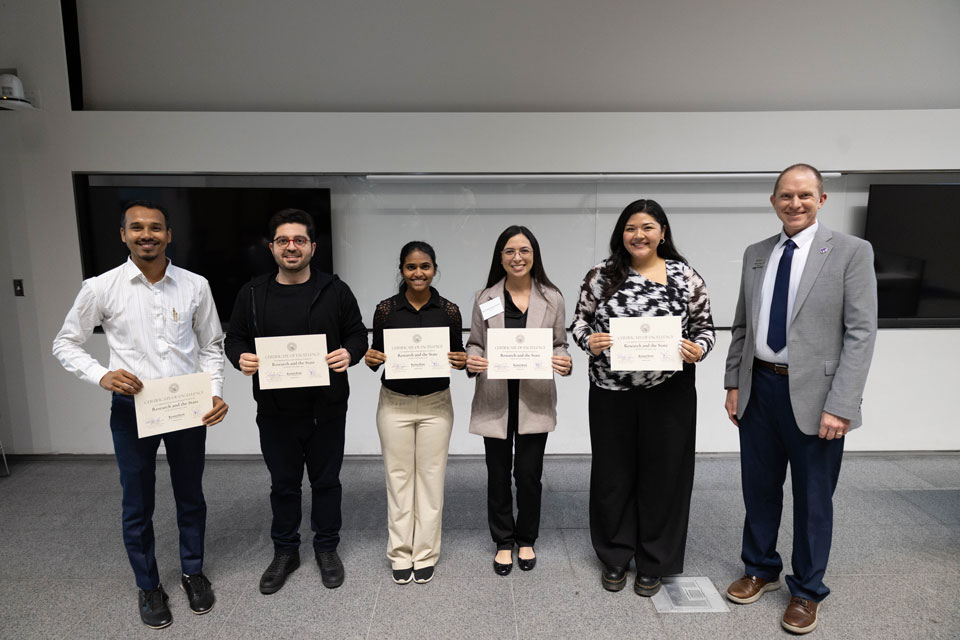
Winners who were present for the awards ceremony in photo from left: Md Suzauddula, Mohsen Davoudkhani, Vidya Nadar, Nayara Mota Miranda Soares, Mia Reyes and Interim Dean of the Graduate School, Phillip Payne.
The energy inside Regnier Atrium on Oct. 28 was unmistakable as 99 graduate students from eight colleges at Kansas State University gathered to share their work at the annual Research and the State poster forum. This year’s event marked the largest participation yet, with 33 master’s and 66 doctoral students presenting their research to peers, faculty, staff and community members.
More than just a showcase of academic achievement, Research and the State is a celebration of graduate student development and the impact of their work across Kansas. The forum offers graduate students an opportunity to gain experience translating complex research into accessible knowledge, an essential skill for professional success within and beyond academia.
“It is inspiring to interact with researchers early in their careers and learn about the innovation and creativity that continues to emerge from their work,” said Phillip Payne, interim dean of the Graduate School. “It is an honor to listen and learn from graduate students about the breadth of research being conducted throughout our university. You can tell they are completely invested in their work and understand the scale at which its outcomes impact the world around us.”
Participation in the forum helps graduate students strengthen communication and presentation skills, gain confidence in discussing their research, and make interdisciplinary connections that can spark new collaborations.
Amy Winstead, a master’s student in biology, studying soil and grass quality, Fort Riley, noted that her own research improved through a relationship she built with Klara Stevermer, a graduate student in biology who was studying grass lineage, Shawnee, and they began to share resources.
For many, it’s also a first step in learning how to articulate the significance of their research to the broader public.
Faculty mentors play an essential role in supporting that growth. This year, their encouragement helped drive a 230% increase in participation over the last four years. Among them were 21 mentors with two or more students participating.
“Faculty mentorship is the foundation upon which the success of this event is built,” Payne said. “When faculty invest time in helping students prepare, it reinforces that collaboration and communication are an integral part of the research process.”
Research and the State also reflects K-State's deep commitment to serving Kansas communities. Volunteer judges, including faculty, postdocs, staff, alumni and community members, evaluated how well the students communicated their research to a general audience and demonstrated the relevance of their research to the state of Kansas. From improving agricultural sustainability and food security to advancing health care and educational innovations, the research presented highlighted the university’s role as a catalyst for improving the lives of Kansans.
Ten graduate students were selected to represent K-State at the Capitol Graduate Research Summit in March 2026, where they will present their research to state legislators alongside graduate students from other Kansas Regents institutions. Each received a $250 award for their outstanding presentation at Research and the State.
Research and the State awardees
Amy Winstead, master’s student in biology, Fort Riley, for “Soil and grass quality are impacted by fire and grazing.” Winstead’s major professor is Lydia Zeglin, associate professor of biology.
Vydehi Gadiparthi, master’s student in agronomy, Guntur, India, for “Beneath the Surface: How Farming Practices Influence Soil Health and Microbial Life.” Gadiparthi’s major professor is Charles Rice, university distinguished professor of agronomy.
Md Suzauddula, doctoral candidate in food, nutrition, dietetics and health, Satkhira, Bangladesh, for “Bioengineered Purple Tomato-Derived Anthocyanins Reduce Colorectal Cancer Progression.” Suzauddula’s major professor is Weiqun Wang, professor of health sciences.
Kelechi Igwe, doctoral candidate in biological and agricultural engineering, Abuja, Nigeria, for “Closing the Water Budget Gap: Leveraging Satellite-Based Insights for Accurate Irrigation Water Use Estimation across the Western U.S.” Igwe’s major professor is Vaishali Sharda, associate professor of biological and agricultural engineering.
Mohsen Davoudkhani, doctoral candidate in psychology, Tehran, Iran, for “Odor Identification and Blood-Based Markers Reveal Early Signs of Mild Cognitive Impairment.” Davoudkhani’s major professor is Heather Bailey, associate professor of psychological sciences.
Mia Reyes, master’s student in agricultural education and communication, Fresno, California, for “Growing Pains: The Entrepreneurial Journey of Kansas Agritourism Operators.” Reyes’ major professor is Nellie Hill-Sullins, assistant professor of agricultural and natural resources.
Nayara Mota Miranda Soares, doctoral candidate in grain science, São José dos Pinhais, Brazil, for “Effects of graded levels of red sorghum bran on processing parameters and palatability in dry dog food.” Mota Miranda Soares’ major professor is Julia Guazzelli Pezzali, assistant professor of grain and food science.
Vidya Nadar, doctoral candidate in chemistry, Kalyan East, India, for “Small Molecules, Big Impact: Building the Next Generation of Cancer and Antibiotic Drugs.” Nadar’s major professor is Ryan Rafferty, associate professor of chemistry.
Dylan Couch, doctoral candidate in electrical and computer engineering, Fayetteville, Tennessee, for “Improving brain cancer detection rates using a quantum computing framework.” Couch’s major professor is Samee Khan, professor of electrical and computer engineering.
Asmita Mahara, doctoral candidate in biological and agricultural engineering, Kathmandu, Nepal, for “The Ultimate Future of Wastewater Treatment: Harnessing nature’s remedy to Tackle the Untreatable.” Mahara’s major professor is Mark R. Wilkins, professor of biological and agricultural engineering.
Additionally, three graduate students received special recognition and a $100 award from K-State's chapter of Sigma Xi, the Scientific Research Honor Society, which co-sponsors the event each year. Sigma Xi awards recognize excellence in research presentation and contribution to scientific advancement, further emphasizing the high caliber of work shared during the forum.
Sigma Xi awardees
Alireza Monavarian, doctoral candidate in biological and agricultural engineering, Mashhad, Iran, for “Modeling the suitability of maize cultivation under future climate scenarios.” Monavarian’s major professor is Vaishali Sharda, associate professor in biological and agricultural engineering.
Olusola Olagunju, doctoral candidate in grain science, Alakuko, Nigeria, for “VRI-YOLO11: An Optimized YOLO-Based Model for Automated Hard Red Winter Wheat Grading.” Olagunju’s major professor is Yonghui Li, associate professor of grain and food science.
Avery Neer, master’s student in regional and community planning, Manhattan, for “Engaged Urban Design and Planning: Student Learning Outcomes and Service-Learning." Neer’s major professors are Susmita Rishi, associate professor of landscape architecture and regional and community planning, and Shakil Kashem, associate professor of landscape architecture and regional and community planning.
Research and the State continues to grow as a cornerstone event for graduate student development. Helping to strengthen emerging scholars and reinforce Kansas State University’s mission to serve and innovate across the state of Kansas.
###