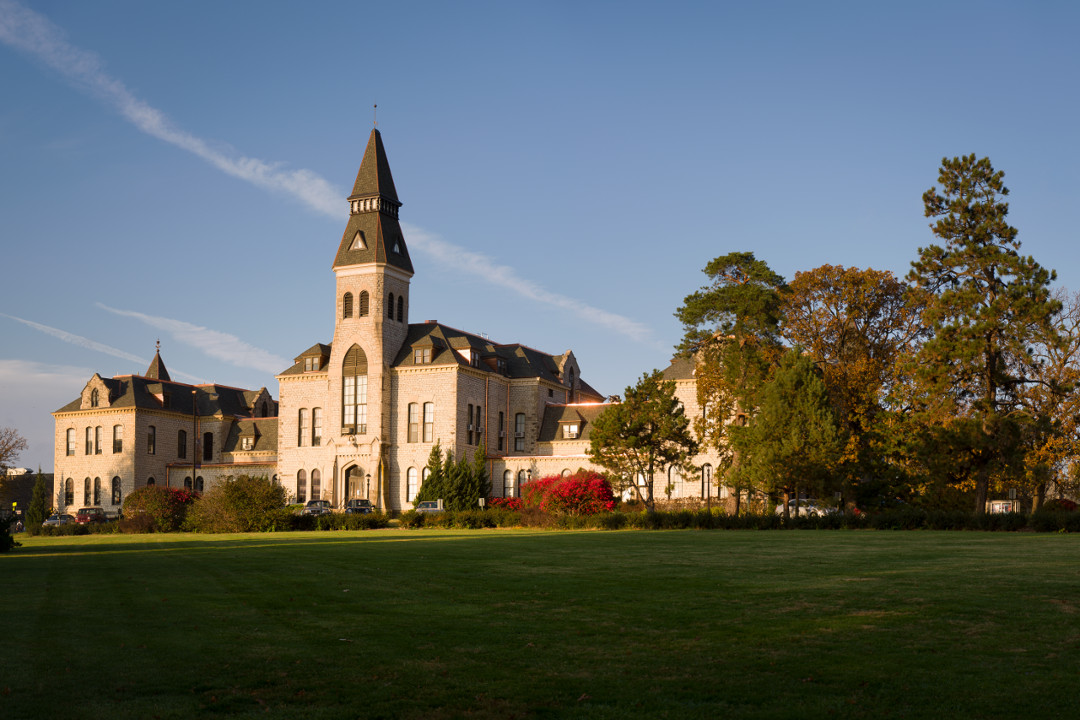
The mission of Kansas State University (K-State) as a comprehensive, research, land-grant institution is to foster excellent teaching, research, and service that develop a highly skilled and educated citizenry necessary to the well-being of Kansas, the nation, and the international community. Since its founding in 1863, the University has evolved into a modern institution of higher education, committed to quality programs, and responsive to a rapidly changing world and the aspirations of an increasingly diverse society. These responsibilities are addressed through an array of undergraduate and graduate degree programs, research and creative activities, and outreach and public service programs. In addition, its land-grant mandate, based on federal and state legislation, establishes a focus for its instructional, research, and extension activities, which is unique among the Regents' institutions.
Review of the selected degree programs each year facilitates the attainment of future goals and the development of relevant curricula to meet the needs of students, faculty, and the Kansas Board of Regents (KBOR). K-State's Program Review process incorporates the six criteria identified by the KBOR in its program review document and, beginning with the 2006 reports, includes a summary of activities and progress related to assessment of student learning in each degree program reviewed. Essentially, the K-State process is divided into two parts. The first part includes detailed reports from departments with information on their instructional and scholarly programs and service activities. The Office of Planning and Analysis provides the Statistical Overview data reports to departments to aid in the review and assists with any additional requests from the departments for data. These departmental reports are reviewed by the respective College Dean, the College Committee on Planning, the Graduate School Dean (for graduate programs), and the Provost. The reviewers make recommendations, and departments prepare a final detailed program review report (PRR). The second part of the process involves summarizing the detailed reports into two-page reports by degree program or discipline. Drafts of the PRR and the two-page summaries are provided to the Provost for review and comment. The reports on assessment of student learning come through a reporting and review process that begins at the department level, continues on through the College Dean's office or the Graduate School, and ends with the summaries created for this report by the Office of Assessment.
For the 2009 cycle, K-State reviewed a total of 32 degree programs in 16 disciplinary areas. The following disciplines were included:
The summary for each program is attached. Where possible, the summary reports for all degree programs within a given department were combined into a single page. The following provides a short review of significant highlights and recommendations for the departments and their related degree programs.
Of the 32 degree programs reviewed, eight are Ph.D.’s., 12 are master’s, and 12 are bachelor’s. On the whole, all of the degree programs are in strong and viable academic disciplines. Overall, each department and its academic programs provide options and opportunities for the advancement of education, research, and service for the state of Kansas, the nation, and the world.
All undergraduate engineering programs are accredited by ABET (Accreditation Board for Engineering and Technology). The Construction Science and Management program is accredited by the American Council for Construction Education (ACCE). The Computer Science undergraduate program was the first in Kansas to be accredited by the Computing Sciences Accreditation Board (C.S.A.B.), which is now a part of ABET. K-State engineering students who take the Fundamentals of Engineering exam have a pass rate of 88% compared to the national average of 75%. The college of engineering offers three B.S./M.S. concurrent programs and seven MS distance education programs.
The Architectural Engineering and Construction Science and Management programs are central to the university, college of engineering and the state because of the important role graduates play in their professional roles in society. The engineering and construction industry is the second largest private sector employer in the country; as such, there is a continuing and unsatisfied demand for graduates. The architectural engineering and construction science and management programs at Kansas State University produce graduates who are well prepared to enter the industry and make notable contributions early in their careers. The architectural engineering program provides a broad-based engineering education in building systems design. In addition, it is one of the largest of 17 ABET accredited Architectural Engineering programs in the nation and is a preferred source of entry-level engineers for consulting engineer firms. Construction Science and Management graduates are prepared to assume positions of leadership in the vital, ever-expanding construction industry. Construction spending totaled $1.16 trillion (8.4%of GDP) in 2007 and plays an even bigger role with the current Economic Stimulus investment in construction and infrastructure. Graduates possess both technical and managerial competencies as the curriculum combines studies in mathematics, engineering, and the basic sciences with studies in business and management methods as they apply to construction. Among construction programs in the United States, Kansas State’s is recognized as one of the very best and is in the top ten in terms of enrollment. The Architectural Engineering Master of Science program is viewed by students, alumni and industry constituents as one of the top three programs in the nation. The M.S. degree is viewed by engineering employers as “value added” in the profession, typically leading to premium salaries for entry-level engineers with graduate degrees in architectural engineering. A combined B.S./M.S. degree is offered in the Architectural Engineering program. This professional Master of Science degree challenges top students in Architectural Engineering with advanced opportunities in education and research experiences, faculty mentoring and advanced course work. The program allows a student the opportunity to specialize in an emphasis area of systems engineering applied to building design and analysis.
Kansas State University is the only university in Kansas that offers bachelor, master, and doctorate degree programs in Biological and Agricultural Engineering (BAE) or Biological Systems Engineering (BSE). The undergraduate degree program is the B.S. in BSE, which is a versatile program that offers environmental, machine systems, and biological engineering options. Biological systems engineers provide an essential link between the biological sciences and engineering, using physical and chemical science to solve practical problems. Engineering fundamentals are applied to achieve the goal of a safe and stable food and renewable energy supply while considering human and environmental factors. The secondary major in biological engineering became available to undergraduate students during the 2008-09 academic year. This program provides engineering students with a structured program from which they can pursue interests in biological engineering while obtaining the primary degree of their choice. At the graduate level, the department also supports an M.S. and a Ph.D. in BAE. In 2008-09, the concurrent B.S. in BSE/M.S. in BAE degree program became the newest addition to the Department’s offerings. The graduate programs are unique as they produce graduates who can apply engineering knowledge in the broad fields of the agricultural industry, natural resources and environmental protection, and processing of biological materials. Internationally, the BAE graduate programs have maintained a good reputation, especially in countries focused in the agricultural industry. The M.S. and Ph.D. students specialize in the areas of environmental engineering, bioprocessing engineering, information and electrical technology, machinery systems, natural resource engineering, and structures and environment. About 50% of M.S. graduates further their education by pursuing Ph.D. degrees at other institutions. Others find employment in business and industry, or work at universities. A majority of Ph.D. graduates (70%) take faculty positions at various universities. The others find employment business and industry, or government agencies.
As compared to other regional and more distant universities, the Chemical Engineering department has distinct strengths in the application of chemical engineering applied to biological and agricultural processes, and in materials sciences (semiconductors, graphene, and other electronic materials). The department has major initiatives in establishing research and education programs on sustainable energy and chemical, biological and radiological sensors at K-State. Chemical engineering, while one of the smaller engineering programs at most engineering schools, is one of the central engineering disciplines. There are just over 100 programs in the US. The centrality and diversity of chemical engineering is demonstrated by the fact that K-State’s graduates work in many different fields, and the faculty have extensive collaborations across the university. Of the Regents’ institutions, only Kansas State University and the University of Kansas provide B.S. degrees, with KSU having demonstrated expertise in materials science and engineering and bioprocessing. The B.S. graduates are in demand and command one of the (if not the) highest starting salaries of any undergraduate degree on-campus. Students have demonstrated the ability to enter top graduate and professional schools and are competitive for national fellowships. The M.S. and Ph.D. graduates are in demand from industry, government, and academia. Recent M.S. and Ph.D. graduates have taken positions in many prestigious universities, national laboratories, and industries. The Department has an extensive distance education program that allows students to earn a MS degree in chemical engineering while working in private industry. As of fall 2008, approximately 15 students were actively seeking their degrees via this program, roughly 80% of all M.S. students in the department.
The Civil Engineering curriculum is designed to be broad-based so that it serves the public needs in five areas: environmental, geotechnical, structural, transportation and materials, and water resources engineering. The graduate curriculum is equally well-balanced with a thorough focus on the individual’s specialty area. The primary education objectives are to produce graduates who will be able to apply the methodologies of current design practice with a sound understanding of basic scientific principles along with recognition of the impact of engineering practice in the social, economic, and political arenas. The M.S. and Ph.D. program attracts top students from all over the world including students graduating from K-State, as well as the best students from many other states in the USA. Engineering professionals from state agencies (such as KDOT) and top engineering firms (such as HNTB and many others) and mid-size and small consulting companies are populating K-State’s distance learning M.S. program. The number of distance learning graduate students has been steadily increasing over the years from slightly over a dozen to over 40. Outstanding international students are constantly joining the on-campus M.S. and Ph.D. programs and effectively contributing to research programs, grants, and contracts. At present, the supply of civil engineering students is far less than the employers’ demand at all levels – local, state, and national. The American Society of Civil Engineers (ASCE) has stepped up its efforts to attract public attention to this issue. With increasing public and government focus on civil/transportation infrastructure improvement in a clean and green environment, the demand for graduates is very likely to increase, which in turn will undoubtedly increase student enrollment. Employers from all over the country are seeking K-State’s civil engineering graduates who are well-known for their outstanding technical competencies as well as their high work and professional ethics.
The discipline of Computing and Information Systems consists of both a science and a technology that respond to societal, industrial, business, and government needs. Literally, every segment of the economy depends on knowledge of information processing techniques. Thus, there is a tremendous demand for graduates with knowledge of computer science, information systems, and software engineering. The Master of Science Degree program offered by the Computing and Information Science Department at Kansas State University has a broad-based curriculum designed to prepare students for advanced positions in the computing industry as well as for further academic studies. It is the largest masters program in the College of Engineering. Students graduating with the M.S. degree from K-State have been offered excellent job opportunities in regional (e.g., Sprint, Cerner and Garmin in Kansas City area) as well as multinational companies (Microsoft, Cisco and IBM). The M.S. program also provides an excellent theoretical foundation for students to continue into the Ph.D. program. This opportunity has enabled K-State to retain several of its M.S. graduates. The Master of Software Engineering degree (M.S.E.) enables students who have a computer science, computer engineering, or related engineering or science degree to learn software engineering technology and thus, be able to specify, design, implement, document, and maintain large software systems in their specialty areas. The M.S.E. degree is specifically coveted by students already working in the industry and has enabled K-State to attract distance learning students for re-training of the information technology workforce. In particular, this program has been very attractive for students from other disciplines who wish to apply computational methods to solve domain-specific problems. The Doctor of Philosophy Degree program is a research-oriented curriculum designed to prepare students for advanced research and University-level academic positions in the computing field. The program ensures that the students have breadth of knowledge (in various basic areas of computer science), skills to engage in scholarly activity, and have contributed towards the knowledge base in computer science. Students from the CIS Ph.D. program have been very successful in both academia and industry, and have earned national and international reputations.
The Electrical and Computer Engineering department provides very strong and unique experiences, especially in the areas of wireless communications, energy systems, and embedded systems with respect to other programs at K-State as well as programs across the State of Kansas. Employers of Electrical and Computer Engineering (ECE) graduates often cite K-State as a top location to recruit due to their strong applied background and capability to quickly contribute to their employer’s greatest needs. Undergraduate programs are offered in Electrical Engineering (EE) and Computer Engineering (CpE). Masters and Ph.D. programs are offered in Electrical Engineering. Two of the technical options of the M.S.E.E. program are offered to students via distance learning. The number of undergraduates in the program at Kansas State University is significantly higher than the corresponding programs at the other two Kansas institutions, and the quality of the graduates at K-State are often seen as the best in the region. As an example, Garmin Inc. has established scholarships for ECE students at many schools in the Midwest, but only Kansas State and the Missouri University of Science and Technology were selected to be premier schools for the scholarship programs. Graduates at both the M.S. and Ph.D. levels are highly sought by industry, research organizations, and other universities. The M.S. in electrical engineering is quickly becoming the standard degree that working engineers achieve in their career. The power systems distance option for the M.S. degree is one of the largest programs in the country with over 30 off-campus students enrolled in the key courses. Kansas State doctoral graduates serve as faculty members at a variety of universities throughout the country and world.
Each of the Industrial and Manufacturing Systems Engineering (IMSE) degrees is a derivative of the industrial engineering discipline. Industrial engineering (IE) is the field of engineering that is concerned with designing, analyzing and improving production systems. The discipline is critical to industry - both goods producers and service providers. Industrial engineers improve product and service quality, reduce costs, improve safety, and work to eliminate waste of all types: time, money, materials, and energy. There are more than one hundred ABET accredited industrial engineering programs in the U.S. Eight of the Big XII institutions have industrial engineering departments. In Kansas, the IMSE Department at K-State and the Industrial and Manufacturing Engineering Department at Wichita State University offer B.S., M.S. and Ph.D. degrees in Industrial Engineering. The concurrent B.S./MSIE program benefits B.S. undergraduate students by allowing them to begin an M.S. degree while still working on their undergraduate degree in IE. This is not a separate degree, but rather an alternative path to receive an M.S in IE. The K-State Masters of Operations Research (MSOR) degree program is unique in Kansas with only eight distance-based MSOR related programs in the nation. Furthermore, the MSOR degree program is unique in the nation in that the U.S. Army contracts with the department to provide the degree program to both civilian and military personnel. Both KU and WSU offer degree programs that are similar to the Masters of Engineering Management (MEM) degree program, but the K-State program is the only one focused on educating working professionals at a distance. This program is completely populated with part-time students who are taking courses while working full time. Consequently, the average time to graduation is more than three years. Graduates of the IMSE Department are employed in all types of goods-producing industries that include agriculture, manufacturing, and mining. They also are employed in service industries such as consulting, telecommunications, information services, health care, distribution and logistics, transportation, insurance, entertainment, food services, and retail.
The Mechanical Engineering program is recognized as one of the fundamental engineering curricula and is, by far, the largest Mechanical Engineering program in the KBOR system. The Nuclear Engineering undergraduate option within mechanical engineering and the Nuclear Engineering graduate programs offered by the department are the only nuclear engineering programs in Kansas and 10 states in the Midwest (Oklahoma, Arkansas, Colorado, Utah, Wyoming, Montana, Nebraska, South Dakota, North Dakota, and Iowa). In addition, the K-State TRIGA reactor facility just had its license renewed and its power upgraded to become the fourth most powerful research reactor of the remaining 24 university research reactors in the country. A student in mechanical engineering can focus on one of several high-profile areas, which include aircraft control, occupant thermal comfort, fracture mechanics, composite materials, pollutant emission reduction strategies, and building energy consumption. The mechanical engineering B.S. graduates are employed in a range of industries such as aerospace, automotive, power generation, petroleum production, mining, materials processing, agricultural machinery, construction machinery, robotics, military hardware, food processing, and environmental control. The department also has a distance M.S. in ME program with approximately 20 students admitted. Additionally, the department participates at a very high level in the Big 12 Engineering Consortium by teaching nuclear engineering classes that are taken by students throughout the Big 12 colleges. The nuclear option graduates find employment in nuclear power plant design, construction or operation, nuclear medicine and health physics, radiation detection and applications, and research at national laboratories. The MSME and Ph.D. graduates continue to be highly sought for academic and industry positions. In the last two years, most, if not all, graduate students completing their degrees had offers of employment prior to graduation. K-State has been fortunate to attract many of the best nuclear option undergraduates into the nuclear engineering graduate program by offering them employment in research and reactor laboratories while still undergraduates. Most of the graduate students have many publications before they graduate and the strong reputation of K-State’s nuclear engineering graduate program and its students attracted industry, government, and other universities to seek them out before they graduate.
The Agricultural Technology Management (ATM) program at K-State is the only program of its kind in the State of Kansas. Regionally, similar programs are available in Nebraska, Iowa, and Missouri. The ATM undergraduate degree program, administered through the College of Agriculture, is a versatile program that offers agriculture, engineering technology, and business management in a single degree program. The ATM undergraduate degree program is a nationally recognized program by the American Society of Agricultural and Biological Engineers (ASABE) and produces graduates who are equipped to manage people, machines, and technology. Along with the College of Agriculture, the Biological and Agricultural Engineering Department recognizes that technologically-trained people must understand the potential impacts of those technologies on the environment. As such, emphases on both natural resource protection and environmental control of agriculture have been developed to prepare individuals for careers requiring integration of science, engineering technology, and business to manage human and natural resources and systems for producing, processing and marketing food and other biological materials. Essentially, the ATM program produces technically trained graduates capable of operating and managing the complex systems utilized in agriculture, food, and fiber production systems.
The ABET accreditation process requires each undergraduate program in the College of Engineering to have an assessment process documenting that their undergraduates have achieved the educational objectives and program objectives stated by the accreditation agency. As a result, the College of Engineering implemented a similar assessment process throughout all undergraduate and graduate programs. The assessment process utilizes a variety of sources and multiple methods of obtaining data for each Student Learning Outcome (SLO). Depending on the assessment mechanism, data are collected each semester or on an annual basis to provide a broad base of information relative to performance and achievement of student learning. One SLO tool used is the Fundamentals of Engineering exam, which is administered nationally once each semester. As indirect assessments, senior surveys are administered at the end of the spring semester. Outcomes of assessments are summarized and discussed by the department faculty and the external advisory boards on an annual basis. As a result of student achievement on SLOs, courses have been redesigned to better meet student-learning needs. Due to modifications to the accreditation standards in 2007, several of the SLOs were modified in all programs.
As a result of the assessment process, the undergraduate and graduate programs identified and addressed program needs with respect to prerequisites, revisions in course offerings, and course content enhancements to meet needs of the current job market. Future plans include adopting an on-line assessment tool to streamline the assessment process and allow more time to analyze the results.
This review indicated that seven master’s programs had low enrollments and/or few degrees conferred, one doctorate program had a low number of degrees conferred, and one program did not meet the minimum for the number of instructional faculty with terminal degrees. Rationales for continuing each program are summarized below.
The five-year averages for the number of students enrolled and degrees conferred for the master’s degree program in Chemical Engineering fall below the KBOR criteria of 20 and five respectively. Although enrollment in the Chemical Engineering M.S. program may appear low, there is actually a strong demand for this program via the distance education program. For the past two years, the number of students seeking a M.S. degree via distance education is more than 12. Furthermore, since the courses must be offered anyway for Ph.D. candidates, it is little burden to also offer the classes to M.S. students. Thus, the Chemical Engineering masters program is an important contributor to the mission of the university, and it should be retained.
The total number of industrial and manufacturing engineering masters degree graduate students taught and graduated by the department as a whole far exceeds the KBOR minimum requirements When separated into master’s programs of Industrial Engineering (MSIE), Operations Research (MSOR), and Engineering Management (MEM), each individually fails to meet KBOR’s requirements of the five year average for enrollment (20 students) and/or degrees conferred (five graduates). Each of these degree programs is growing and is expected to exceed the KBOR standards within the next year or two. For instance, the MSIE program currently (December 2009) has 33 students. This increase in numbers allows the MSIE degree to meet all of KBOR’s minimum requirements for the five year period between 2005 and 2009 (an average of 22 enrolled and 10 graduated per year). Furthermore, a substantial amount of funds, approximately $350,000 per year, are generated for K-State through the distance-based MEM and MSOR degree programs. With no additional expenditures, the IMSE department has leveraged electives in order to better serve its constituents and also K-State. These benefits indicate all master’s IMSE programs should be retained.
The five-year averages for the number of students enrolled for the master’s degree programs in Biological and Agricultural Engineering (BAE) and Architectural Engineering (ARE) fail to meet KBOR’s criteria of 20. The BAE master’s program provides an alternative degree for graduate students who are recruited to the doctoral program but who decide to no longer pursue the Ph.D. Given that there are no additional costs or resources to offer the BAE M.S. program, we request that the BAE master’s program be retained. The number of M.S. ARE majors (5yr. average) reported to the KBOR should reflect 25 graduate students annually, instead of the six ARE majors reported. Since an undergraduate student in ARE applies for graduate school at the end of the 8th semester and may be accepted to the B.S./M.S. program at the beginning of the (9th semester) of the 5 year (10 semesters) program, these students were not included in the Fall 20th day enrollment figures. Selected advanced courses (15 credit hours) are taken for graduate credit during the 9th and 10th semesters with the final 15 credit hours of graduate courses taken in the extra 11th semester. So, at any point in time K-State averages 25 students in the ARE B.S./M.S. program which is spread over three semesters. The number of ARE master’s students (six students) reported on the KBOR minimum form certainly does not correlate with the number of master’s degrees granted (5 yr. Average of 19 students per year) and thus, the master’s program should be retained.
The five-year averages for the number of students enrolled and degrees conferred for the master’s degree program in Nuclear Engineering (NE) fall below the KBOR criteria of 20 and five respectively. In addition, the five year average for the number of degrees conferred in the doctorate degree program also fails to meet KBOR criteria of two degrees conferred. Although, KBOR is interested in the approved graduate programs, it is extremely important to increase the number of undergraduates in the Nuclear Option because increased graduate enrollments are partly driven by the number of undergraduates. By carefully designing a core undergraduate course that surveys nuclear science and technology, K-State has been very successful at increasing the undergraduate enrollment with about 50-60 Nuclear Option students a year – sufficient to be a major source for attracting students into the Nuclear Engineering graduate programs. In addition, the K-State Department of Mechanical and Nuclear Engineering has provided leadership to form a Big 12 Engineering Consortium among the Big 12 engineering colleges. The purpose of this consortium is to create an undergraduate outreach program offering distance-learning courses to undergraduate engineering students at the schools that do not have nuclear engineering programs, and thus increase the number of trained nuclear engineering undergraduates to enter the graduate program. With the recent surge in external funding (over $14M in extramural research funding has been received) to support graduate students, graduate enrollment has increased substantially and presently consists of 14 MS students and ten Ph.D. students. As would be expected, there is a lag time between an increasing graduate student enrollment and an increasing number of graduate degrees conferred. Within three years, K-State expects to reach an annual sustainable production rate of at least three M.S. and two Ph.D. degrees conferred. Based on the recent productivity and the expected greater productivity in the future, we strongly recommend that the NE programs be continued.
The majority of faculty in the department of Biological and Agricultural Engineering had funded appointments in the Agricultural Experiment Station, and for many the teaching portion of their appointment is the minority component of their funded position. Thus, this department did not meet the BOR minimum criterion for the number of faculty having a 50% or more instructional appointment in the department. However, these are full-time faculty working with the undergraduate and/or graduate programs on a daily basis, and the total number of faculty exceeds the BOR program minimums. Given that these faculty members are contributing to the instruction of both undergraduate and graduate students with limited instructional costs, we request that the minimum criterion for faculty be waived for this department.
At this point, all programs summarized in this document are funded to the extent necessary to support the programs in their present structure. In light of the budget issues at the state level and the current focus on efficiency, K-State is examining numerous ways to increase efficiencies, including consolidating or streamlining programs and departments. Given the budget cuts over the past few years and the uncertain environment in the future, we will continue to engage in such discussions. We feel our academic programs demonstrate high quality and view further cuts as a threat to the quality of our academic mission.