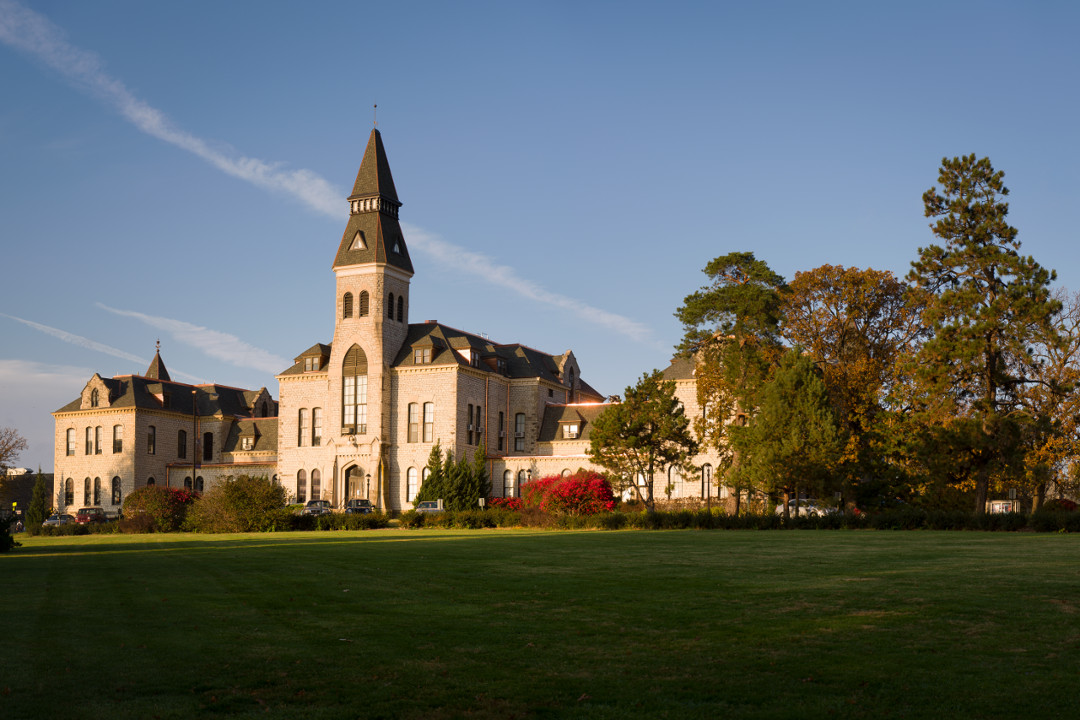
The mission of Kansas State University (K-State) as a comprehensive, research, land-grant institution is to foster excellent teaching, research, and service that develop a highly skilled and educated citizenry necessary to the well-being of Kansas, the nation, and the international community. Since its founding in 1863, the University has evolved into a modern institution of higher education, committed to quality programs, and responsive to a rapidly changing world and the aspirations of an increasingly diverse society. These responsibilities are addressed through an array of undergraduate and graduate degree programs, research and creative activities, and outreach and public service programs. In addition, its land-grant mandate, based on federal and state legislation, establishes a focus for its instructional, research, and extension activities, which is unique among the Regents’ institutions.
Review of the selected degree programs each year facilitates the attainment of future goals and the development of relevant curricula to meet the needs of students, faculty, and the Kansas Board of Regents (KBOR). K-State’s Program Review process incorporates the six criteria identified by the KBOR in their program review document and, beginning with the 2006 reports, includes a summary of activities and progress related to assessment of student learning in each degree program reviewed. Essentially, the K-State process is divided into two parts. The first part includes detailed reports from departments with information on their instructional and scholarly programs and service activities. The Office of Planning and Analysis provides the Statistical Overview data reports to departments to aid in the review and assists with any additional requests from the departments for data. These departmental reports are reviewed by the respective College Dean, the College Committee on Planning, the Graduate School Dean (for graduate programs), and the Provost. The reviewers make recommendations, and departments prepare a final detailed program review report (PRR). The second part of the process involves the Deans, who prepare the two-page summaries. Drafts of the PRR and the two-page summaries are provided to the Provost for review and comment. The reports on assessment of student learning come through a reporting and review process from the departments through the College Dean’s office or the Graduate School and are summarized in this report by the Office of Assessment.
For the 2007 cycle, K-State reviewed the academic degree programs within the College of Architecture, Planning and Design. In addition, two degree programs in the College of Agriculture and fourteen degree programs in the College of Arts and Sciences were reviewed. This included the following disciplines:
The summary for each program is attached. Where possible the summary reports for all degree programs within the department were combined into a single page. The following provides a short review of significant highlights and recommendations for the departments and their related degree programs.
The 11 programs reviewed this year were from nine academic departments and are, on the whole, strong and viable academic disciplines. Of the 23 degree programs offered, five are Ph.D.’s., ten are master’s, and eight are bachelor’s. Overall, each department and its academic programs provide options and opportunities for the advancement of education, research, and service for the state of Kansas, the nation, and the world.
The Department of Plant Pathology is the only such department in the state to manage crop diseases. Its mission is to understand and improve plant health by gathering fundamental knowledge about pathogens and diseases and applying that knowledge for disease management. With less than 2.0 FTE devoted to instruction, the major focus of this department is research and public service. Therefore, despite being one of the smaller departments in the College of Agriculture, the department ranked first in the college in extramural funding over the past 4 years (2003-2006, $4.2 million per year); 47% higher than the next highest department. Faculty work on applied aspects of controlling plant diseases as well as fundamental biological research. In addition, extension faculty members develop and communicate relevant research information to public and private clientele across the state.
This large emphasis on research translates into cutting-edge training for graduate students. Over 80% of the department’s graduate students are Ph.D. students (average of 24 students over the past five years). The limiting factor for the number of students in this program is availability of funding to support student work (about $25,000 per student). The department does not accept graduate students unless they are fully funded (mostly from grants) because the department expects them to devote 100% of their time to their graduate training. The department also offers M.S. training to a small number of students (average of seven students for the past five years), whose career goals (e.g. laboratory manager or county agent) do not require the extra training necessary for a Ph.D. As in most graduate-level programs, offering training at the Ph.D. level enables training at the M.S. level without additional resources. Overall, all recent graduates have been employed in an area closely allied to their degree program.
The College of Architecture, Planning and Design combines the related disciplines of architecture, interior architecture, landscape architecture, and regional and community planning, and it is one of the few such comprehensive colleges in the country. The departments are transitioning from offering the professional bachelor’s degree, to offering a professional master’s degree. The establishment of the master’s degrees as the first professional degree is on the cusp of a national transition to a higher requirement for professional practice. Essentially by 2011, all baccalaureate degrees in the college will have been replaced by non-baccalaureate master’s degrees. At the same time, the master’s of regional and community planning will become the non-baccalaureate master’s in regional and community planning. The post-professional Master of Architecture is becoming the Master of Science in Architecture. In 2007, the Master of Science in Community Development was established, which is a collaborative degree program through the Great Plains Interactive Distance Education Alliance (IDEA).
The college sponsors two events during each year to assist in employment for its graduating classes. The college hosts a Mock Interview event in the fall semester to prepare students for professional interviews when they seek a job the following spring. In the spring, the college hosts a DesignExpo event. Every student from the graduating classes of 2006 and 2007 has a job and the employment rate for graduates is 99% over the past five years.
The Department of Architecture challenges and enables its members and collaborators to surpass their own expectations as they advance the quality of built and natural environments. Through its nationally recognized expertise in energy conservation and sustainable architecture, the department provides research and leadership for the profession and Kansas communities on improved building design strategies that are less reliant on fossil fuel technology. The Bachelor’s of Architecture program has consistently been ranked among the top degree programs in the DesignIntelligence survey of architectural firms. With the 2006 rankings, it is the sixth time K-State’s architecture program has been ranked in the top 12 since 2000. The Bachelor of Architecture was reaccredited by the National Architectural Accrediting Board in 2005 for a full six-year term. Demand for the graduate degree in Architecture diminished after Sept. 11, 2001, as it became more difficult for international students to study in the United States. Demand has increased greatly as a new area of emphasis, Ecological and Sustainable Design, was added beginning Fall 2006. Those with the post-professional degree in architecture usually enter, or return to, architectural practice, with specialized knowledge. Some become faculty at schools of architecture, either in this country or their home country. Students have no difficulty in obtaining employment. In the future, the Master of Architecture and the Master of Science in Architecture should not compete for students since one is a professional program with students coming directly from high school and the other a post-professional program for students who already have a professional degree in architecture or in a related field.
The Department of Interior Architecture focuses upon two areas: interior space planning and design, and product and furniture design. The program attracts high achieving students from Kansas, Missouri, other Midwestern states, as well as from across the nation. In 2000, a survey of the top 500 design firms employing design professionals, ranked K-State’s Interior Architecture and Product Design graduates in the top three in the nation. The department has maintained top four or higher status in the survey over the last seven years and has been rated as high as number two.
Three degree programs are offered through the Department of Landscape Architecture and Regional & Community Planning. The department advocates the importance of the natural and built place within the larger context of public policy, and thereby focuses on visual, physical, ecological, economic opportunities and limitations encountered in rural and urban landscapes at both regional and local scales. The Design Futures Council is comprised of industry leaders and innovators. Each year they survey design professionals from around the country as to how they feel design schools are preparing students to enter their chosen profession. For 2007, Kansas State University’s Master of Landscape Architecture Program was ranked 2nd in the nation (it was 6th in 2006, and 8th in 2005). The Bachelor of Landscape Architecture Program was ranked 3rd in the nation (it was 5th in 2006). Currently, in the post-baccalaureate Master of Landscape Architecture (MLA) degree there are twenty-five students. The number of students the program can accommodate is based upon studio space and student/faculty ratios. Normally the department accepts ten post-baccalaureate MLA students each year. Employment growth for students with a degree in Regional and Community Planning will be driven by the need for state and local governments to provide public services such as regulation of commercial development, the environment, transportation, housing, and land use and development for an expanding population. Non-governmental initiatives dealing with historic preservation and redevelopment will provide additional openings. Graduates with a master’s degree from an accredited program will have an advantage in the job market. Most new jobs for urban and regional planners will be in local government, as planners will be needed to address an array of problems associated with population growth, especially in affluent, rapidly expanding communities.
The Chemistry Department can trace its lineage to the very earliest days of the university's existence. In 1873 the Department of Chemistry and Physics was established and Chemistry became a separate entity in 1885. Currently, the Department of Chemistry provides broad instruction to students in many curricula in various colleges through “service” courses. It interacts productively through collaborative research with many units, including Agronomy, Biochemistry, Biology, Grain Science, Physics, and Chemical Engineering. The department offers the B.S., M.S. and Ph.D. degrees in Chemistry. At the undergraduate level, a sub-curriculum, Chemical Science, is offered for students seeking a strong concentration in chemistry, often as a foundation for professional school degree programs. The B.S. program is accredited by the American Chemical Society. The undergraduate program is thriving as can be seen by its steady enrollment, by the placements of B.S. graduates, and by the many prestigious honors and awards received by students and faculty. Many of the B.S. graduates have chosen to attend graduate school and have been admitted to top-tier programs. At both the undergraduate and graduate levels, students have found excellent industrial positions in Kansas. The department offers a M.S. program which has less than KBOR required majors and degrees conferred. However, the degree serves an important need within the department without incurring any additional cost burden. Therefore, the department does not actively recruit students to it. Instead, their emphasis is on the PhD program. The department has seen steady enrollment growth in the Ph.D. program (48 in fall 2002 to 69 in fall 2006), to the point where it is one of the two largest programs in the College of Arts and Sciences.
The Department of Geology offers a bachelor’s degree (B.S. or B.A.) and a master’s degree (M.S.) in geology. At the bachelor’s degree level, graduates have a basic concept of all the natural sciences, and of the concept of ‘science’ in general. At the master’s degree level, students may specialize in areas such as geochemistry, geophysics, or geobiology, as well as ‘mainstream’ geology. At this level, graduates are fully prepared to apply their education to a career track, or go on for a higher degree. In general, it is understood that the bachelor’s degree is not a full preparation for a geology career, and that further study, or a professional training program will be needed. Basically, geology majors tend to have a high skill level in math and science, largely due to the perceived rigor inherent in the supporting courses (calculus, physics, and chemistry). In the past five years, approximately 40% of the graduates have obtained satisfactory employment in the geosciences, and 60% have entered graduate programs, here or at other universities. The master’s degree provides the advanced education needed for a successful career in geology, or for additional study toward the Ph.D. degree. Although most of the M.S. graduates accept career-track employment, many (7 of the past 18) of the recent graduates have enrolled at other universities
The mission of the Department of Mathematics through all its degree programs is to prepare students for careers in teaching and research, as well as for a variety of technical and administrative positions in industry and government in Kansas, the United States, and abroad. The department also plays a fundamental role in the university's mission via the delivery of a variety of service courses which are an integral part of virtually every degree program on campus. Mathematics is a central core discipline and at Kansas State four emphases are available for undergraduate majors: actuarial mathematics, applied mathematics, pre-graduate school emphasis for students planning to enter graduate school, and mathematics education. The department's emphasis on team research through the Center for the Integration of Undergraduate, Graduate, and Postdoctoral Research (I-Center) is unique among Regents' Universities. The I-Center administers an NSF supported Research Experience for Undergraduates, which has a national reputation for excellence. Essentially, the I-Center provides directed research experience for undergraduate majors as soon as possible and in an area of their choice. The graduate program offers training in many specialties in pure and applied mathematics, some of which are unique in the region. Specifically, the master’s degree program prepares graduates for high school and community college mathematics teaching and for a variety of technical and administrative careers in industry and government. The Ph.D. program is designed to educate mathematicians who intend to make research or teaching at the university level their career. In addition, the Ph.D. Program in Mathematics was initiated in the 1960s, and was for many years ranked by the American Mathematical Society as a group three program. However, the latest report in 1995 has elevated the Ph.D. Program to group two status – the only program in the state ranked this high.
The Department of Physics provides the undergraduate physics major with the skills he/she needs to contribute effectively in his/her chosen career. In its graduate education program the department produces a person confident of his/her ability to function as a professional physicist. The department also provides education for students in scientific, engineering, and other disciplines that require an understanding of both basic physics concepts and applications of physics. The quality of the teaching by the faculty in physics has been maintained despite large increases in the extramural research funding of the department. Faculty are engaged in teaching and are continuing to seek ways to make their teaching more effective. In fact, two faculty members have been honored with the highest teaching award given in the United States, the CASE/Carnegie Foundation for Teaching National Professor of the Year Award. Since this award began in 1981, only three universities – K-State, Rutgers and UC Berkeley – have had more than one recipient. The Department of Physics at K-State is the only one in the country in any academic discipline to have two recipients from the same department. Research experience as an undergraduate plays a major role in the education and training of the physics majors. Graduating students consistently comment that their research experience as an undergraduate was one of the most meaningful experiences as students at K-State. In addition to acceptance to prestigious graduate schools, the undergraduate research experience has been instrumental in many of the undergraduate students winning prestigious national fellowships. Approximately one-half of the BS graduates go on to post-graduate study. There are two areas by which students complete a M. S. degree in Physics: a) en route to PhD and b) as a terminal Masters. Since the core courses are the same as the PhD program, there is no extra cost or use of resources to continue offering the master’s program. Prior to fall 2006, the number of PhD students has been about 55 students annually. Starting in fall 2006 and continuing in fall 2007, the number of PhD students has been over 70, about a 32% increase. This enrollment includes about 20 female graduate students, about 18 domestic graduate students, and the remainder is international. In recent years, the department has made important progress in recruiting both domestic students and female students for the graduate program.
While other Kansas universities offer degrees in mathematics that have an emphasis on statistics, K-State is the only full Department of Statistics in the state of Kansas. Further, K-State’s statistics degree programs tend to put significantly more emphasis on the applied aspects of statistics than the other universities in the region. K-State’s department has a well-deserved reputation for training capable applied statisticians. The department offers bachelors, masters and doctoral degrees in statistics. Although the B.S. program is small, averaging three graduates per year over the last few years, the department devotes no resources exclusively to this program. Essentially, there is not a single course taught exclusively or primarily for undergraduate majors. The students who do finish B.S. degrees are well prepared for work or graduate study. The department has healthy programs at both the masters and doctoral levels. The degree requirements include a significant number of applied courses as well as mandatory consulting experience. The department is nationally and internationally known for its ability to train students at the M.S. and Ph.D. level who will become outstanding applied statisticians with strong consulting and communication skills. The program has strong components in both applied and theoretical courses, but the theoretical courses are always taught with an eye toward the application of that theory to real-world problems. There is a very high demand for students with M.S. degrees in statistics. A small percentage of MS graduates continue to the PhD program at K-State or at another university. The remainder is heavily recruited with nearly all finding jobs that value them for their ability to solve problems and quickly contribute to their employers’ work efforts. The job market for Ph.D. statisticians remains very strong in both industry and academia at the present time, and the forecast is that there will continue to be growth and demand for those who wish to pursue statistical careers in academia, federal, state, and local government agencies, nonprofit organizations, and a diverse group of industries.
This review indicated that three bachelor’s programs and seven master’s programs had low enrollments and/or low degrees conferred. Rationales for continuing each program are summarized below.
The master’s degree programs in plant pathology, chemistry and physics have average number of students enrolled and degrees conferred that fall far below the KBOR criteria of 20 and five respectively. All the programs are offered in conjunction with very strong doctorate programs within their respective departments. The master’s programs are offered with no additional resources. For most, the master’s program provides graduate students who are recruited to the doctorate program an alternative to at least complete a degree when the student decides to no longer pursue the doctorate program. A similar situation is true for the bachelor’s program in statistics in that no extra costs are associated with offering this program. The majority of the undergraduate courses are also offered as service courses to other programs within the university and 25 of the credit hours required for a B.S. degree in statistics are in courses numbered between 500 and 799. Given that there are no additional costs or resources to offer these programs, we request that the one bachelor’s program and the three master’s programs be retained.
The average number of students enrolled (26) in the master’s of Landscape Architecture exceeds the KBOR criteria of 20 students, but the average number of degrees conferred (4) is slightly under the KBOR criteria. In contrast, the average number of students enrolled in the master’s of Regional & Community Planning (17) and the master’s of Architecture (18) do not meet KBOR’s criteria, but the average number of degrees conferred (7 and 6 respectively) exceeds the KBOR criteria. The post-baccalaureate master’s programs in Architecture, Landscape Architecture and Regional and Community Planning will soon transition into the professional master’s programs. Therefore, we recommend that these programs be excluded from any further review.
The average number of students enrolled (23) and average number of degrees conferred (5) for the Physics bachelor’s degree does not meet the KBOR’s criteria of 25 junior and senior students and 10 degrees conferred. One of the department’s seven-year goals is to attempt to substantially increase the numbers of students earning bachelor’s degrees in physics. In order to achieve this goal, the department must consciously widen its appeal to students by doing a better job of convincing students that a physics graduate can do many things besides go to graduate school. The department plans to contact all Kansas high school science teachers and ask for their help in this matter. In addition, the GROW conference held at K-State for middle school aged girls interested in engineering and science may also encourage enrollment in the undergraduate program. The bachelor’s degree program is recommended for continuation; it will be monitored over the next three years to consider any changes in enrollment and time to degree.
Both the bachelor’s and master’s programs in Geology are not meeting KBOR’s criteria for average number of students enrolled and average number of degrees conferred. For the bachelor’s program, the average number of students enrolled is 21 juniors and seniors with 12 who are freshmen and sophomores. The master’s program only has an average of 14 students. The average number of degrees conferred follows this trend, with an average of five for the bachelor’s degree and four for the master’s degree. Unfortunately, in the past three years, the department has lost about half of its faculty due to retirements and other career opportunities. These departures have left the department with almost no funded research, and therefore, no funding for graduate students. By 2010, the department should be back to full strength, which should infuse new ideas, new research, new students, and more funding for graduate research assistants. The department also wants to attract more students to the program as freshmen. The department plans to develop advertising campaigns, visit high schools and notify high school students of the scholarship opportunities for entering freshmen. With the influx of new faculty, strong possibilities of research funding and providing graduate study in areas with the greatest demand (petroleum geology, hydrology, applied geophysics, and earth science education), we recommend that both the bachelor’s and master’s programs be continued with monitoring over the next three years to consider any changes in enrollment.
Our approach to assessment of student learning is focused on continuous improvement and is an on-going process that involves the following steps:
In the assessment section of their program reviews, degree programs have summarized the assessment measures for selected SLOs, results, and actions taken in response. The following is a brief synopsis of these aspects of the assessment reports.
Programs selected between two and five SLOs to measure in their first three-year assessment plans. These SLOs were, in general, focused on foundational skills for the major discipline:
Direct measures:
Indirect measures:
As faculty in degree programs have begun to compare student performance to baselines and minimum standards, they have made some observations and taken preliminary steps to address some opportunities and challenges:
Given the nature of these changes, the university will not see significant shifts in positions or other direct resources. However, various new strategies for improving enrollment and degrees conferred will be monitored.