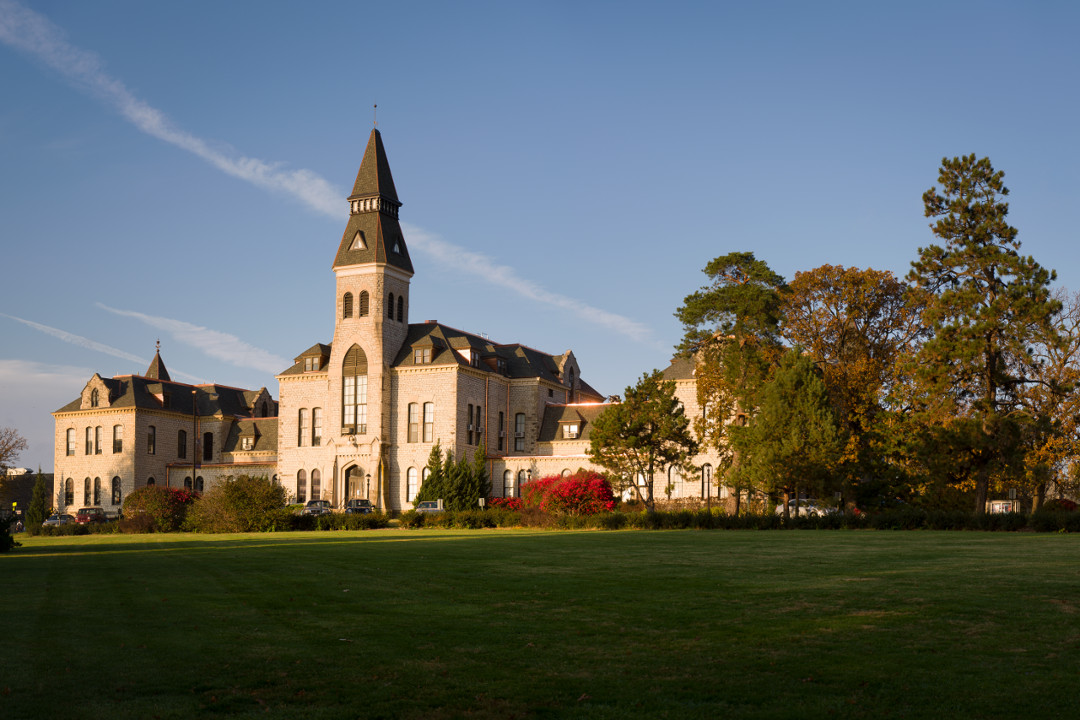
The Department is comprised of three components: counselor education, educational psychology, and college student personnel services. The disciplines share a mission of preparing knowledgeable, ethical, caring decision-makers. Essential undergraduate instruction is offered in educational psychology and interpersonal relations, which are courses required for teacher certification in Kansas and most other states. At the graduate level, the Department offers one of only two CACREP- certified school counseling specializations in the state, and its Ph.D. specialization in counselor education and supervision is the only CACREP-approved program in Kansas. The master’s level sub-specialization in college student personnel work is one of only three programs in the state, and one of just 74 in the nation that meets standards of the American College Personnel Association (ACPA). Finally, the Ph.D. specialization in student affairs in higher education, one of just 43 in the nation, is the only doctoral program in Kansas emphasizing student affairs. Because of failure to meet Board of Regents (BOR) standards, faculty members have decided to discontinue the Ed.D. in Educational Psychology.This will enable the Department to focus exclusively on preparing school counselors, counselor educators, and college student personnel professionals.
Quality of Faculty
Quality teaching is the highest faculty priority. Several faculty members have past experiences as school counselors, and they remain connected with the field through their consulting activities. A number of individuals have received teaching and service awards; others have received national recognition for groundbreaking research on college-student mental health. In FY03, four of the seven full-time faculty members served as consultants on federal and/or state grants, and all faculty continue to conduct research on topics related to their respective disciplines. Since 1996, faculty have served on editorial boards, state and national committees, and in state and national professional organizations; they have consulted on federal and state grant projects, participated in faculty governance, served on student committees, consulted with schools and community agencies, conducted workshops, and presented numerous papers at professional conferences.
Quality of Students
The quality of students tends to be high. Master’s degree students typically are not admitted with less than a B average in undergraduate work from an accredited college or university, and a GRE or MAT score at or above the mean of those taking the test who enter the field of education. Doctoral students are screened rigorously by all faculty members on the criteria of performance at the master’s level, GRE scores, three references, and a written statement of objectives. Students admitted typically have demonstrated superior prior academic performance; GRE scores at or above the mean of those taking the test who enter the field of education; strongly supportive references verifying high levels of ability in teaching, research, and interpersonal skills; and a targeted statement of objectives fitting the purposes of the graduate program for which the prospective student has applied.
Employer Demand
There is currently a shortage of school counselors, both nationally and in the state of Kansas. The job market for graduates is good as long as students are willing to be flexible and adaptable to changing market conditions. The increasingly complex array of societal and individual problems ensures the demand for school counselors will remain high. In fact, the shortage of school counselors has reached the level that the universities in the state cannot provide sufficient candidates to meet the demands. Employment opportunities at the doctoral level are also available. A number of students are currently employed in jobs they retain upon graduation. At the university level, faculty members who currently prepare counselors are aging, and a significant number of openings are appearing, particularly for the preparation of school counselors.
Service Provided to the Discipline, the University, and Beyond
The faculty members provide several crucial services. In the fall of 2002, the Department generated 2,268 student credit hours (SCH) at the graduate level and 3,887 at the undergraduate level. These totals accounted for 22% of the total SCH generated in the College. CEP faculty members are productive in teaching, with loads averaging three courses per semester and student ratings consistently being high. They are extensively involved in coordinating College and University activities, serving on over 40 University and College committees related to governance and directed service. Most have high profile roles in state, regional, and national professional organizations. In keeping with the land-grant mission of Kansas State University, faculty members have a long and distinguished history of responding to the needs of practicing school counselors in Kansas. They have consulted with program graduates employed as school counselors, worked with counseling staff in local schools, evaluated public school counseling programs, presented at state professional counseling conventions, and held offices in state organizations.
Cost Effectiveness
From 1998 to 2002, the Department’s general use expenditures as a percent of the University’s general use instructional expenditures has averaged approximately 1% annually. Across that same time period, the Department’s SCH production as a percent of the University’s total graduate SCH production has averaged around 3.4%. In addition, the Department has accounted for approximately 1% of the University’s total undergraduate SCH production. This represents a good return on investment. Total SCH within the Department has increased by 10% since 1998. Amazingly, this increase occurred within the context of a 12.5% decrease in faculty headcount and a 6% decrease in Department general use expenditures. Because the faculty have decided to discontinue the Ed.D. in Educational Psychology, they will be more effective in devoting time and resources to students in counseling and student personnel services. Faculty in Counseling and Educational Psychology certainly play their role in helping to make Kansas State University “one of America’s 100 best college buys.”