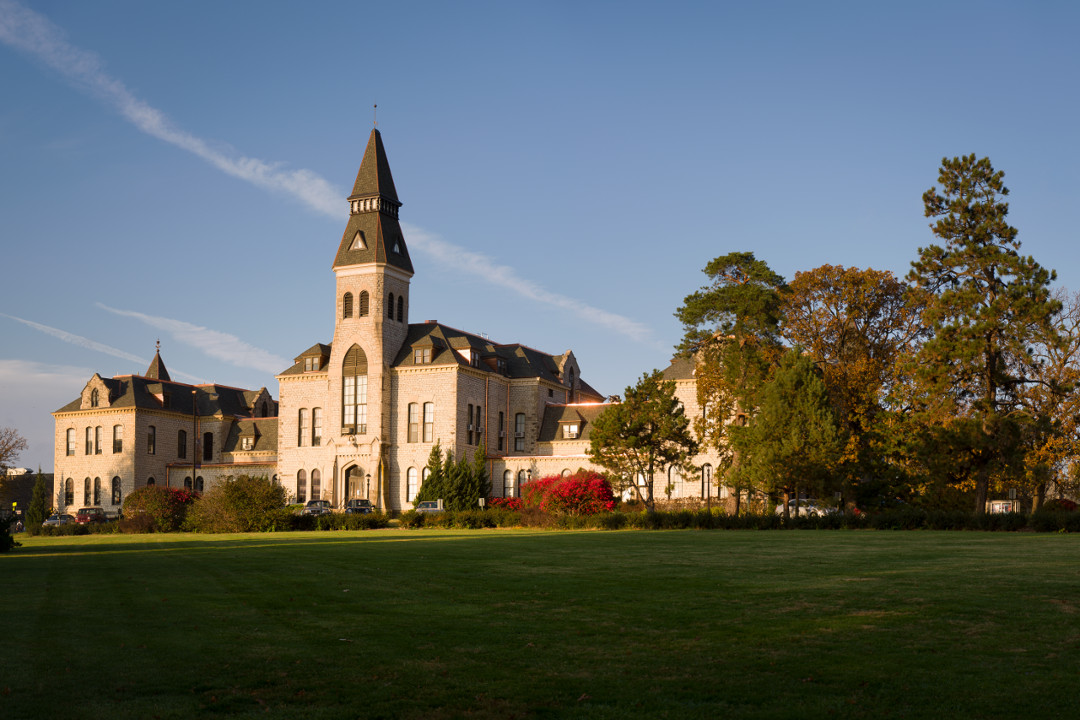
Mission. The Department of Secondary Education is committed to addressing the needs of a broadly divergent set of constituencies. A primary responsibility, as a major component of one of the oldest and strongest land-grant universities in the nation, is providing quality instruction and clinical supervision in both on-campus and field-based settings. Examination of programs, students’ skills and understandings, and the reactions of those institutions that employ secondary education graduates, highlights success in adhering to a major program goal: Developing educators who are knowledgeable, ethical, caring decision-makers.
Centrality. Preparation, inservice, and advanced instruction of secondary teachers in Kansas has been a role of the university for most of its history. The secondary education program contributes to the economic development of the State of Kansas by preparing human capital in the form of secondary school teachers.
Uniqueness. With respect to the college and university, the department is responsible for ensuring that state standards for teacher licensure are addressed and met by candidates seeking secondary level teacher licensures from K-State. Department faculty work closely with colleagues in respective colleges to ensure that academic majors meet rigorous national and Kansas State Board of Education standards. Kansas State University’s land grant mission enhances the uniqueness of the institution in offering teacher licensure in academic majors not duplicated elsewhere in the Regent’s System. One program, Agricultural Education, is not offered elsewhere in the State of Kansas; another, Family & Consumer Sciences, is one of two programs in a Regent’s school. Other programs such as science (e.g., biological, chemistry, earth/space, and physics) and mathematics, while not unique in the Regent’s System, are traditional strengths associated with the land grant mission.
Quality of Faculty
Full-time faculty, responsible for course work leading to both the baccalaureate degree and accompanying teacher licensure, generally hold appropriate terminal degrees (91% possess a doctorate). Each faculty member, in addition, is a specialist in disciplines of study for which they prepare candidates for eventual licensure (e.g., English, mathematics, science, etc). The Kansas State Department of Education and Kansas State Board of Education unconditionally approve all programs leading to licensure through the year 2007. The National Council for the Accreditation of Teacher Education (NCATE) nationally accredits secondary education.
Quality of Students
All students complete two years of study in general education course work outside the College of Education prior to formal admission to the college, students must possess a 2.5 overall GPA, 2.5 GPA in the discipline in which they intend to seek licensure. Students matriculating in the K-State teacher preparatory program possess an average ACT score (1998-2002) of 25.1. For students admitted to the M. S. in Secondary Education, their undergraduate grade point average can be seen as a measure of student quality. The overall grade point average of students admitted in FY 02 is 3.28.
Employer Demand
Demand for graduates in secondary education is high both on the state and national levels. With the exception of social studies, there are currently teacher shortages statewide in all secondary teaching fields offered at Kansas State University. The number of secondary school teachers expected to retire in the next decade will, on a percentage basis, be greater than it has been in half a century. Thus, the current shortage of teachers will be exacerbated. Kansas State University is therefore, well positioned to contribute quality graduates to the teacher workforce.
Service Provided to the Discipline, the University, and Beyond
The Department of Secondary Education is heavily involved in national, regional, state, and local service to both educational institutions/agencies (i.e., local schools, regional consortia, state department agencies) and in areas of specialization represented by faculty members in the department. Consistent with the K-State land grant mission, department faculty members have virtually daily contact with constituencies throughout the state and nation in ways that provide on-going visibility for the department and university. Examples include: service on local school advisory committees; providing testimony to local school boards; assisting local districts with curriculum mapping, school improvement plan goals, and accreditation reviews; serving on state level review teams; journal editorships, editorial and other scholarly board service; presentations to national, regional, or local audiences; providing technical reports for state agencies and other advocacy groups. Similarly, service to the university and college is provided by department faculty through such activities as participation in formal faculty governance, committees and service functions required to effectively and efficiently carry out the functions of a comprehensive university.
Cost Effectiveness
The land grant mission of K-State is reflected by the department; it is the only state institution to graduate Agricultural Education majors, one of two to graduate Family & Consumer Sciences Education majors, and it is specifically positioned to integrate applied sciences. Student credit hour (SCH) production declined by 6.7% during this five year period; however, this figure is offset by a corresponding loss of 8.3% instructional FTE and a 16.9% loss of OOE. These facts are consistent with a modest decline in the number of secondary education majors over the same period. Nonetheless, given the current and impending teacher shortages to be faced in virtually every discipline represented in secondary education, the unit is vital to the interests of K-State and the State of Kansas. The 2003 consolidation of the M.S. in Secondary Education and the M.S. in Elementary Education into one degree - the M. S. in curriculum and Instruction will have some impact on overall program cost effectiveness.