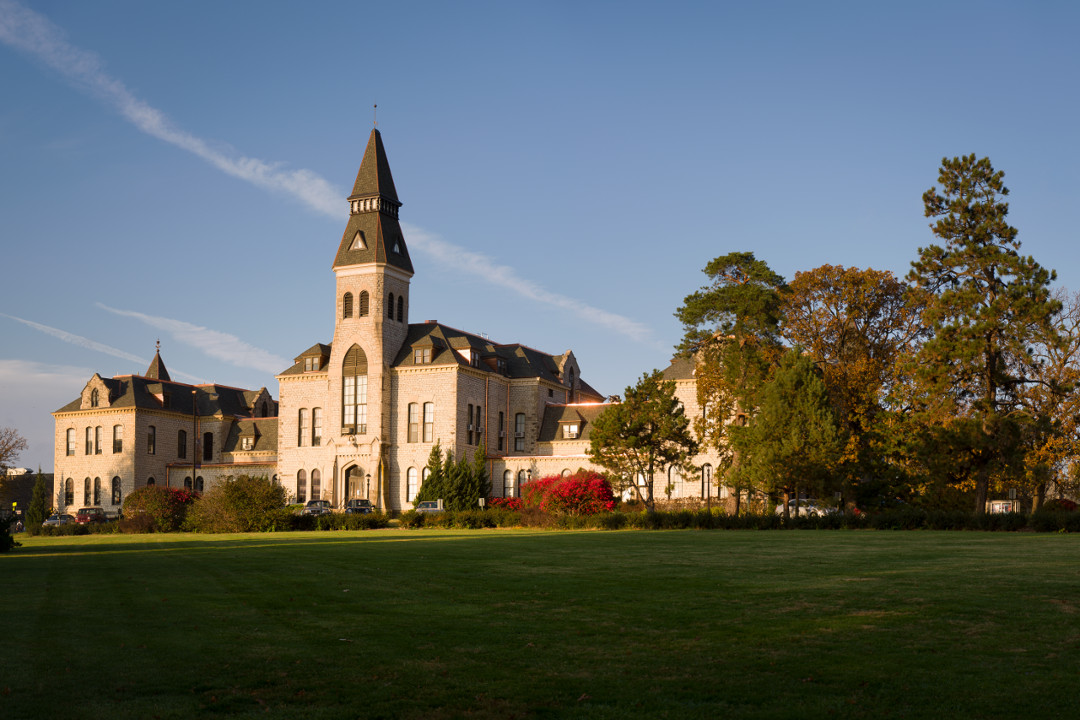
As a fully accredited member of the National Association of Schools of Art and Design, Art Department degree programs exceed NASAD requirements. A further effort to enhance program offerings grew out of recognizing the importance of matching individual student aptitudes to curricular choices. The result was the creation and implementation of a new Concentration Admission Procedure. Evaluating student accomplishments upon completion of foundation studies has assured better placement into an area of concentration and continued assessment of programs. An additional outcome of the new Concentration Admission Procedure was the complete revision of the Department’s foundation core. Approval of a new curriculum ultimately replaced a bulky and inefficient course sequence, assuring student completion of basic requirements before entering a major area of study. The Art Department offers students a curriculum of courses designed to prepare them for various careers in the visual arts. Common to all artists/designers, is a need to function not only creatively, but philosophically, and historically through appropriate communication. Curricula in the visual arts prepare students to “read” the non-verbal language of art. They develop responses to visual phenomena, and organize perceptions and conceptualizations. Students study major historical achievements, including the works and intentions of leading artists in the past and present. The goal is to create an understanding and ability to evaluate contemporary thinking about art or design, and to make valid assessments of quality in design projects and works of art.
The Art Department continues to record dramatic growth in numbers of majors. Revision and updating of curriculum and procedures to manage this growth have been instituted to help assure the likelihood of success among those students selecting Art as a career. Of 65 academic units within Kansas State University, Art is listed among the ten most sought after areas of study. In the College of Arts and Sciences, Digital Imaging ranks at or near the top as an area of interest among entering Freshman. Students graduating with degrees in Visual Communications move directly into careers as designers, and placement continues to be good. Web design, electronic imaging and animation represent the cutting edge of employment opportunities. Portfolio preparation reviewed by professionals in the design field support continued successful placement of students in graphic design related fields. In studio areas, students seek careers in gallery and art center employment, combine creative study with K-12 certification, and prepare for an Art Therapy occupation. On average, 25 Pre Art Therapy students seeking opportunity for study in M.A. programs are successful in their application efforts, as are studio art students choosing to study toward a terminal M.F.A. degree. The Master of Fine Arts degree is required for artist/teachers in higher education, and current employment opportunities are good due to the unusually high number of faculty retirements occurring now and expected to continue on into the future. The Department provides vital services to other departments. Students from disciplines such as: Interior Architecture in the College of Architecture, Clothing, Textiles and Interior Design in Human Ecology, and the College of Education utilize course offerings in the Department. University General Education opportunities are provided by the Department in large lecture formats such as in Survey of Art History courses, as well as in introductory studio formats, particularly well suited to providing active learning content basic to UGE expectations. The experiential context and the ability of connecting ideas across disciplines, also basic to UGE requirements, are fulfilled by the content of Department course offerings.
The Department provides on average 85 sections of instruction, generating approximately 4,290 credit hours each semester. This level of performance is accomplished with an OOE budget of $54,000.00, GTA support of $82,000.00, faculty salaries totaling $1,244,887.00, and department administrative salaries totaling $61,615.00. The majority of courses occur in a studio environment resulting in sections often limited to 18 students or less. The Department’s credit hours are produced each semester in spite of four ongoing faculty vacancies and the inability to fill retirements occurring this current year. Instructional demands are met with twenty-one full time tenure track positions, two temporary instructors, and 26 individual graduate teaching assistants. Department studio and visual communications faculty teach three courses per semester (18 contact hours), along with an average of 15% of time dedicated to service and 40% assigned to required research. Each semester the Department faculty course load is beyond that of the national norm.
The curriculum leading to a bachelor’s or master’s degree in music, indeed, all of the activities of the Department of Music, in concrete ways, upholds the commitment to the mission by seeking to create optimum conditions for the educational and professional development of both music students and faculty. The academic degrees offered by the Department of Music are unique to the College and University. While the degrees are neither unique to the offerings of other Board of Regents institutions in the State, nor the Region, the educational experience students receive at K-State is entirely unique. Since much of the music major’s education is measured in terms of his or her experiences with applied teachers (one-on-one instruction) and in ensembles, working with the highly distinguished faculty of K-State both in the applied studio and in the classroom is one of the strengths of the program that is entirely unique.
The employment opportunities for any person completing a degree in music performance is determined only in part by performing ability. Determination, creativity, marketing, timing, and luck are also factors that often come into play with determining the employment demand for a person with a degree in music. Besides the traditional careers in music performance and teaching, many options are available to music graduates. Careful coordination of non-music courses with the requirements of a music degree can lead to entry into the music industry (music publishing, instrument and equipment merchandising, advertising, recording, electronic music, computer graphics, etc.). Graduates in the arts are often sought by companies for training in personnel management. More and more students are using their interest in and love of music to earn music degrees that serve as pre-professional programs for entry into medical, dentistry, law, divinity, or other professional schools. The success of our graduates in finding gainful and important employment or using their musical training as a leading point to graduate education experiences is considerable. There is a dire shortage of qualified, certified teachers for the public school systems of Kansas and surrounding states. The placement rate for the undergraduate receiving a degree and certification in music education has been at or near 100% for a number of years. Especially compelling, however, is that the students from K-State who complete degrees in music education are very much in demand in the region because they are recognized statewide as being the product of an excellent program in teacher education.
The nature of one-on-one instruction inherent in the successful teaching of music students precludes a wide profit margin in the ratio of number of SCHs generated to the cost of faculty time. In order to provide the necessary courses to support a major in music, there is a certain threshold of sheer number of faculty specialists under which an institution may not go without seriously compromising the quality of the offerings. While the number of majors who earn degrees with an emphasis on performance may not meet the minimum numbers of graduates expected by the Board of Regents, the cost of maintaining a faculty in support of all of the music programs at K-State (music education and music) is the same regardless of which music degree students choose to pursue. More importantly, the entire experience for students studying music - as majors, minors, non-majors, or even as listeners - is significantly upgraded because the Department of Music at K-State is able to attract and successfully train some students who choose to pursue degrees in music other than music education. Performance majors raise the quality of all performances produced by the department. The more trained and qualified specialists a music program has, the better the output, but the more expensive the burden to the institution. The Department of Music at K-State - in terms of the quality of its faculty and the output of program - is highly effective. The music class instruction is handled almost exclusively by faculty members who also specialize on one or more instruments and teach in the classroom. To offset the cost of supporting the program, the Department offers a number of general education classes to the university as well as at least one key support class for the elementary education curriculum (MUS 405: Music for Elementary Teachers). All in all, the significant contribution of music to the university, community, and beyond cannot be measured.
Several indicators are used to assess curriculum quality. In 2001, the average ACT score of students majoring in speech communication was 24 and in 2002, the average ACT was 25.5. Exit interviews and a rigorous capstone research experience are also used to assess quality of students. The quality of the degree can also be seen through the work of the graduates. Most of the graduates take their degree and go into the business world - e.g., sales, human resource development, management trainee programs. The graduates are also successfully entering graduate degree programs in speech communication and law. Still other graduates go into public education.
The M.A. in Speech Communication is positively valued. Many graduate students come to K-State specifically to receive an M.A. in Speech Communication and receive training in coaching collegiate forensics and debate. The M.A. graduates are now coaching at colleges and universities literally around the country. Other M.A. graduates have entered law schools and have been quite successful. Other graduates have completed their M.A. and gone into business. Still other graduate students have taken significant positions in politics - one with the Clinton White House, one with Senator Sam Brownback, one with Congressman Dennis Moore, one with Governor Bill Graves and one with Governor-elect Sebelius, and others with a variety of political interest groups. Theatre: The MA graduates with a theatre track have gone on to MFA or PhD programs and have been hired by college and university programs. Many of the drama therapy students have taken therapy positions in various health care institutions.
During the five-year period from 1998-2002, junior/senior enrollment in the undergraduate major has averaged 24 students, ranging from 21 to 28 per year. During this same time period, the major has conferred an average of six BA/BS degrees per year. The Department is concerned about these numbers and faculty are currently engaged in strategic planning process to determine strategies for increasing undergraduate manors and graduating those majors. There are substantial employment opportunities for speech majors. The best job opportunity is teaching and coaching high school debate and forensics. Public schools around the state and country struggle to find coaches with proper training and experience. Private business, law schools, and politics also provide employment opportunities for graduates with effective communication knowledge and training.
There is a significant demand for the M.A. in Speech Communication. Typically the Department has between 15 and 20 students enrolled in this program. Students desire the opportunity to study speech communication, have the opportunity to be in charge of their own public speaking classroom, and have the opportunity to coach forensics and debate at one of the premiere competitive speech programs in the country. Nearly all of the M.A. students are able to find employment following graduation. Because of the success of the competitive speech and debate teams, the M.A. graduates are highly sought. Most junior colleges, colleges, and universities also require students to take some form of communication class. Thus, there are many job opportunities for M.A. students to teach communication classes at the college and university level. As with the B.A./B.S. degree, private business and politics provide employment opportunities for M.A, graduates with effective communication knowledge and training. Theatre: Typically, between 10-15 MA students are enrolled in the theatre track. Since adding the Drama Therapy to the MA course offerings, however, there has been an increase in applications to the theatre focus. In fact, the majority of the theatre-track students are now Drama Therapy students. College and university teaching offer job opportunities. Professional theatre also offers opportunities. There is significant demand for Drama Therapy students in health care, social service, and the therapeutic positions.
The Department of Communication Studies, Theatre and Dance is comprised of 20 full-time, tenure track faculty. The department has 7.8 faculty FTE dedicated to teaching activities. Because of the nature of courses taught in this major (public speaking, small group, interpersonal communications), large lecture courses are not pedagogically sound. Still, the cost of delivering education in speech communication has decreased as percentage of overall university costs during the last five years. Further, 80% of the lower division courses are taught by GTAs and temporary instructors and thereby holding down instructional costs.
The dramatic arts play a central role at K-State and in the state. Theatre and dance courses fulfill the College of Arts and Sciences distribution requirements and the university’s general education requirements. Theatre and dance faculty also provide outreach to the community and the state. Besides providing a focal point for cultural expression on campus and in the surrounding community, the drama therapy faculty are assisting therapeutic services around the community and state. The theatre and dance faculty also provide creative and technical assistance for local and regional theatres and dance companies and studios.
The dramatic arts degree uses several indicators to assess curriculum quality. Exit interviews and performance assessment of undergraduates are used. In 2001 and 2002 the average ACT score for undergraduate majors was 24. Quality of the B.A./B.S. can also be seen in students’ career paths following graduation. Many graduates have successfully used their theatre degree to take the next step in their professional and personal lives. Following graduation, some of the graduates have entered graduate theatre programs. Others have gone to New York, Los Angeles, Chicago or Kansas City to work in professional theatre. Still other graduates have gone into public school teaching. Many of the graduates use their undergraduate degree to fulfill a lifelong interest and achieve a casual participation in theatre as they take employment positions outside of professional theatre.
This major has averaged 44 juniors and seniors between 1997 and 2001 and has graduated an average of 10 students per year during the same time period. Each year about 10 students are enrolled in theatre with a dance track emphasis. The theatre degree offers liberal arts training in theatre. The degree seeks to prepare students for advanced professional training or graduate school and seeks to provide basic theatre skills for the bachelor’s candidate. While there is no clear job track for students graduating with a theatre degree, students are successful in obtaining jobs in professional theatre, either as actors, technicians, or stage managers. Public education also offers substantial employment opportunities for theatre/dance graduates.