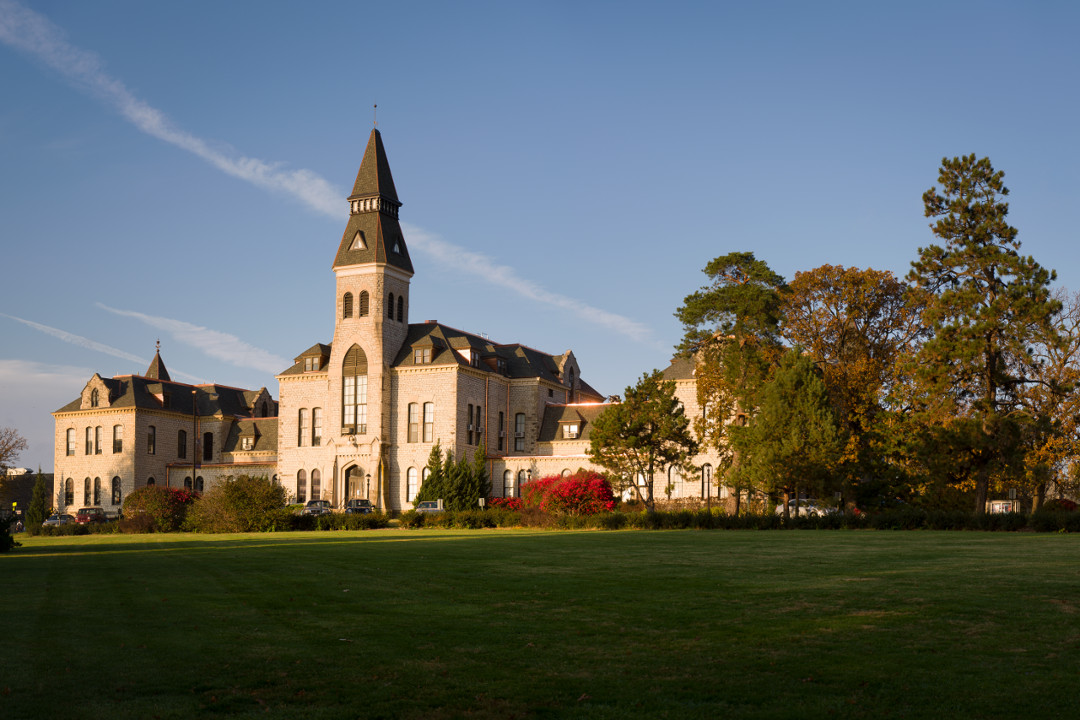
The architectural engineering and construction science and management programs are central to the university, College of Engineering, and the state because of the important role graduates play in their professional roles in society. The engineering and construction industry is the second largest private sector employer in the country and, as such, there is a continuing and unsatisfied demand for graduates. The architectural engineering and construction science and management programs at Kansas State University produce graduates that are well prepared to enter the industry and make notable contributions early in their careers. It is the largest department in the College of Engineering. Fall 2000 enrollment in the Department of Architectural Engineering and Construction Science accounted for 18% of the enrollment increase at the university and over 75% of the enrollment increase in the College of Engineering. The department maintains an active involvement with the engineering and construction industry in Kansas, and on a national and international scale.
Curriculum Quality
The
Department of Architectural Engineering and Construction Science
is nationally recognized for the quality of its programs.
More than 300 students currently are enrolled in the five-year
architectural engineering program, one of 13 programs accredited
nationally by the Accreditation Board for Engineering and
Technology (ABET). This program attracts highly qualified
students from across the nation with an average ACT composite
of 27.2. The pass rate for fourth and fifth year students
taking the Fundamentals of Engineering exam is approximately
85%, compared to the national average of 73%. More than 300
students are currently pursuing a degree in construction science
and management, one of 40 programs accredited nationally by
the American Council for Construction Education (ACCE). This
program attracts highly qualified students, with an average
ACT composite of 22.6, from across the nation.
The
architectural engineering program is planned for students
particularly interested in the engineering aspects of building
design. The educational objective of the five-year architectural
engineering program is to prepare the student with fundamental
engineering competence in the analysis and design of buildings
and their systems. Specifically, the student must be able
to understand and apply engineering fundamentals and design
principles for engineering the infrastructure of architecture-that
infrastructure being structural, mechanical, and electrical
building systems and all sub-disciplines related to these
primary designations. A number of Master's degree candidates
in architectural engineering are enrolled in the B.S./M.S.
program, but are shown as B.S. majors only. There are approximately
13 candidates in the program a year. The department has held
the number of candidates to 13 since commonly there is a 100%
graduation rate. In addition, the number of M.S. degrees conferred
has averaged over 10 in the last four years.
The
construction science and management program prepares students
to be professional constructors, and managers of personnel
resources, financial resources, materials, and machines. The
curriculum is an engineering-based management program designed
to produce technically competent managers of construction.
The program prepares graduates to execute the designs created
by engineers and architects. Graduates may enter fields of
general, commercial, residential, heavy and highway, utility,
mechanical, or electrical construction. Their education provides
the fundamental engineering and management skills necessary
for success in any of the above areas.
Faculty Quality
Outstanding
faculty members possess academic credentials, professional
training, and strong links to professional and service organizations
vital to the success of the department. Department faculty
members have extensive professional experience as design engineers,
project engineers/managers, construction managers, and estimators.
These professional qualities expose students to both theory
and practice in an established learning environment. Faculty
commitment to a quality education for students is reflected
by their demand from industry and high rate of career placement.
The
department values the professional capability of faculty,
gained from working with professional firms and the construction
industry. Faculty members are very profession-oriented, and
this is considered to be one of the main strengths of the
department. Eight are registered professional engineers, and
two are licensed architects. Faculty members continue to be
active and well represented in local professional societies,
engineering education societies, and national professional
societies. Many of these professional organizations are affiliated
with student professional chapters and their activities. This
helps the professional development of the curriculum, student
activities, and with professional identity. Faculty have been
very successful in receiving various teaching and advising
awards, and other forms of professional recognition.
Student Need and Employer Demand
Students
enjoy a high rate of career placement. For the past several
years, almost 100% of graduates have accepted career positions
prior to graduation. Faculty members are very involved in
the employment search process and have established a cooperative
link with industry to help assure industry needs are satisfied
with motivated and quality students. Many students accept
summer employment working as interns in leading firms in Kansas
and throughout the nation.
Services Provided to the Discipline and Kansas State University
The
programs are both highly supported by engineering and construction
companies in Kansas and across the nation, along with statewide
professional and trade associations. Industry support consists
of scholarships and part-time, summer, and full-time employment
opportunities for those that desire to stay in Kansas. The
strength of the architectural engineering program lies in
the fact that a graduate is not only capable in structural,
mechanical, electrical, lighting, or acoustical design consulting,
but also understands building design and construction and
how the systems are integrated into a building.
Construction
science and management graduates are prepared to assume positions
of leadership in the vital, ever-expanding construction industry.
Graduates possess both technical and managerial competencies
as the curriculum combines studies in mathematics, engineering,
and the basic sciences, with studies in business and management
methods as they apply to construction. Graduates become project
managers, general superintendents, estimators, cost engineers,
schedulers, facility managers, expediters, purchasing agents,
office managers, sales engineers, building inspectors, field
engineers, and owners of construction operations. Among more
than 150 construction programs in the United States, Kansas
State's is recognized as one of the very best.
Evaluation and Cost-Effectiveness
Over
the next seven years, it is the goal of the department to
maintain enrollment at the current operating level of between
550-650 undergraduate students and 15 graduate students, with
no new academic degrees. The enrollment capacity is resource-constrained
primarily by the facilities and number of faculty and staff
to teach, advise, and support the students.
The
B.S./M.S. architectural engineering program was established
by the department and approved by the Graduate School and
the Board of Regents and has been very successful with no
additional cost to the university. The students take courses
within the department except for the Master's Report and Research.
These courses are taught as professional electives and were
not courses added for the M.S. program.
Major
instructional, scholarship, and service responsibilities of
the department consist of teaching approximately 50 classes
a semester with 14 full-time faculty dedicated to more than
600 students in two programs within the department. Scholarship
responsibilities include working with students and industry
to advance the understanding of engineering and construction
aspects of building structural, mechanical, and electrical
systems integration into the design, engineering, and construction
of a building. This scholarship of application is essential
and critical to the teaching and learning process for students
and faculty. Service responsibilities include advising student
professional organizations, providing technical and managerial
service to industry, and providing support to community organizations
and activities.
The
department's student credit hour production is approximately
5,900, which is about 1.1% of the institution's total. Instructional
cost per credit hour is about $76.00, with 14 faculty assigned
to the department. This is well below the institution average
cost per credit hour of $91.00. The department generates more
than 2% of the undergraduate and graduate student credit hours,
with only 1.3% of the institution's general use expenditures.
As a practical matter, the department generates more than
$1.5 million in tuition revenue with a total budget of $1.14
million, reflecting a cost-effective department operation
and good return on investment.
The mission of the Department of Biological and Agricultural Engineering (BAE) is to provide biological and agricultural engineering-based teaching, research, and extension programs in food and fiber production, processing, and distribution systems that address environmental quality and safety and are responsive to the needs of Kansans. The department's two programs include B.S., M.S., and PhD. in BAE in the College of Engineering (COE) and B.S. in Agricultural Technology Management (ATM) in the College of Agriculture (COA). These programs are at the heart of the land grant mission of Kansas State University (K-State) and are the only such programs in the State of Kansas. The BAE B.S. program teaches engineering design applications to agriculture, natural resources, and value-added processing. The M.S. and PhD. degrees provide advanced training and research for the same areas as the undergraduate program. The ATM program produces technically trained graduates capable of operating and managing the complex systems utilized by the agriculture food and fiber system and it also provides many non-engineering, technology-based service courses for the COA and other K-State non-engineering students. The department contributes directly to the service of Kansas's agricultural producers and industries as a vital part of the land grant mission of K-State through engineering research and engineering extension programs supported by K-State Research and Extension (KSR&E).
Curriculum Quality
The
teaching mission is fulfilled by an ABET accredited undergraduate
curriculum (B.S.) BAE degree, M.S. and Ph.D. BAE degrees,
and the ATM B.S. degree. The BAE B.S. degree in the COE provides
graduates who can apply engineering knowledge in the broad
fields of the agricultural industry, natural resources and
environmental protection, and processing of biological materials.
Junior and senior class ACT scores average 28 (93rd percentile), near the highest at the University (K-State, Planning & Analysis, 2001). Over one-third of BAE students are
women, the highest percentage in any program in the COE. Students
earn many awards for excellence: 35% graduate in the top 10%
of the COE, nearly 90% of graduates take the Fundamentals
of Engineering Examination with a 95%+ pass rate, five students
received Udall scholarships in the past six years, student
design teams won half of all of national competitions sponsored
by the ASAE in the past three years, two students were the
Outstanding Undergraduate Engineer in the U.S. by the ASAE
(past three years).
Demand
for graduates of all degrees is high with positions in industry,
universities, and government. Over half of the graduate students
are international and many return to their home countries.
The M.S. program has an average enrollment of 11 students,
below the BOR guidelines of 20, but has produced an average
of five graduates per year for the past five years. Contributing
factors include: (1) faculty turn over due to low faculty
salaries and inadequate infrastructure support for research;
and (2) high industry demand for B.S. graduates and high starting
salaries create a serious challenge to attract students for
advanced studies. The Ph.D. program has produced an average
of one degree per year for the past five years and is below
the BOR guideline of two. Enrollment in the Ph.D. program
has increased to 14 students in 2001 and will meet the BOR
guideline of two graduates in 2001and beyond.
The
ATM program administered through the COA has been developed
to prepare individuals for careers requiring integration of
science, engineering technology, and business to manage human
and natural resources and systems for producing, processing
and marketing food and other biological materials. This program
is recognized by ASAE, the only official assessment method
for such programs. The John Deere Co. selected K-State and
the ATM program as the fourth university at which to place
a Dealership Management Program. The John Deere Co. provides
internships, scholarships, equipment support, and access to
equipment. ATM students have average ACT scores of 22.5, above
the University average. ATM students are active in extracurricular
activities and about half participate on the national championship
winning quarter scale tractor team.
Total
faculty instructional effort to support these programs is
5.0 FTE allocated as a part of the responsibilities of 12
faculty members. The remainder of the total faculty effort
of these individuals is directly funded by research and service
from KSR&E. The degree programs allow some synergy among
faculty resources because faculty teach similar subject matter
of their expertise across the spectrum from the applications
for ATM, design for BAE undergraduates, and research for the
BAE M.S. and PhD. In addition, students from the undergraduate
level through the doctorate have the opportunity to be directly
involved in the research projects of these faculty members.
We are in the process of substantial curricular change at
the undergraduate level to provide two combined courses at
the introductory level in our undergraduate programs.
Faculty Quality
BAE
teaching faculty includes eight Full Professors (tenured),
two Associate Professors (tenured), and two Assistant Professors.
All faculty members have the Ph.D. terminal degree. Five BAE
faculty members have been recognized as outstanding undergraduate
teachers or advisors in the Colleges of Engineering and Agriculture.
Three faculty members are fellows in the ASAE and other organizations
have recognized many of them for outstanding contributions
to teaching, research, and service. In 2000, BAE faculty members
published 26 refereed articles, served on Standards development
and review committees and provided many other contributions
through presentations and workshops at local, state, regional,
national and international conferences. Accreditation reviews
consistently recognize the professional quality and professional
service activities of these faculty members.
Student Need and Employer Demand
Undergraduate
student enrollment in BAE has been stable above 80 for the
past 5 years, which is nearly double the number for the previous
5 years. Many students are interested in the environmental
engineering option. The number of degrees per year has stabilized
at 16 for the past 3 years. Demand for graduates has been
high with starting salaries at about $50,000. About 25% continue
their education at their choice of universities. Enrollment
in the ATM program has remained steady near 70 for the past
five years. Graduates from the ATM program are employed in
a wide variety of industries and about 25% return to production
agriculture or private business. Average starting salary for
those entering industry was about $34,000 in 2000. Graduates
with M.S. degrees include about half that begin professional
careers with salaries averaging about 10-15% greater than
comparable B.S. graduates. The other half chooses to continue
toward a PhD. degree. A substantial number of Ph.D. graduates
return to their native country. Those that stay in the U.S.
find good professional opportunities.
Service Provided to the Discipline and Kansas State University
About
72% of total BAE faculty effort in the department is used
to meet the mission of K-State Research and Extension (KSR&E).
BAE faculty members work with other researchers to provide
engineering knowledge and apply engineering systems to enhance
food and fiber production, processing, and waste management
systems. Over half of the KSR&E effort by department faculty
members provides high quality extension engineering to the
citizens of Kansas to insure efficient, effective, and safe
production and processing systems. BAE faculty members have
a heavy service load because of their uniqueness as applications
engineers with knowledge on agricultural production and related
areas. They are intimately involved in the operations of two
academic colleges and KSR&E, provide unique perspective
and knowledge, and act as a link between all units to help
fulfill the total land grant mission. All faculty members
belong to professional organizations and provide service to
those and other organizations.
Evaluation and Cost-Effectiveness
Departmental
instructional programs are delivered by the 4.9 FTE teaching
and 5.0 FTE research assigned to 11 faculty members. In total,
the teaching effort generated 1,816 SCH's in FY00. The unique
and specialized nature of the two programs requires a substantial
teaching load in terms of courses. Research, an essential
component of the M.S. and Ph.D. programs, is supported in
part by KSR&E through 5.0 FTE of faculty time assigned
to 11 faculty members. Faculty members work on teams and provide
support for other researchers. BAE researchers are involved
in about 20 grants and contracts with the Kansas Center for
Agricultural Resources and the Environment (KCARE) in KSR&E.
These internal projects total more than $1.5 million of effort
being done by the BAE department. The BAE department's actual
FY01 expenditures for externally funded grants/contracts totaled
$1.44 million.
The department's mission reflects the university's mission of education, research, and service. Specifically, the mission of the department is
C in education, to offer a rigorous program firmly rooted in fundamentals, producing the nation's best-educated graduates who become successful, productive members of society;
C in research, to create and disseminate world-class scholarship of broad significance while educating students in close-working relationships with faculty; and
C in outreach, to provide cutting-edge educational and research access to citizens, businesses, and colleges in Kansas and the world.
Chemical engineering, while one of the smaller engineering programs, is one of the central engineering disciplines. This is shown by collaborations of faculty with other engineering programs and colleges: civil engineering, biological and agricultural engineering, computing and informational science, electrical engineering, and mechanical engineering, as well as with chemistry, physics, biochemistry, and grain science. The centrality and diversity of chemical engineering to the mission of K-State is demonstrated by the fact that graduates of the program work in many different areas, including fuels and chemicals, biotechnology, microelectronics, food and consumer products, and environmental engineering.
Curriculum Quality
Chemical
engineering at K-State has a long and proud history: the first
B.S. degree was awarded in 1924 with the first M.S. degree
in 1932, and the first Ph.D. in 1964. The undergraduate program
has received the maximum periods of accreditation from the
Accreditation Board for Engineering and Technology during
each review cycle for more than 30 years. During the most
recent visit in 1999, the reviewer praised the department
and found no aspects of the program to label "deficiency,"
"weakness" or "concern." Other indicators of quality are the
department's ability to attract bright students (ACT composite
of the 2000 freshman class averaged 28.0), and the fact that
the department's American Institute of Chemical Engineers
(AIChE) student chapter has been designated an Outstanding
Student Chapter (top 10%) by AIChE for the past seven consecutive
years.
The
department's greatest strength is its long-standing and department-wide
emphasis on scholastic quality and productivity. This general
attitude has permeated the undergraduate program as well as
the graduate program, and is an example of the important synergies
between the graduate and undergraduate programs. One evidence
for the high quality of the department is given by the last
review of chemical engineering Ph.D. programs by the National
Research Council. In this review, the department ranked 59th
out 93 Ph.D.- granting chemical engineering programs in the
U.S. If one considers only departments with 10 or fewer faculty,
the department ranks 9th of 42, behind only Stanford,
Caltech, Case Western, Columbia, Yale, Johns Hopkins, Syracuse,
and Southern California. It ranks 6th in the Big
12, despite having the smallest faculty. It ranks behind only
North Carolina State and Iowa State among K-State's designated
peer institutions. These high rankings for a small program
reflect the faculty's high level of scholarship.
At
the undergraduate level, the department exceeds BOR guidelines
with a five-year average of 30 B.S. degrees per year. The
Ph.D. program also well exceeds BOR guidelines, with a five-year
average of 3.4 Ph.D.s per year, almost double the guideline's
expectation of two Ph.D.s per year. The M.S. program falls
slightly short of the guidelines, with a five-year average
of four M.S. degrees per year, while the BOR guidelines anticipate
an average of five or more. It reflects a limited demand for
professional M.S. degrees, which require coursework only:
M.S. degrees in chemical engineering normally require a thesis
based on original research. Thus, the M.S. program may be
classified as a "research support program" for many chemical
engineering students as they prepare for the Ph.D. degree,
although many students do find professional employment with
terminal master's degrees. The department has recently hired
two new associate professors. This will change the composition
and research emphasis of the faculty with an expected result
being an increase in the number of masters students above
the BOR's guidelines.
Faculty Quality
The
department has eight full professors (six full-time in the
department) and one assistant professor, all Ph.D. degrees.
Among them, they hold three endowed chairs and a University
Distinguished Professorship. Recently, they have won a variety
of prestigious awards for teaching, research, and service.
All faculty with research appointments have extramural research
support, and each averages more than two refereed publications
per year; most average substantially more than this. The department's
level of research funding has averaged around $700,000 per
year for the past five years. In FY 2000, extramural expenditures
within the department were $891,928. If the activities of
the chemical engineering faculty in the Hazardous Substance
Research Center (HSRC) and the Agricultural Experiment Station
(AES) are included, this total rises to $1,816,686. Per faculty
FTE, these expenditure levels are $111,491 and $227,086; per
faculty research FTE, these numbers are $262,332 and $534,319.
The funding comes primarily from federal sources (NSF, EPA,
DOE, DOD, NASA), but also from state and industrial sources.
Student Need and Employer Demand
There
is a significant demand in industry for program graduates
at all degree levels. Virtually all of the students have full-time
employment by graduation, at starting salaries among the highest
of any major at K-State ($52,612 in 2001, 2.1% over the national
average for chemical engineering). Students are hired by companies
such as ADM, Black & Veatch, Cargill, Conoco, Dow Chemical,
ExxonMobil, Goodyear, Koch Industries, Motorola, Phillips
Petroleum, Philips Lighting, and Procter & Gamble, as
well as many smaller companies. The diversity of the employment
base means that students are in demand even when a particular
industry sector is weak. The department's external advisory
board, including members of some of the companies listed above,
believes there is a demand for greater numbers of K-State chemical
engineering graduates, and thus increasing enrollment from
current levels is a priority.
The
department makes an important non-financial contribution toward
a key goal of the university via diversity of its student
body. Although engineering as a discipline has been male-dominated,
chemical engineering has been quite successful in attracting
women students: 32.8% of undergraduates in fall 2000 were
women, comprising 12.6% of the college's total enrollment
of women.
Services Provided to the Discipline and Kansas State University
The
department provides service courses in materials science,
primarily for mechanical engineering and industrial and manufacturing
systems engineering. This generates 36% of the department's
SCHs. The department also provides support courses for the
food engineering option offered by biological and agricultural
engineering. Graduate courses are taken by graduate students
from a variety of disciplines.
The
department also provides significant service to the discipline,
industry, and society. Faculty members sit on a number of
editorial boards, serve on NSF review panels, review articles
for many professional journals, and assist national organizations
by serving as officers, organizing workshops and symposia,
and in other ways. Faculty members are also actively involved
with economic development in the state in a variety of ways.
In addition to consulting for a variety of companies in Kansas
and elsewhere, some faculty members also work closely with
the Advanced Manufacturing Institute, which supports small
manufacturing businesses in Kansas.
Evaluation and Cost-Effectiveness
The
department has a five-year average instructional budget of
$767,462 and generates an average of 2,337 SCH annually using
an average of 8.05 FTE's, all at the upper division or graduate
level. It receives no funding for GTAs; all lectures, recitation
sections, and faculty members teach laboratories. Nearly all
of the general use budget goes toward salaries of faculty
and staff; only $13,423 is allocated for OOE. Due to inadequate
OOE, operations receive support by corporate and individual
sponsors (for FY00, $66,881 in unrestricted donations were
received) and indirect cost recovery (for FY00, $46,676 was
received). Direct costs of the graduate program are entirely
funded by research grants except for $45,393 for GRAs from
the Engineering Experiment Station. Thus, operational expenditures
beyond salary are largely self-generated, from direct payments
by students via the engineering equipment fees, unrestricted
donations by corporate and individual sponsors, and indirect
cost recovery. As noted above, faculty members generate substantial
funding to directly support the graduate program and also
enhance the educational experiences offered by the undergraduate
instructional program. The department is in the process of
redesigning its service courses in materials to appeal to
a broader range of students and thus to increase the number
of SCHs produced and is also making significant efforts to
increase the number of undergraduate majors in the department.
As a comprehensive, research, land-grant institution, serving not only Kansas but also
the nation and the world, Kansas State University is committed to developing human potential, expanding knowledge, enriching cultural expression, and extending the knowledge base to individuals, businesses, education, and government. The mission of the civil engineering department is consistent with the role of Kansas State University in that it addresses these responsibilities through an array of undergraduate and graduate degree programs, research and creative activities, and outreach and public service programs.
The mission of the Department of Civil Engineering at Kansas State University is to provide: 1) excellence in classroom instruction and an educational environment that prepares our students for professional careers in civil engineering, 2) enrichment of the academic and professional experience of students and faculty, 3) outreach to the engineering community, and 4) advancements in civil infrastructure development and preservation.
The department resides in Fiedler Hall, a new facility with state-of-the-art laboratories and classrooms equipped with multimedia capabilities.
Curriculum Quality
The civil engineering curriculum
is designed to be broad based so that it serves the public
need in five areas: environmental, geotechnical, structural,
transportation and materials, and water resources engineering.
Within this broad framework, students are given the opportunity
to choose construction options of general, environmental,
and a more recent addition - structural, to provide in-depth
knowledge in a specific area. The graduate curriculum is equally
well balanced with a thorough focus on individual specialty
areas. The primary education objectives are to produce graduates
who will be able to apply the methodologies of current design
practice with a sound understanding of basic scientific principles,
along with recognition of the impact of engineering practice
in the social, economic, and political arenas.
Faculty Quality
The department has four full professors
(tenured), three associate professors (tenured), seven assistant
professors (tenure track), and two instructors. Professorial
faculty members are all on state appointments, and the two
instructors are funded using release money generated by the
faculty. All faculty members have Ph.D.s as their terminal
degree, and ten of them are licensed professional engineers
(PEs). Because of the PE licensure and significant industrial
experience of many of the faculty members, they are uniquely
qualified to give real-life design experience to our graduates.
Most, if not all, faculty members are active in all three
aspects of the profession - teaching, extramurally funded
research, and professional society activities. During this
past year, the faculty generated extramural funding totaling
$1.7 million. Five faculty members serve on editorial boards
of national/international journals. Several faculty members
have authored/edited several books, book chapters, and numerous
refereed articles in archievable journals. They have given
numerous presentations at all levels - local, regional, national,
and international conferences, and influenced several public
and regulatory policies at state and national levels. More
than 50% of the faculty members are active in the professional
society (ASCE), leading several of its committees, and organizing
symposia and conferences.
Student Need and Employer Demand
There
has been 100 percent placement of the undergraduate students
in recent years. Increasingly, the seniors are getting involved
in research programs; these students usually opt to pursue
graduate degree programs within the department. The M.S. and
Ph.D. graduates are also well placed in practicing industries,
with increasing numbers securing post-doctorate and faculty
positions at other institutions. The current number of graduates
at the B.S. degree level (average 25/year) is expected to
increase in the near future because of increased enrollments
last year at the freshman and sophomore levels. The graduation
rate at the M.S. degree level (currently 10/year) and Ph.D.
degree level (currently 5/year) fluctuate more than the corresponding
numbers for the B.S. degree level. Civil engineering has the
highest number of Ph.D. graduates during the last five years
in the College of Engineering.
At
present, the supply of civil engineering students is far less
than the employer demand, at all levels - local, state, and
national. The American Society of Civil Engineers (ASCE) has
stepped up its efforts to attract public attention to this
issue. Likewise, the department is very active at the present
moment in increasing enrollment and student retention; a new
course developed at the freshman/sophomore level and a more
active mentoring and advising of the students are expected
to increase student enrollment and retention. Graduating seniors
(about 15 to 20 per semester over the last two years) attract
multiple offers from employers well before their graduation
dates. With increasing public and government focus on civil/transportation
infrastructure revival in a clean environment, current employer
demand is very likely to increase, which in turn will undoubtedly
increase student enrollment and retention.
Service Provided to the Discipline, the University, and Beyond
The
faculty continue to play key roles in civil engineering practice
and research through their numerous activities at national
(ASCE) and local levels. The Midwest states continue to rely
on faculty expertise in large-scale infrastructure testing
and research (K-State Civil Infrastructure Systems Laboratory,
an off-campus facility, serves the needs of four states in
the region.). In addition to basic research that advances
civil engineering practices worldwide, faculty members continue
to support state-level agencies. Kansas Department of Transportation
(KDOT) heavily interacts with faculty members and actively
seeks K-State graduates to serve their increasing needs in Kansas.
Likewise, Kansas Department of Health and Environment (KDHE)
relies on faculty expertise to design regulations on water
quality and waste containment.
Evaluation and Cost-Effectiveness
In
spite of the recent decrease in the department's enrollment,
the average SCH per FTE remains high at 167. In fall 1997
and 1998, the corresponding numbers were 220 and 156, respectively.
This is expected to increase even further with signs of increasing
enrollment this year. The department offers six service courses
to non-civil engineering majors; in fall 2000, 63% of departmental
SCH were due to non-civil engineering majors. The department's
total instructional expenditure in FY '00 was $1,181,648,
and the extramural funding generated by faculty members during
that year was $1.7 million. Due to limitations in state appropriations
for instructional expenditures, the department had to increasingly
rely on faculty time-release money to cover the two instructor
positions. In fact, three of the faculty members consistently
bring 30 to 70% of their academic year salaries through their
research. Extramural funding corresponds to about $100k per
faculty member in the department, and this number is only
expected to increase due to the hiring of a number of active
researchers over the past two years.
The mission of the Department of Computing and Information Sciences (CIS) is sevenfold:
The knowledge and technologies for computing and information systems are essential for workers in every discipline of society. Many disciplines across K-State utilize the computational research paradigm and collaborate with CIS faculty on research projects. Thus, the role of the CIS department has become central to the mission of the university as a whole.
Curriculum Quality
The
computer science B.S. degree program was the first in Kansas
to be accredited by CSAB (which is now merging with ABET).
In the last accreditation visit (fall 2000), the review chair
noted that the continual quality assessment process should
be a "model for the nation." The CIS department has the only
Master of Software Engineering degree program in this region,
and student and industrial demand is dramatically increasing.
The B.S. degree in information systems is unique in a computing
sciences department and its graduates are in high demand in
industry because of their abilities to integrate technical
computing skills and knowledge of business processes. Computer
science graduates with B.S. and M.S. degrees are in high demand
in industry for their skills in building software infrastructure
that enables the broad spectrum of business, industry, and
government. The Ph.D. graduates are in high demand in industrial
laboratories and universities for their research contributions
to the state-of-the-art computing.
The
average ACT score for students admitted to CIS is 27.2. Nearly
all graduates from CIS programs will have professional computing
experience. CIS student interdisciplinary teams have placed
in the top five in the international mobile robotics contest
over the past seven years and won it in 1997. At the graduate
level, the average GRE "analytical" score of students is in
the 95th percentile.
Finally,
during the last five years, industry has recognized the quality
of our undergraduate and graduate programs with equipment
and software grants worth more than five million dollars.
Faculty Quality
The
quality of the CIS faculty is evidenced by high student evaluation
of teaching, and by the faculty's success in publishing their
research and acquiring extramural funding. Both research publications
and nationally competitive extramural funding have quadrupled
in the past five years. Five CIS faculty members have held
an N.S.F. Career Award. The percentage of active NSF awards
in CIS has increased to 11.5% of the K-State total (10 of 85)
in 2001. Two out of the last three College of Engineering
research awards have gone to CIS faculty. The 2000 K-State Presidential
Outstanding Department Head award went to the CIS department.
In areas of programming languages and software engineering,
research collaborators of CIS faculty include faculty at top
computer science universities in the U.S. A faculty member
in CIS was the only researcher in 2000 in an EPSCoR state
to be awarded an Army Research Office/University Research
Initiative basic research grant. CIS was listed as the 20th
fastest improving CS program in the nation. CIS faculty members
serve on numerous national and international program committees
and review boards.
Student Need and Employer Demand
The
number of undergraduate majors has grown by 40% in the past
five years, and graduate enrollment has increased by 70%.
Salaries awarded to CIS graduates are among the highest at
the university.
In
past years, it was estimated there were nearly one million
empty information technology (IT) jobs, yet only 40,000 graduates
in these areas each year. This led to widespread hiring of
international workers and workers without university degrees
in IT fields. With the decline of the economy in 2001, hiring
of international workers and non-CS workers reversed dramatically,
yet placement of CIS graduates remained strong.
Enrollment
in the computer science B.S. degree program has increased
dramatically (from 248 to 355 students) and the employer demand
is high with new graduates getting a starting salary of approximately
$50,000. Enrollment in the computer science M.S. degree program
has increased significantly (from 32 to 59 students) and the
employer demand is high with new graduates getting a starting
salary of approximately $65,000. The computer science Ph.D.
degree enrollment is unchanged in the past 5 years (as across
the nation) due to the high demand for B.S. and M.S. computer
science workers in industry. But in the 2001-2002 academic
year, there is a substantial increase in enrollment (both
locally and nationally). Demand in industry and at universities
for Ph.D. graduates in computer science is very high and the
average national starting salary (for nine-month appointments)
at research universities is $80,000+ and at industrial research
laboratories is $140,000.
The
Master of Software Engineering degree is a new degree and
its enrollment has grown dramatically, from 9 to 67. The number
of graduates has grown from 0 to 27 students per year. Employer
demand has also been very high. With the exception of a few
international students, all students are employed and in high
demand by industry with starting salaries around $60,000.
Enrollment
in the information systems B.S. degree program is increasing
and the graduation rate is on course to increase the next
several years. Employer demand is also very high. All graduates
are accepting very good positions with average beginning salaries
around $50,000. The disparity between the number of junior
and senior majors (5-year average of 45 students) and the
number of graduates (5-year average of 9 graduates) in the
information systems major is because many transfer students
who come into the program with enough credits to be categorized
as an upper classman take at least three years to finish because
they don't have the required computer science background.
Also, there are typically an additional 2-3 information science
graduates who are dual majors in other departments and these
are not included in the graduate numbers for the information
systems degree.
Services Provided to the Discipline and Kansas State University
CIS
faculty members contribute to the computing science discipline
through service on numerous national and international technical
program committees and review panels. They also work with
research collaborators throughout the world to contribute
to the knowledge pool in basic and applied computing sciences.
They collaborate with researchers in a wide variety of disciplines
at K-State to solve problems that occur at the interface between
disciplines, which require the computational research paradigm.
The
CIS department offers information technology literacy to approximately
1,000 K-State students per semester who are majoring in departments
other than CIS. To help improve the supply of critically needed
information technology workers, the department also produces
B.S. graduates in computer science, B.S. graduates in information
systems, M.S. graduates in computer science, master of software
engineering graduates, and Ph.D. graduates in computer science
to industry, government, and education across the U.S. The
department also operates an internship program with industry
to improve the industrial base of information technology workers.
Finally, the department provides an outreach program to practicing
computing professionals in a wide variety of industrial, governmental,
and educational institutions to help them improve their professional
computing and information technology skills.
Evaluation and Cost-Effectiveness
In
past years, the CIS department has shown continuing large
growth in undergraduate and graduate enrollment, extramural
funding, and research productivity. The department has accomplished
this with no new faculty positions or OOE resources. However,
the department is approaching a phase in which there is concern
about stress and sustainability of workloads.
In
the last five years, the CIS department's share of total student
credit hours at K-State has grown more than 1%, and its share
of the K-State budget has been reduced by 1.1%. With 2.2% of the
total K-State budget, CIS produces 2.6% of the institution's undergraduate
student credit hours and 2.7% of the institution's graduate
student credit hours. CIS faculty members have acquired 95%
of the laboratory equipment and software (required for both
teaching and research) through grants from industry and the
federal government.
With
only 14 tenure/tenured track faculty members, the CIS department
regularly advises 325+ undergraduate majors and 100+ graduate
students, generates 12,700+ student credit hours per year
and produces approximately 84 graduates per year. All of these
numbers have been steadily increasing and will undoubtedly
continue to increase. In summary, the CIS department and its
programs are growing and are extremely cost-effective.
The mission of the Department of Electrical and Computer Engineering (EECE) is to provide students the best possible education to prepare them for professional careers in electrical or computer engineering. We expect to create an environment that motivates students to make contributions to the profession and society while upholding the highest standards of professional ethics. The department also provides the atmosphere for faculty to create new knowledge through scholarly work. The department is housed in Rathbone Hall and provides a variety of laboratories for teaching and research. Undergraduate programs are offered in electrical engineering (EE) and computer engineering (CpE). Master's degree and Ph.D. programs are offered in electrical engineering. One of the technical options of the M.S.E.E. program is offered to students via distance learning techniques.
Curriculum Quality
Electrical
engineering was accredited in 1936 (the first year accreditation
was available) and has been accredited continuously since.
The computer engineering degree grew out of a computer emphasis
in electrical engineering, was accredited in 1991, and has
been continuously accredited since. Undergraduate enrollments
have remained at levels that are near the maximum number of
students that can be properly educated with current staffing
levels. Over the past five years, electrical engineering enrollment
has remained constant at about 250, and computer engineering
enrollment has grown by 67 percent and is currently 266. Many
B.S. graduates continue their education at the graduate level.
Graduate
students are prepared for advanced jobs in industry and universities.
Emphasis is placed on research abilities, in addition to completion
of advanced level course work. The current enrollment in graduate
programs in the department is 55. Given the job market and
salaries that B.S. degree candidates are receiving, it is
increasingly difficult to convince students (particularly
U.S. citizens) to enter graduate school. This impact has been
minimized at the masters' level by aggressive recruiting of
K-State graduates and of graduates of science programs that
wish to pursue an engineering graduate degree. The effort
at the Ph.D. level has been much more difficult. Current M.S.
degree graduates' salaries in many cases exceed those that
a Ph.D. would get in an academic position. While this struggle
is ongoing it should be noted that the number of Ph.D. students
has increased by nearly 50% from its low in 1997. This has
been accomplished by finding better support for Ph.D. students,
actively recruiting students that have fellowships, and aggressively
following up with students who leave the campus with employment
opportunities. The 5-year window of data associated with this
BOR review shows that the Ph.D. program does not have an average
of 2 degrees per year. This is partially a result of the booming
economy of the late 1990's, but is also an anomaly of the
data. The year before the current data window (FY 95) there
were 7 Ph.D. degrees granted which gives an average of 2 per
year for the FY 95-FY99 window. There have already been seven
Ph.D. students who have defended their dissertation during
the current academic year. This will give an average of 2
per year for the FY 97-FY 01 window. Thus, the current data
are not representative of the long term Ph.D. production of
the program. There is 100 percent placement of graduates (B.S.,
M.S., Ph.D.) after graduation.
Faculty Quality
The
department currently has ten tenured professors, four tenured
associate professors, and four tenure-track assistant professors.
Seventeen of the 18 have Ph.D.s. Most faculty members are
members of the graduate faculty and are involved in teaching,
research, and service. Faculty members in the department spend
on an average 60 percent of their time in teaching. Service
loads average 15 percent, leaving only 25 percent of average
assignments for research. In spite of this distribution, faculty
members have been successful in getting outside support for
research and in publishing research results. Several faculty
are involved in international professional organizations at
various levels. Research interests of faculty cover several
areas within the discipline. Three of the last five faculty
hired have received National Science Foundation CAREER awards.
Over a recent five-year period, faculty members have published
about 0.9 journal articles/year/faculty member and 2.1 conference
papers/year/faculty member. Faculty members also publish results
of their research in research reports, patents, and other
appropriate venues. Two faculty members have been recognized
for their contributions to the profession by election as Fellows
of the Institute for Electrical and Electronics Engineers
(IEEE). (Less than one-tenth of one percent of the membership
may be elected in any year.) Two emeritus faculty members
are also Fellows of IEEE.
Student Need and Employer Demand
At
the undergraduate level, virtually all of the students are
U.S. citizens. About 7.5 percent are female and 8.4 percent
are minority. The average ACT score for incoming students
is about 28 for both programs for each of the last five years.
At the master's degree level, less than 30 percent of the
students are international. At the Ph.D. level, approximately
70 percent of the students are international.
The
EECE department has established long-term relationships with
a number of companies that cover a wide range of electronics
and computer industries. A large number of companies recruit
on campus. Graduates at all levels are highly sought by industry,
research organizations, and other universities. Kansas State
doctoral graduates serve as faculty members at a variety of
universities throughout the country and world. At least four
electrical engineering department heads are K-State electrical
engineering Ph.D.s, and one electrical engineering Ph.D. is
a dean of engineering. (These numbers are impressive considering
that the department had only 40 Ph.D. graduates prior to 1990.)
There is a strong demand for graduates with advanced education
in computer engineering. The M.S. degree in electrical engineering
allows specialization in computer engineering.
Services Provided to the Discipline and Kansas State University
Several
faculty members have served as consultants to a variety of
Kansas companies. These relationships strengthen the companies
by providing expertise that is not available to the company
otherwise. In some cases, these consulting contacts have led
to sponsored research programs at the university. Faculty
members are often sought out as speakers at other universities,
companies, and conferences. Faculty members have held positions
as president of an IEEE Society, editor of an IEEE technical
magazine, several guest editors for special issues, and numerous
reviewers of technical articles and books. In addition, faculty
members have held offices in accreditation organizations,
technical societies, and the electrical engineering department
heads association. Faculty members of the department also
provide a great deal of service to the department, college,
and university. Between 25 and 30 percent of student credit
hours taught by faculty members are taken by students from
other departments. Faculty members serve on a wide variety
of university/college committees and governing bodies, including
faculty senate and graduate council.
Evaluation and Cost-Effectiveness
The
11.2 instructional FTEs in the department generated 6,074
SCHs in FY 2000. There were 5.48 FTEs devoted to research,
2.60 FTEs devoted to service, and 0.22 FTEs devoted to professional
development. Two faculty members retired at the end of the
spring 2001 term. Due to the job market and shifting makeup
of the undergraduate program, it is imperative that additional
computer engineering faculty members are hired. A concern
is the lack of adequate research space. The research budget
has been growing and more faculty are involved in research.
We have only about 160 square feet of space per faculty member
for research. This is clearly inadequate. The department's
budget for FY 2000 of $3,453,184 was comprised of state funding
of $2,111,997, sponsored research funding of $1,174,849, student
equipment fees of $69,128, K-State Foundation support of $42,677,
and other restricted fees of $54,533. In addition, the current
year's level of support by industry with gifts-in-kind for
the educational programs is approximately $2.5 million dollars.
If issues of faculty hiring and space can be addressed, the
electrical and computer engineering department is well positioned
to take advantage of growth opportunities at both undergraduate
and graduate levels.
The Industrial & Manufacturing Systems Engineering (IMSE) faculty conducts research and provides educational programs that are focused on the design, improvement, and management of production systems. A production system can be simply defined as the integration of all the resources (such as facilities, equipment, people, information, energy, methods, and materials) needed to produce goods and services.
IMSE Mission: The department prepares students for successful life-long careers and provides leadership in industry and the profession through its research and educational programs. The department's mission is to:
1) educate students to become industrial and manufacturing systems engineers who can design, analyze, and improve production systems and processes;
2) educate students at the graduate level to become masters of Industrial & Manufacturing Systems Engineering so that they can apply current IMSE skills and tools and lead the quest to advance the state-of-the-art in IMSE;
3) perform research in the discipline that is both of fundamental importance and of value to industry, the profession, and society as a whole.
4) serve the institution, community and profession by using skills and time to advance their missions.
Synergy of the Instructional Programs:
The IMSE department offers six different degree programs: two baccalaureate, three masters, and the Ph.D. Each of these degree programs is an amplified focus area within the broad field of industrial engineering. The department provides ABET accredited baccalaureate degrees in Industrial Engineering (IE) and Manufacturing System Engineering (MFSE), Master of Science degrees in Industrial Engineering and Operation Research, a Master of Engineering Management (MEM) degree, and the Ph.D. degree. Furthermore, two graduate degree programs have been developed to support working engineers and scientists. The M.S. in Operation Research (MSOR) is offered both on-campus and through Continuing Education to personnel at Fort Leavenworth. The Master of Engineering Management is offered both on-campus and through Continuing Education to practicing engineers throughout the United States. Both of these degree programs enhance the IMSE graduate program by involving large numbers of practicing professionals in the courses. By offering this mix of programs, the department takes advantage of common core courses between the programs to increase efficiency and yet provides students with the option to specialize in a chosen field within the broad scope of industrial engineering.
Manufacturing Systems Engineering: Industrial Engineering tools can be applied to the design and improvement of production systems to produce goods (manufacturing systems) or services. The primary application focus of the IMSE department at K-State is on manufacturing systems. The manufacturing systems engineering degree provides students with the opportunity to focus their education on the application of industrial engineering principles and tools to manufacturing systems.
Operations Research: Operations research is a field of study that is related to the development and application of mathematical tools and techniques to help decision makers create solutions and analyze the effectiveness of solutions to complex production system problems. The study of OR is required in both baccalaureate degree programs. The M.S. degree in operations research provides students with both the depth necessary to master the theoretical foundation of operations research and the broad background in OR fundamentals and techniques to solve practical problems that they might face.
Engineering Management: Engineering management is related to the management of technical people and projects. The Master of Engineering Management degree is targeted toward working engineers who are moving up the career ladder. The program provides students with skills, information, and experiences that will enhance their ability to function as an engineering manager. The MEM degree program is a natural extension of the IMSE department since the BSIE program includes specific classes to enhance the IE student's managerial ability and awareness. The result is that some of the basic engineering management courses taught to IMSE seniors and graduate students are also taught simultaneously to MEM students as part of the MEM degree program.
Curriculum Quality
The
IMSE department created a program improvement process whereby
the faculty regularly collects data about each of the programs,
reviews each program annually, and creates action plans to
address areas of improvement and/or opportunities to build
on strengths. Part of this process is to carefully monitor
the changing needs of students and their eventual employers.
The department systematically employs a multifaceted approach
to identifying both existing needs for curriculum change and
opportunities to proactively improve its curricula. This process
employs exit survey questionnaires and interviews with new
graduates to get the student's perspective on programs. Additionally,
course evaluations, enrollment and employment data are carefully
monitored so that evolving trends and patterns can be detected.
The IMSE Department maintains an active Industrial Advisory
Council composed of representatives of companies and agencies
employing its graduates. This advisory council meets twice/year
to review programs and provide input about their needs and
about ways the department can improve its programs.
The
assurance of the quality of BS instructional programs in all
engineering colleges in the U.S. is the mission of the Accreditation
Board for Engineering and Technology (ABET). Both BS instructional
programs in the department are fully accredited by the ABET.
The average composite ACT scores for our upperclassmen in
IMSE was 26.5 for the Fall 2000 semester.
The
quality of the BS programs can be further illustrated by recent
examples of the success of the undergraduate students. Last
year's K-State student body president was an IMSE student who
is currently enrolled as a graduate student at the London
School of Economics on a $25,000 Rotary International Scholarship.
Since its inception, about 1/3 of all the students selected
to participate in the Washington Internship for Students in
Engineering (WISE) program from K-State have been IMSE students.
K-State leads the nation in the number of students selected for
this competitive program. A student has earned the Society
of Manufacturing Engineers Education Foundation Wayne Kay
scholarship for manufacturing students in each of the last
four years. In 1998, the student team won 2nd prize
in an international computer simulation competition while
in 1996, the team won the national championship and one student
was named the second Most Outstanding Industrial Engineering
student in the nation.
The
MSOR program is offered by contract to the US Army through
Fort Leavenworth. Faculty members regularly meet with program
officials to make sure the program is meeting the needs of
the Army supported students. Evidence of the quality of the
program is the willingness of the Army to continue to pay
for the program. Furthermore, the army has recently cut some
graduate Operations Research programs offered by other universities
across the U.S. and has begun to offer the department's program
at sites where these other programs have been eliminated.
The
Board of Regents approved the MEM program in 1997. This program
is offered primarily to engineers working full-time in industry.
The program was defined with input from the IMSE Advisory
Council. The first two students to take all of their course
work via distance education graduated from this program in
2001. The IMSE department will continue to monitor the quality
of the program via the program improvement process outlined
above.
The
quality of the graduate program is further indicated by the
faculty members' productivity listed below, the interest in
the graduate program from potential students, the quality
of incoming students, and the success of the graduates. More
than 200 applications/semester are received for the graduate
programs. On average, about 40% of the applicants are accepted
on the basis of admission requirements. In 2000, the average
GRE quantitative scores of those students who are accepted
into the program and those students who actually began to
study at K-State are 764 and 773 respectively. For the same period,
the average GRE analytical scores of both accepted and attending
students was 663. The average TOEFL scores of the foreign
graduate students was 613 and 611 respectively.
Faculty Quality
Faculty
members of the department include two Professors, five Associate
Professors and four Assistant Professors. The post-Ph.D. experience
of this group is: 68 years at the Professor level, 62 years
at the Associate Professor level and 20 years at the Assistant
Professor level. Six of the faculty members have appreciable
industrial experience totaling over 50 years.
In
calendar year 2000 IMSE faculty members received $1,264,595
in extramural funding to support their research activities.
They also published two books, 24 refereed journal articles
and 12 refereed articles in conference proceedings.
Student Need & Employer Demand
Fall
2000 data indicated there were a total of 128 B.S. degree
students. Twelve students were pursuing a BSIE and 116 were
pursuing the MFSE degree. The vast majority of the undergraduate
students are Kansas residents. About one third of the undergraduate
students are females. Nearly 70% are classified as juniors
and seniors. The heavy enrollment of upper-class students
is typical of IMSE programs around the nation since many students
do not know about IMSE before they come to college and will
transfer into the department sometime between their freshman
and junior years. During FY 2000, 41 students earned B.S.
degrees in IMSE: 37 in IE and 4 in MFSE. Graduates of the
two BS programs are in strong demand in Kansas, the mid-west
region and nation. Approximately 40 percent of them remain
in Kansas after graduation. Nearly all have some work experience
in engineering intern positions prior to graduation.
There
are 41 graduate students currently listed in the department,
35 in Masters programs (21 in Industrial engineering, 10 in
Operation Research, four in Engineering Management) and 6
in the Ph.D. program. It should be noted that these numbers
do not clearly reflect the entire instructional load in the
IMSE courses that support these programs. Many part-time students
enroll in the courses offered by the department through continuing
education as part of their personal professional development
plan. These students are not counted as degree seeking students
unless and until they apply for and receive admission to the
graduate program. Those that choose only to take a few courses
of interest will never be included in the department statistics
for enrollment or graduation. Many others do not apply for
admission to the graduate programs until after they've taken
the first two to three courses. Typically the enrollments
in IMSE graduate courses that are offered to off-campus students
are significantly greater than those that are only offered
to on-campus students. This is an example of the synergistic
offering of these academic and service support programs.
Typically,
about 25% of the graduate students are international students
and about 15% are females. The majority of IMSE full-time
graduate students are foreign students and the majority of
part-time students enrolled in the distance based programs
in engineering management and operations research are American
citizens working in the U.S. During FY 2000, 7 students graduated
with the M.S. degree in IE, 6 with the M.S. degree in MSOR,
zero in MEM and one student graduated with the Ph.D. degree.
Graduates of the MS and Ph.D. program mostly remain in the
US to live and work after graduation. The placement rate for
the graduates who remain in this country is 100 percent.
The
MFSE program fails to meet the BOR guidelines for enrollment
or number of graduates. This program, however, is both an
interdisciplinary and academic support program. The IE and
MFSE degrees are very closely related. In fact, the courses
that forms the core of the MFSE program are elective courses
for the IE program and vice versa. Therefore, these courses
would be taught regardless of whether the degree program existed
and the demand for these individual classes meets K-State course
enrollment guidelines. Furthermore, it is one of only 20 programs
accredited in the nation and the only accredited manufacturing
program in Kansas or any of its surrounding states.
The
MSOR program is an academic, research, and service support
program. It primarily serves the significant concentration
of operations research professionals employed by the US Army
at Fort Leavenworth, Kansas. The success of the program, following
its inception in 1990, and the development of modern electronic
telecommunications have resulted in this program being participated
in by Army professionals as far away as Fort Monroe, Virginia.
The
MSOR program fails to meet BOR guidelines for enrollment,
but meets the guideline for graduates. This anomaly occurs
because of the large number of graduate students who enroll
in graduate OR courses through continuing education. There
are typically 20-30 graduate students enrolled in each OR
course that the department offers through continuing education.
Some of these students will take just one or two courses for
their own professional development. Others will eventually
apply for admission to the graduate program, but there is
no way to determine who will apply and who will not. Operations
research is a major research emphasis of the IMSE department.
In fact, four faculty members within the department claim
operations research as their primary area of expertise. The
MSOR degree, therefore, directly supports the IMSE research
mission.
The
MEM is an academic and service support program. The MEM Program
is primarily conducted for the benefit of off-campus students
already employed in the Kansas economy. Courses are delivered
by videotape to working engineers at their homes across the
State of Kansas and beyond. This program is intended to continue
the development of skills needed by students to further their
professional development.
The
MEM degree fails to meet BOR guidelines for both enrollment
and graduates. This program, however, was just approved by
the BOR in 1997. Since most of the students enrolled in the
program take only two to three courses/year while they work
full-time, the typical student will work on their MEM degree
for four years before graduating. In 2001, the first two students
to work entirely through the MEM degree program via distance
education courses earned their MEM degrees. It should be noted
that a number of the students who enroll in the MEM courses
are actively pursuing graduate degrees both on-campus and
off-campus in other disciplines and are choosing to take an
MEM course as part of their program of study. This means that
15-20 additional students enroll in graduate courses that
support the MEM degree program each semester.
Services Provided to the Discipline and Kansas State University
Two
senior faculty members serve as members of editorial advisory
boards for international journals in their discipline. The
IMSE Department provides one significant service course within
the university: IMSE 250 - Introduction to Manufacturing Processes,
which is a required course for the BS in mechanical engineering.
The MSOR and MEM Programs provide continuing education opportunities
for individuals employed in the Kansas economy across the
state.
In
addition, IMSE faculty members serve on organizing committees
of international conferences and boards, they are active within
professional societies such as IIE, SME, APICS and other.
They are actively engaged in professional meetings, conferences
and workshops.
Evaluation and Cost Effectiveness
In
the Fall Semester, 2000, there were 9.45 full-time-equivalent
(FTE) faculty positions in the IMSE Department. These were
distributed as follows: 4.35 to instruction, 2.45 to research,
0.90 to service, 1.10 to professional development, and 0.65
to academic administration/student service.
In
FY 2000, IMSE faculty members generated 2,760 SCHs, advised
128 undergraduate students and 41 graduate students, and graduated
41 students with B.S. degrees, 13 with M.S. degrees and 1
with the Ph.D. degree. Over the past four years, IMSE programs
have produced on the average, 29 students with B.S. degrees,
9 students with M.S. degrees and 2 students with Ph.D. degrees.
Excluding
research expenditures, $936,081 was allocated to IMSE to operate
the department in FY 2000. More than 88 percent of the budget
was allocated to salaries, including 70 percent for faculty,
11 percent for staff, and 7 percent for graduate assistants.
The department annually spends between $50,000 and $60,000
on operations. Typically, the State of Kansas funds only about
50 percent of these operational expenses and the remainder
is funded by sponsored research overhead, donations from alumni
and industry, and restricted fees.
Program:
CIP Code 14.1901 Mechanical and Nuclear Engineering, B.S.,
M.S., and Ph.D.;
CIP Code 14.2301 Nuclear Engineering, M.S. and Ph.D.
The mission of the Department of Mechanical and Nuclear Engineering (MNE) is to:
Faculty accomplishes this mission by teaching and mentoring students; by engaging in scholarly research and educational activities; and by providing leadership and service in the university, the community, and in our professional societies. These activities include recruiting top quality students; establishing and maintaining world-class teaching and research facilities; developing collaborative relationships with professionals from other universities, national laboratories, and industry; and discovering and disseminating new knowledge and new applications of knowledge. The department maintains a modern curriculum accredited by the Accreditation Board for Engineering and Technology (ABET) that prepares students for lifetime careers in mechanical and nuclear engineering. The MNE department maintains a culture of academic excellence by recruiting and cultivating a world-class faculty and a competent and willing support staff. The department plays a strategic roll in meeting the university's land-grant mandate.
Curriculum Quality
In
1997 a faculty initiated merger of the Departments of Mechanical
Engineering and Nuclear Engineering replaced the nuclear engineering
undergraduate program by an option in nuclear engineering
in the mechanical engineering B.S. degree program. With the
merger of the two departments the nuclear engineering M.S.
and Ph.D. programs were retained. The department has a formal
evaluation/improvement process for the undergraduate curriculum.
This process and the curriculum recently received full accreditation
by the ABET. The graduate program is also subjected to regular
review both internally and by the graduate school. The mechanical
and nuclear engineering department aggressively recruits outstanding
students into both undergraduate and graduate programs. The
undergraduate curriculum is a very challenging 135 credit
hours. The average ACT score of upper-level undergraduate
students is 27.0. Over 75% of the B.S. graduates in the past
five years have taken the Fundamentals of Engineering (FE)
examination and over 99.5% have passed. Nationally, 50% of
mechanical engineers take the exam and 82% pass. Passing the
FE exam is the first step in securing a professional engineer's
license and is an excellent measure of an individual's preparation
to enter the practice of engineering.
Faculty Quality
Quality
of MNE faculty is evidenced by the outstanding record of external
funding received by the department and its centers, laudable
record of research and textbook publication, faculty awards
received, achievements of student organizations mentored by
the faculty, and commitment of faculty members to excellence
in teaching and advising. Current extramural funding for the
department is about 4 million dollars. All members of the
faculty hold an earned Ph.D. with specialization in an area
that is a major component of the curriculum. All faculty members
are members of the graduate faculty and are actively involved
in teaching, research, and service. Within the past two years,
one faculty member received the College Research Excellence
Award, another the College Advisor of the Year honor, and
two others the Best Paper Award at a national ASHRAE meeting.
Faculty
members are encouraged to teach a variety of courses to maintain
and develop broad teaching skills. To achieve the total teaching
commitment of the department a pool of at least three faculty
members for each required course and a pool of at least two
faculty members for each technical elective is maintained.
In both cases, the pool of faculty associated with a course
consists of all faculty members who have taught the course
at least once. This ensures a good distribution of teaching
expertise among the faculty and adequate coverage of curricular
needs. The department places great importance on teaching
quality and effectiveness. Members of the faculty regularly
receive nominations and awards for their excellence in teaching.
Within the last two years, one member of the faculty won the
Myers-Alford Teaching Excellence Award, while another won
the Hollis Award for Teaching in the College of Engineering.
Student feedback gained from senior exit interviews and individual
course evaluations (conducted every semester for every course)
also indicate that students are largely satisfied with the
quality of teaching in the department. These teaching evaluations
are also valuable as a means of identifying problems and finding
solutions.
One
of the most difficult issues in the department in recent years
has been the retention of faculty. In the past three years,
seven top members of the faculty have been recruited away
to major universities or national laboratories with significantly
higher salaries and superior resources. This has been a major
loss, and the cost of recruiting and retaining new young faculty
of quality is very large.
Student Need and Employment Demand
Demand
for graduates from K-State with mechanical and nuclear engineering
degrees is very large. Demand is, of course, influenced by
the economy and in recent years all of the graduates have
secured outstanding professional employment opportunities,
with most having several excellent offers to choose from.
Undergraduate enrollment has grown steadily over the past
five years from 364 to 495. Demand for M.S. and Ph.D. graduates
is also very strong, but the department has been unable to
attract the number of students needed in the graduate program
in spite of more than doubling the amount of assistantships.
The department competes vigorously for both domestic and outstanding
international graduate students. A 50/50 ratio of domestic
and international graduate students, with a larger percentage
of M.S. students being domestic and a larger percentage of
Ph.D. students being international are retained. These statistics
result from the extremely high demand for graduates by industry
and other top graduate schools.
The
demand for graduates with the nuclear engineering option and
graduates with the M.S. and Ph.D. degrees in nuclear engineering
is also exceptionally high. Many firms, not usually recruiting
at K-State, have recently come to K-State desperately seeking graduates
with the nuclear engineering background. This unusually high
demand for nuclear engineering graduates reflects a critical
nationwide need for engineers trained in this discipline.
Services Provided to the Discipline and Kansas State University
The
MNE department teaches four large-section service courses
(dynamics, fluid mechanics, thermodynamics, and computer programming)
to MNE students as well as engineering students in other departments.
Among the many state-of-the-art research laboratories that
have been developed by the faculty are the National Gas Machinery
Laboratory, the Institute for Environmental Research, and
the TRIGA nuclear reactor facility. These are unique facilities
for Kansas and the Midwest region. The TRIGA reactor is used
by researchers throughout the university and the state for
research and teaching purposes. Demand for professional services
of the faculty has increased dramatically in the past five
years. Sponsored research expenditures have increased from
about $500,000 per year in FY96 to more than $4,000,000 last
year, with no increase in the number of faculty members. There
has been a commensurate increase in the number of publications
and presentations at national and international technical
meetings, and in the number of papers and proposals reviewed.
This has also resulted in a large increase in professional
leadership and service opportunities in chairing committees
and program sessions. Members of the faculty also serve in
college and university leadership rolls. Four members of the
faculty have served in the university faculty senate in the
past two years. These service and leadership responsibilities
have greatly increased the workload of the faculty.
Evaluation and Cost-Effectiveness
The
current faculty consists of 20 FTE with ten full professors,
six associate professors, and four tenure-track assistant
professors. On average, faculty members spend 25-30% of their
effort on teaching duties, 20-25% on service, and 50% on research.
With 6.3 FTE teaching, faculty produced 5,703 student credit
hours in FY00 for about 900 SCH/FTE. With 10.5FTE research,
faculty produced $4,000,000 in research funding for about
$380,000/FTE. These figures are comparable to most highly
respected mechanical engineering departments in the region,
if not the country. Total state appropriation for the department
for FY00 was $2,136,678, with all but $66,822 going to salaries
and wages. Operation of the department was supported by the
extramural research budget.
The
faculty and facilities involved with the graduate nuclear
engineering degrees not only support the graduate programs
but also the undergraduate nuclear engineering option and
the K-State TRIGA Nuclear Reactor. Continuation of the nuclear
engineering graduate programs and the employment of associated
research faculty members are essential for maintaining the
department's strong undergraduate option in nuclear engineering.
It is well documented that many employed nuclear engineers
at industrial plants and research sites are retiring. This
fact, coupled with the nation-wide decreasing number of graduates
with nuclear engineering training, suggests the importance
for existing and cost effective nuclear engineering graduate
programs to remain viable in order to meet the industry and
national research needs. The 1996 merger of the Departments
of Mechanical Engineering and Nuclear Engineering unintentionally
delayed the production of graduate students in the nuclear
engineering graduate programs. However, the window of data
(Fall 1996-Fall 2000) does not recognize that from December
1997 to December 2001 the department produced two Ph.D. degrees
and five M.S. degrees in nuclear engineering. An additional
four students are pursuing their graduate degrees with two
planning to defend their M.S. theses in January 2002. Furthermore,
from 1996 to 2001, four nuclear engineering graduate students
received nationally competitive graduate fellowships from
the National Academy of Nuclear Training (NANT). Each fellowship
is worth approximately $15,000 in graduate student support,
which would not be available without the M.S. and Ph.D. programs
in nuclear engineering. The recruitment of two new nuclear
engineering-trained faculty members to replace four recent
retirements and resignations bode well for the future growth
of the nuclear engineering graduate programs and the support
of the undergraduate option in nuclear engineering. These
new faculty members will bring to the department their established
research programs and graduate students. It is expected that
within four years the M.S. and Ph.D. enrollments and graduate
production in nuclear engineering will increase to the levels
of the BOR criteria.