
 HOMEDATABASESABOUTPOLICIESRESEARCHRESOURCESPLANT IDCONTACT
|
|
||
| SEARCH THE DATABASES | ||
| > History | ||
| > Collections | ||
| > People | ||
| > Support | ||
|
||
|

|
HISTORY |
|
|
|
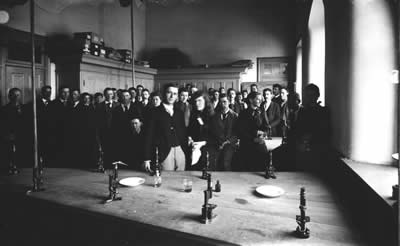 Image, from glass-plate negative, courtesy of University Archives and Manuscripts, Richard L.D. and Marjorie J. Morse, Department of Special Collections. |
|
Professor Hitchcock's Botany laboratory in Dickens Hall. The doorway (left side) enters the Herbarium (ca. 1895). |
||
1877 - 1955: The Kansas State University Herbarium (KSC is our official acronym) was established in 1877 and is among the oldest, largest, and most diverse collections of preserved plants in the Great Plains region, with holdings estimated at 190,000 specimens. It has a rich history of activity, both in basic taxonomic research and applied work. Mycologist William A. Kellerman served as its first curator (from 1883-1891, after which he joined The Ohio State University) and was instrumental in establishing an early legacy for natural history collections-based science at KSU that was taken up feverishly by his successors, Albert S. Hitchcock (1890-1901, after which he became Chief of Agrostology at the U.S. National Herbarium, Smithsonian Institution) and, later, Frank C. Gates (1919-1955). These latter two workers were among the first Great Plains floristic experts; their activity and that of their protégés resulted in the core of the Herbarium. Hitchcock and his students ventured onto the prairies of the region during the late 1800s, documenting the original flora of what is now an imperiled ecosystem. As a result of Hitchcock's research program, the KSU Herbarium houses the most complete record of Kansas plants from the late 1800s and is unique in the region due to its important historical holdings. Gates added greatly to the collection through his research program, and his curatorial work is evident throughout the Herbarium.
|
||||
1955 - 1998: Two later curators, Lloyd C. Hulbert (curator from 1955-1961) and Theodore ("Ted") M. Barkley (curator from 1961-1998) continued the legacy of excellence of the Herbarium. Hulbert, a floristic ecologist, founded Konza Prairie Biological Station. Konza Prairie is a site of intensive ecological research (currently an NSF Long Term Ecological [LTER] site). The natural history collections and Konza Prairie maintain a strong connection, part of the legacy of Hulbert. Barkley was instrumental in Flora of the Great Plains projects, serving as an editor and contributor; he and collaborators utilized the Herbarium extensively as part of the basis for that work, which remains the authoritative resource for floristics in the Great Plains. Barkley oversaw tremendous growth of the taxonomic library associated with the Herbarium and mentored numerous students in plant taxonomy. He continued taxonomic research and editorial work for the Flora of North America project at the Botanical Research Institute of Texas until his death in 2004.
|
||||
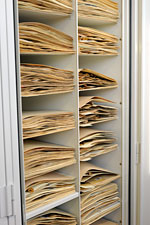
1998 - present: The Herbarium is currently housed in 85 specimen cabinets (not including cabinets dedicated to the research of particular investigators) on the top floor of Bushnell Hall on the KSU campus. Continued growth focuses on the Great Plains region generally, weeds and introduced species, and plant families of interest to current faculty researchers (Asteraceae, Euphorbiaceae, Polemoniaceae). |
|
|
||
|
||||

 K-State Home | Division of Biology